






Competitive yoga is yoga postures performed in front of judges for a score, usually under the name yogasana sport. For a teacher trainee, the useful question is not who wins. It is what the scoring tests, what it ignores, and how a Hot 26&2 training prepares you to understand both.
We asked Mr. Ian Terry, E-RYT 500, to explain it the way he does to new trainees. He is a Master Trainer for the Republic of Indonesia Yogasana Sports Federation, and he has stood on both sides of the line: in the hot room and at the edge of the competition floor. His answers shape every section below.
Competitive Yoga in Plain Words
The simplest definition is also the most quoted one. Wikipedia describes competitive yoga as the performance of asanas in sporting competitions. It adds that the idea is controversial, because some practitioners feel it clashes with the nature of yoga.
Both statements are fair, so you can hold them together. Competitive yoga is a real, organised sport, and it is also a debate about what yoga is for. A trainee who understands both sides can talk to any student who asks.
Not one sport, but several federations
Here’s the part that confuses newcomers. There isn’t a single owner of the sport. Different federations run their own championships under their own rules. The International Yoga Sport Federation describes yogasana sport as a discipline of precision, balance and endurance. Its 17th World Championship of Yogasana Sports is scheduled for 4 to 6 December 2026 in Italy.
Meanwhile, the championship in Ahmedabad, India, in June 2026 belonged to another body. Always check which federation runs an event before you quote its results. If you want the full list of events, age groups and rulebooks, our sister site has a detailed guide to how the sport is organised. This article stays closer to the trainee’s view of competitive yoga.
What a scoreboard can and cannot measure
A judge can see alignment, balance and control. A judge cannot see your breathing, your mood or your patience on a hard day. That is the first thing Mr. Ian tells trainees, because it explains most of the arguments about the sport.
It also explains why a studio class feels so different. In a YogaFX class, nobody ranks you. The only comparison is with your own last class.
Class, Teaching and Competition: Three Rooms, Three Scorekeepers
Trainees often lump these three settings together. They are not the same. The table below shows who is watching, what counts, and what each room asks of you.
| Setting | Who evaluates you | What counts | What it asks of you |
|---|---|---|---|
| Studio class | Nobody. You and your teacher. | Effort, breath and staying in the room for 90 minutes | Show up, follow the scripted dialogue, and keep going in about 40 degrees Celsius and 40% humidity |
| Teacher training | Your trainer, in live practice teaching and a practical assessment | Clear instructions, correct alignment cues and a calm delivery | Learn the words, then teach real students while someone watches |
| Yogasana competition | A judging panel under one federation’s rules | Precision, balance and endurance of set postures or routines | Repeat clean form on demand, with an audience and a time limit |
Notice the middle row. Teacher training sits between the other two. You get watched, like a competitor, but the goal is to help someone else, like a teacher. That’s why the skills overlap so much, and we come back to it below.
Why the middle row matters most for new teachers
For example, think about your first practice class as a trainee. Your trainer watches, and a few classmates watch too. Your hands shake a little. That’s normal, because being observed changes how the body behaves.
Competitive yoga athletes know that feeling well. Instead of avoiding it, they train inside it. As a result, a trainee who learns to stay steady under a trainer’s eye is already practising a small version of the same skill. Nobody has to want a medal for that lesson to be useful.
Seven Medals From Two Graduates
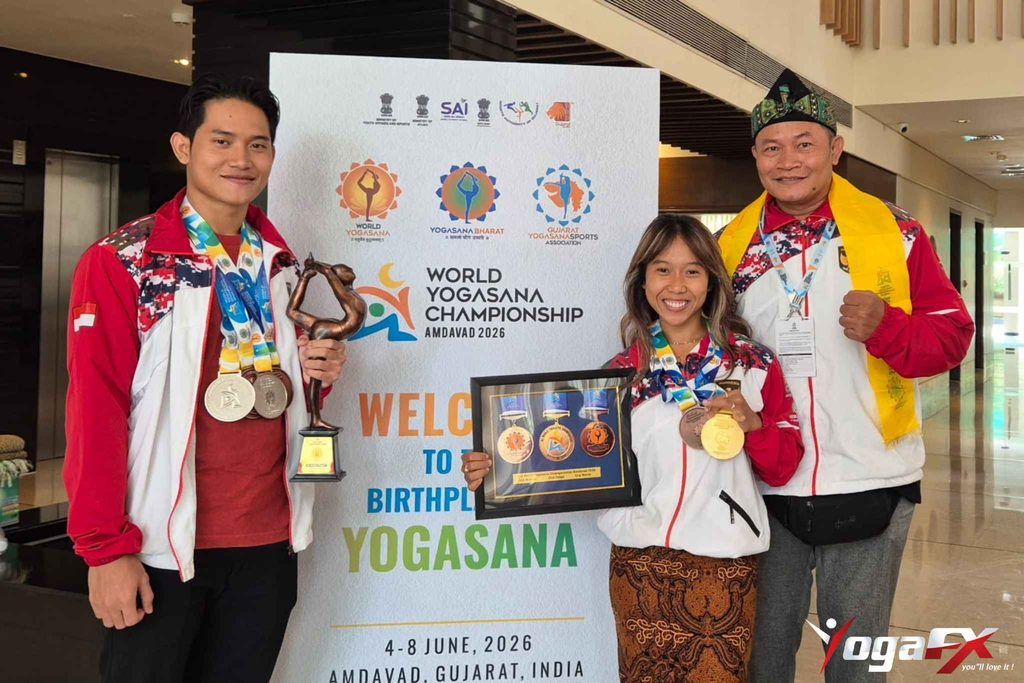
Here is the proof point we can stand behind. At the World Yogasana Sports Federation championships in Ahmedabad, held from 4 to 8 June 2026, Indonesia won seven medals. Every one of them went to a YogaFX graduate. We tell the full story in a separate report on the World Yogasana Championship 2026, so here we only use the numbers.
Be careful how you read those cards. Two medallists tell you about two dedicated athletes. They do not promise a medal to every graduate. Still, they show something useful: a standard teacher training can sit underneath serious competitive yoga.
Skills a Trainee and a Competitor Both Need
Why would a teacher training help someone in competitive yoga at all? Because both jobs start with the same habit: looking closely at a posture and fixing it. Mr. Ian points to four overlaps he sees every intake.
- Alignment. You learn where the weight sits, where the hips point and what the spine does. As a result, you can correct your own form before anyone else sees it.
- Precision with words. The Hot 26&2 dialogue is exact. Learning it trains your mind to break a posture into small, ordered steps.
- Calm under observation. Practice teaching makes most trainees nervous at first. By the end, they lead a room while a trainer watches.
- Routine. The course runs on a fixed rhythm of practice, study and teaching. Competitors need the same steady habit.
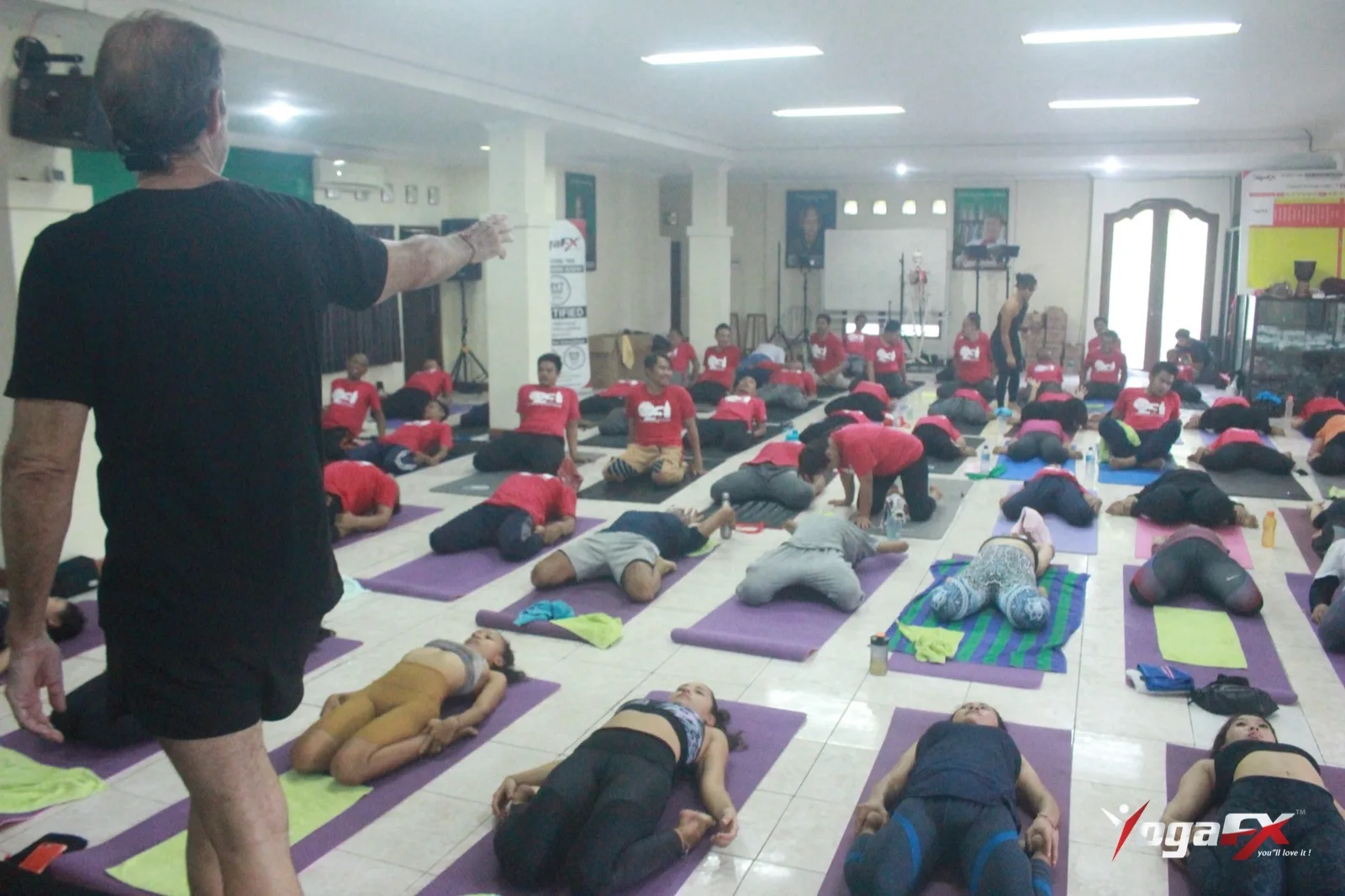
The format makes this practical. You study the sequence and the dialogue at home first. Then you spend six days in Bali with direct correction from Mr. Ian. Our guide to the 6-day hybrid format shows how each day runs.
Consistency beats intensity
Mr. Ian repeats one rule more than any other, so we’ll repeat it here. Regular practice changes the body more than occasional heroic sessions. That holds whether you want to teach, compete or simply understand the sequence from the inside.
Is Hot Yoga a Sport? The Trainee’s Answer
People ask this a lot, and the honest answer has two parts. A hot yoga class is not a competition, because nobody scores it. It’s still real physical work. The body does not care whether a scoreboard exists.
Research backs up the physical side. A 2014 University of Wisconsin study led by Porcari measured people during a 90-minute hot class. It reported about 333 calories for women and 460 for men, at roughly 80% of maximum heart rate. A 2013 study by Tracy and Hart reported a 20% rise in posterior chain strength after an eight-week Bikram programme, along with better flexibility.
We name these studies instead of linking them, because the publisher’s pages blocked our automated check when we prepared this article. Search the author names to read the abstracts yourself. These results describe practice in general, not competitive yoga, so treat them as context. If you want more on heart effort, see what male trainees learn about the heart.
So the trainee’s answer is simple. Hot yoga is a demanding physical practice, and competitive yoga is a sport built on top of postures like it. Both are valid. They just ask different questions.
What heat adds to the picture
Competitive yoga events usually don’t use heated rooms, so the heat in our classes is a training choice rather than a sport rule. Because the room is warm, trainees often learn to relax into a posture instead of forcing it. That habit can help in any setting. Even so, heat raises the demand on the heart, so build up gradually and drink water before, during and after class.
What Trainees Say About the Training
A medal table is one kind of proof for competitive yoga, but it isn’t the only kind. The words of people who finished the course are another. These two come from video reviews on our YouTube channel.
“I’ve stuck with the program. I’ve trusted the program. And it is absolutely highly recommended from me.”
Jilly, YouTube review, 2019
Lars, who reviewed the training in 2026, said it was more than he expected. He said he had “never experienced so much kindness” in his life, and that a few moments on the mat were a struggle and brought up emotion. He called it an important point in his journey (Lars, YouTube review, 2026).
Neither review mentions competition, and that matters. Most trainees come to teach. The confidence they describe is the same quality that lets a few of them step onto a competition floor later.
How to Answer a Student Who Asks: Is It Still Yoga?
Sooner or later, a student will ask you about competitive yoga. They might have seen a clip online, or heard about the Olympics. Some will be excited. Others will be a little suspicious, and they have company: the Wikipedia article on the sport records critics who call the idea an oxymoron.
You don’t need to pick a side in the middle of a class. Instead, Mr. Ian teaches trainees a short, honest reply with three parts:
- Say what it is. It’s yoga postures performed for judges. It tests the physical side of the practice, the asana, and nothing else.
- Say what it isn’t. It’s not a replacement for a class, and it doesn’t measure breath, patience or attitude. Some people feel that’s a loss.
- Say what you do. Your classes stay non-competitive. Nobody’s ranked, and everyone works at their own depth.
That answer works because it’s true. It also keeps the student’s trust, which matters more than winning the argument. Because you’ve studied the debate, you can stay relaxed when the question comes.
A simple first month for the curious graduate
Let’s say you finish the MasterClass and want to explore the sport. Don’t sign up for an event straight away. A calmer plan looks like this:
- Week one: keep teaching and practising. Let the new postures settle in.
- Week two: watch recorded events from the federations you’re interested in. Notice what the judges reward.
- Week three: read the published rules for one event. If something’s unclear, ask a coach.
- Week four: decide whether you want to compete, coach or just watch. All three are fine.
Should You Try Competitive Yoga? A Teacher’s Checklist
Curious about trying competitive yoga yourself? Mr. Ian suggests asking these questions first. Be honest with each one.
- Why do you want it? A score can motivate you, or it can pull you away from why you started. Know which one is happening.
- Is your base solid? Learn the 26 postures properly first. Judges reward clean, repeatable form, not borrowed flexibility.
- Which federation? Read the rules of the specific event. Criteria and categories differ between bodies.
- Who coaches you? Find someone who understands the posture and the judging. Self-coaching a hard posture is how injuries start.
- How will you protect your teaching? Competition prep takes time. Plan it so your students still get your best classes.
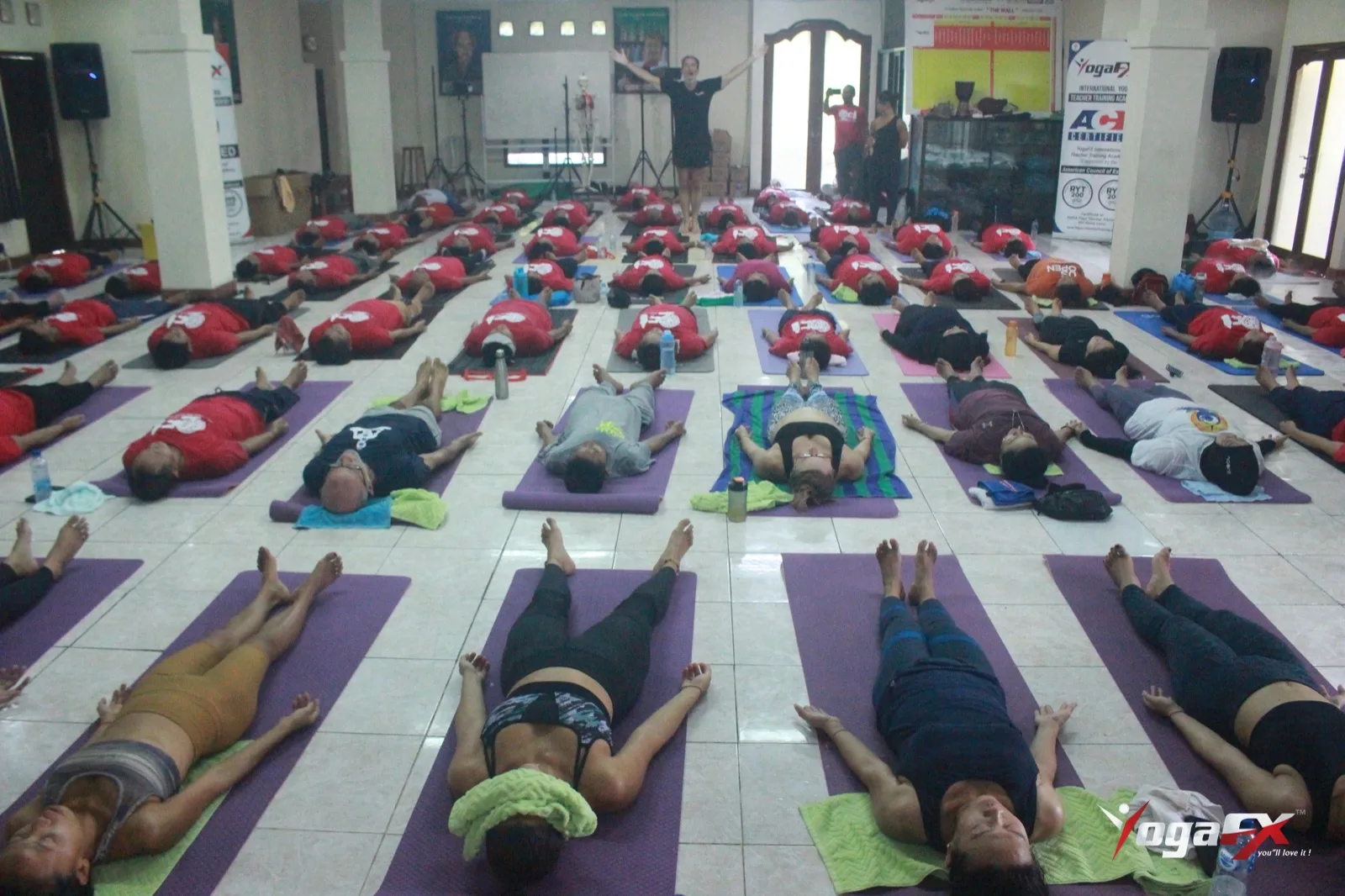
Health note: hard postures held under heat and pressure can strain joints and the cardiovascular system. Anyone with a heart condition, an injury or a pregnancy should consult a healthcare professional before intensive training, and before any competition preparation.
Where Competitive Yoga Can Fit Into a Teaching Career
Most graduates never compete, and that’s fine. Still, the sport opens a few extra doors for those who are curious:
- Athlete. A few graduates, like Ivara and Arkan, take their practice into yogasana events at national, Asian and world level.
- Coach. Teachers who understand posture well can coach others who want to compete.
- Organiser. Slamet Ariyanto, class of 2024, chairs the Yoga Practitioner Association of Indonesia and manages the national yogasana team.
- Studio teacher. The most common path by far, with a credential studios recognise internationally.
Mr. Ian himself trained for five years, from 2014 to 2019, with the founder of the Bikram Hot 26&2 method, and he has more than 12,000 teaching hours behind him. You can read more about him on his teacher page, and his sport work is covered in Mr Ian Terry’s federation roles and coaching.
Train With the Coach Behind the Medals
If this article made you curious about teaching, here is the course both medallists took. It is a hybrid format: you prepare online, then train in Bali.
- Format: a self-paced online pre-course, then a six-day MasterClass in Bali.
- Certification: Yoga Alliance RYT 200 plus a Bikram Hot 26&2 200-Hour International Yoga Certification.
- Next batch: check-in Sunday 24 January 2027, check-out Friday 29 January 2027, at Soham Wellness Center in Seminyak.
- Price: US$1,899 Early Bird, with interest-free instalments from US$250 a month.
For the full syllabus, read our 200-hour yoga teacher training in Bali guide. More than 1,500 graduates from over 80 countries have trained with YogaFX since 2017.
FAQ
Is yoga a competitive sport?
Yoga can be a sport when it is organised as yogasana competition, where judges score postures. Most yoga classes are not competitive, though. A normal studio class has no scoreboard, and nobody ranks you. Competitive yoga is one branch of the practice, not the whole of it.
Does yoga teacher training prepare you for competitive yoga?
It builds many of the same skills: alignment, precise instruction and calm under observation. It is not a competition course, though. Two YogaFX graduates went on to win medals, but most graduates simply teach. Competing is an extra step that needs its own preparation and coaching.
How is yogasana sport different from a hot yoga class?
A hot yoga class is a shared practice with no judges. Yogasana sport is a scored event where athletes repeat set postures or routines for a panel. The class asks you to stay and breathe for 90 minutes. The competition asks for precise form on demand, with an audience.
Is hot yoga good for athletes?
Research suggests hot yoga can build strength and flexibility, and a University of Wisconsin study measured real calorie burn in class. Results vary by person. Athletes with heart conditions, injuries or heat sensitivity should consult a healthcare professional first, then build up heat exposure slowly.
Do you need to compete to be a good yoga teacher?
No. Good teaching depends on clear instruction, accurate alignment cues and care for students, not on medals. Competing can sharpen your eye for posture, and some teachers enjoy it. Plenty of excellent teachers never compete, and Mr. Ian says the course is built for teachers first.
Still have questions? Message Mr. Ian on WhatsApp and the YogaFX team will answer them personally. Whether you want to teach, coach or just learn the 26&2 method properly, we will help you decide if the January 2027 MasterClass fits you.