













Hot yoga mental health men: two randomised trials suggest heated yoga can lift mood and well-being. About four in five volunteers were women, though, so the evidence for men is promising, not proven. At YogaFX we see something the trials can’t: among 41 men on our enrolment forms, 59% wanted to teach.
Mr. Ian Terry is our founder and an E-RYT 500 with more than 12,000 teaching hours. His school has trained more than 1,500 teachers from over 80 countries since 2017. This guide pairs the research with what we see in Bali. It isn’t medical advice. Please consult a healthcare professional before you start, especially with a heart condition, high blood pressure or regular medication.
Hot Yoga Mental Health Men: What the Research Shows and Misses
Two trials carry most of the hot yoga mental health men conversation, so it helps to read them closely.
The Boston depression trial
The first was led by Massachusetts General Hospital (Nyer et al., Journal of Clinical Psychiatry, 2023). The team randomised 80 adults with moderate to severe depression, and 65 were analysed. After 8 weeks of heated yoga, 59.3% of the yoga group had cut their symptoms by half or more, against 6.3% of the waitlist group. Clinicians rated the symptoms. You can read the abstract on the Journal of Clinical Psychiatry site.
The Cambridge well-being trial
The second was a 2022 Cambridge trial by Hui and colleagues in Psychosocial Intervention. It followed 290 healthy adults who were new to yoga. For six weeks, one group took free 90-minute hot classes while the other waited.
The yoga group improved on life satisfaction, general health, mindfulness, peace of mind and eudaimonic well-being, but not on flourishing. Positive emotions rose in the yoga group only. Here is the full paper in Psychosocial Intervention.
What the trials miss for men
Neither trial was built around men. About four in five Cambridge volunteers were women. So any claim about hot yoga mental health men rests mostly on female data. A fair summary looks like this:
- What the trials support: hot yoga may improve mood and well-being over six to eight weeks.
- What they don’t show: whether men respond differently, because the trials weren’t built to compare men and women.
- What they can’t separate: heat from exercise, since both trials compared yoga with waiting.
- What they don’t replace: professional care for depression or anxiety.
People search for this under several names, including hot yoga for mental health, bikram yoga mental health and men’s mental health yoga. The evidence behind all three rests on the same two trials. For how men and women differ in who applies to train and how they handle the heat, see hot yoga men vs women.
Want the trial numbers unpacked further? Our online sister site has a detailed read of how the research treats men in hot yoga. Here, we look at the other side: what happens after a man decides the practice is worth keeping.
Why a Fixed Class Can Feel Safe When You Don’t Want to Talk
For hot yoga mental health men, structure may matter as much as heat. Many men don’t want a group circle or a heart-to-heart, and a hot class offers something different. The room is hot, the clock runs for 90 minutes, and nobody asks you to share a thing.
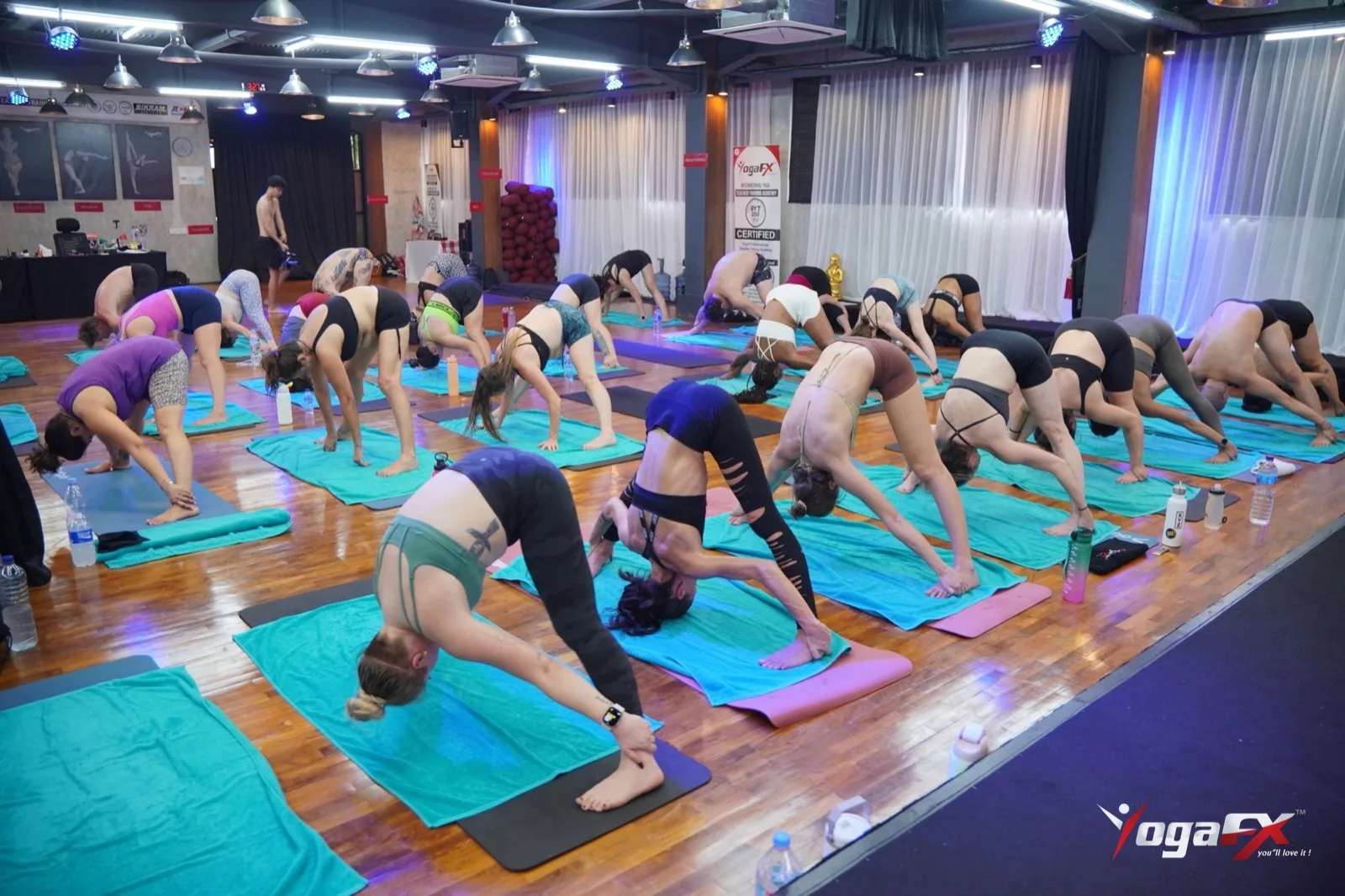
The class is built the same way every time. It has 26 postures and 2 breathing exercises in a fixed order. The room is about 40°C with 40% humidity, and a scripted dialogue guides you. There is no music and no demonstration, so you simply listen and move.
- A target you can see. Locking a knee or going a little deeper in a backbend gives you something to measure.
- A time box. The class starts and ends on the clock, so the effort has an edge.
- No performance. The teacher gives the same instruction to everyone, and nobody is singled out.
- A repeatable benchmark. Because the sequence never changes, last week’s class is your yardstick.
These are coaching observations, not research findings. Still, Mr. Ian keeps the dialogue, the order and the timing fixed on purpose. So the only thing that changes in the room is you.
Week one is rarely easy, though. Our guide to whether hot yoga is harder for men explains why the first classes feel so tough.
What Men Tell Us When They Apply to Train
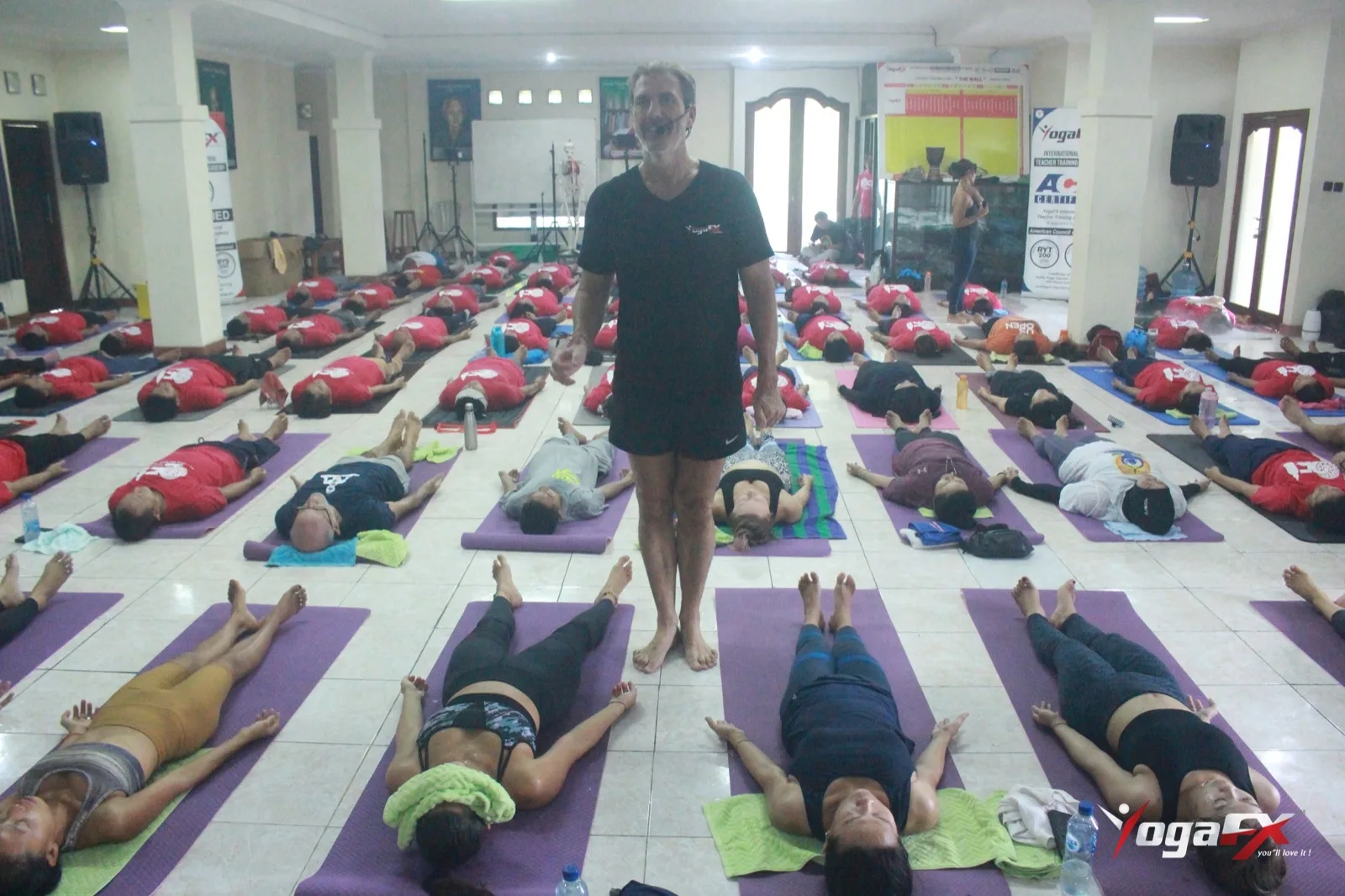
Every applicant to a YogaFX teacher training fills in an enrolment form. We coded the reasons people gave between 2019 and 2025. This is YogaFX applicant data, not trial data, and the numbers are small: 41 men and 158 women. Treat it as a picture of who applies, not proof of what yoga does.
| Reason given on the enrolment form | Men (41) | Women (158) |
|---|---|---|
| Wants to teach or share the practice | 59% | 69% |
| Wants to improve their own practice and postures | 34% | 20% |
| Names Mr. Ian as a reason | 29% | 20% |
| Health, flexibility, posture or healthy ageing | 29% | 34% |
| Wants personal attention before enrolling | 20% | 15% |
| Career change | 10% | 5% |
| Short, intensive format | 5% | 24% |
Two things stand out. First, 59% of the men wanted to teach or share the practice. Among women the share was higher still, at 69%. So wanting to teach isn’t a male trait. It is common to nearly everyone who applies.
Second, men more often wanted to deepen their own practice (34% against 20%) and more often named Mr. Ian as a reason (29% against 20%). One in ten described a career change.
The form doesn’t code mental health as its own reason. So we can’t say how many of these men came for their mood. One male applicant in 2023 did write about it directly:
“I initially came to yoga for the mental benefit as I discovered after a couple of sessions I could not think in many of the classes which is so important for me.”
Male applicant, enrolment form, 2023
From Feeling Better to Wanting to Teach: Why Many Men Go On to Teach It
Why would a man who started yoga for his own head want to teach it? We can’t prove a cause. Yet hot yoga mental health men stories often follow the same pattern.
- Ownership. The sequence is fixed, so a man can measure progress and feel he earned it.
- Purpose. When a practice helps, the next natural question is who else needs it.
- Skill. Teaching the dialogue is hard but learnable, which suits people who like clear goals.
- Role models. Every man who qualifies shows the next man that it’s possible.
Applicants say it in their own words. A footballer wrote, “I’m a football player and once my friend showed me Bikram Yoga I completely fell in love. I’m already thinking what’s next after football.” Another man wrote only, “Want to get more guys into yoga.” Both come from enrolment forms (2022 and 2024).
What trainees say about hot yoga mental health men benefits
Trainees describe it too. Judith spoke about a habit many careful people know well, waiting until you’re perfect before you start.
“I’ve put down my ‘I’ve got to be perfect before I can teach’ mantra and I’m just going to run with it this year. There are so many people that need this for their health.” (lightly trimmed from her video)
Judith, YouTube review, 2025
Kate described being humbled by the training, and finding relief in letting go of perfect.
“Maybe your journey here is to drop to the mat and just let go and be okay with not being perfect.”
Kate, YouTube review, 2025
Cherry, who joined in 2019, wrote about learning to settle her mind and trust her body:
“Learn how to balance my mind and learn to be aware with my mind and body. You never know how strong you are until you finish this training.”
Cherry, Google review, 2019
None of these reviews is a clinical result. They are first-hand accounts. They add a human side to the hot yoga mental health men research, and they show how a steadier mind can turn into a wish to share the practice.
When Your Mind Gets Loud in the Hot Room
For hot yoga mental health men, the hardest part is often the head, not the hamstrings. By minute 30, many people hear a loud inner voice that says stop, you’re behind, everyone is better than you. Teachers learn to coach that voice, and so can you. Four habits help:
- Follow the next instruction. The dialogue gives you one task at a time, so your attention has somewhere to go.
- Keep your eyes on your own edge. The mirrors show everyone, but only your own range matters today.
- Rest without apology. Sitting out part of a posture is part of the method, not a failure.
- Leave rank at the door. Treat the person on the next mat as weather, not as a rival.
These habits matter beyond the studio. Staying steady while your mind complains for 90 minutes is useful practice for a hard day at work.
What Teaching Adds to the Practice
For hot yoga mental health men, practising is about you, and teaching adds other people. A trainee has to learn the dialogue, speak clearly to a full room and notice who is struggling. That asks for focus and care. Some men find it steadies them more than they expected.
It also teaches humility about limits. A yoga teacher is not a therapist. A good one knows when to say, “please speak to a doctor or counsellor about this.” That boundary matters, because people in a hot room carry all kinds of stress.
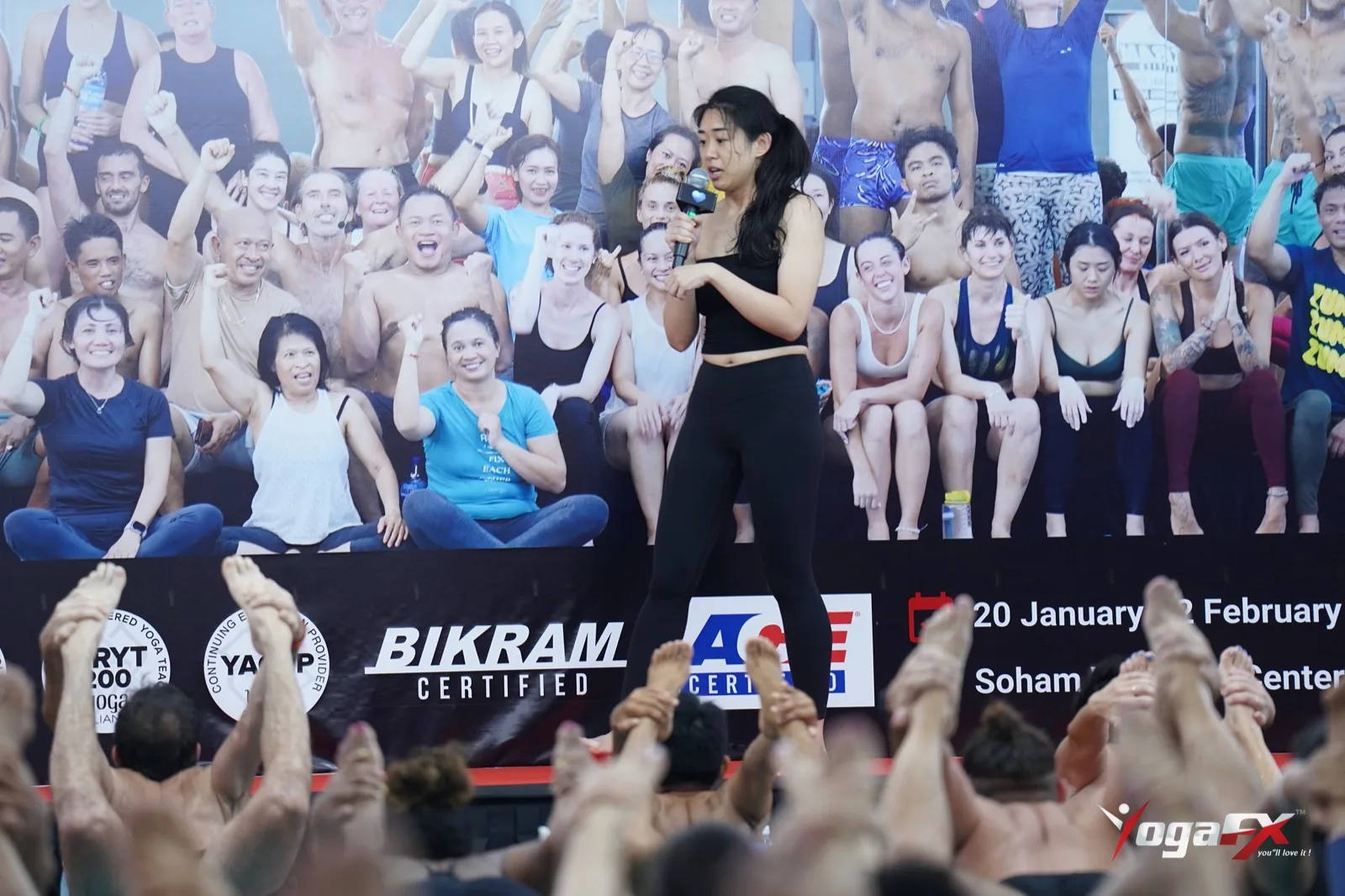
What the 6-Day Bali Training Asks of You
YogaFX teaches this method as a 6-day hybrid course. You study online before you travel, then complete an intensive in Bali. The course is the Bikram Hot 26&2 Yoga Teacher Training MasterClass, led by Mr. Ian Terry.
He trained for five years, from 2014 to 2019, with the founder of the method. He also holds the title of Master Trainer from the Republic of Indonesia Yogasana Sports Federation.
- Certification: Yoga Alliance RYT 200-Hour plus the Bikram Hot 26&2 200-Hour International Yoga Certification.
- Next batch: check-in Sunday 24 January 2027 and check-out Friday 29 January 2027 at Soham Wellness Center in Seminyak.
- Price: Early Bird US$1,899 (normally US$1,999), with payments from US$250 a month and no interest.
- Who joins: beginners, long-time practitioners and working teachers from more than 80 countries.
See how the days are laid out in our guide to the 6-day hybrid yoga teacher training in Bali. For men in particular, read about our men’s yoga teacher training.
Hot Yoga Mental Health Men: The Numbers at a Glance
Here are the hot yoga mental health men figures in one place. The first two come from published trials. The third comes from our enrolment forms, and the last two describe the class and the school.
How to Start Safely if Your Mood Has Been Low
Hot yoga mental health men advice starts with dose. Treat the trials as a guide, not a promise. The Boston trial asked for at least two classes a week. If you are new, start lower and build up.
- Talk to your doctor first. This matters most with heart problems, high blood pressure or medication that affects heat tolerance.
- Keep your usual care. Add yoga to treatment, not instead of it.
- Pace yourself. Sit down when you need to, sip water when the teacher allows, and skip the heroics.
- Watch for warning signs. Low mood lasting more than two weeks, lost interest in things you enjoy, or drinking more to cope all call for a professional.
Hot yoga isn’t a crisis tool. If you are thinking about harming yourself, contact your local emergency number or crisis line today. Tell someone you trust.
What to Read and Do Next
Men over 40 will find a practical angle in our guide to yoga for men over 40. For the wider picture of who walks into the hot room, start with what male applicants tell us.
The practice came first for most of the men we meet. The wish to teach came later, once they had felt the change themselves. For hot yoga mental health men, that is the order we hear most often. If that sounds familiar, the next step is simply a conversation.
FAQ
Why does yoga help mental health?
Researchers don’t know the full answer yet. In the Cambridge trial, hot yoga raised mindfulness, peace of mind and life satisfaction. Positive emotions rose in the yoga group only. Movement, breathing and routine probably all play a part. Yoga supports care and does not replace it.
What type of yoga is best for mental health?
No single style is proven best. The two trials we describe studied heated 90-minute classes, and both compared yoga with waiting, not with other styles. A style you enjoy and attend regularly is most likely to help. Check with a healthcare professional if you have a condition.
How much hot yoga is too much?
There is no universal limit. The Boston trial prescribed at least two classes a week, and the Cambridge trial offered up to four. Build up gradually, rest when you feel dizzy and drink enough water. If you notice headaches, faintness or poor sleep, cut back and ask a doctor.
Is hot yoga miserable at first?
The first classes are often tough, because the heat and the 90-minute length are new. Most trainees say the room feels calmer once they know the sequence. The same 26 postures and 2 breathing exercises repeat every class. Rest freely, and keep your first classes small.
Who is hot yoga for?
It suits most healthy adults who check with a doctor first, including men who feel stiff, stressed or unsure. Many men on our enrolment forms started for their own practice, and 59% of the men who applied to train also wanted to teach. You don’t need to be flexible to begin.
Still have questions? Message Mr. Ian and the YogaFX team on WhatsApp, and we will answer them personally. Ask about the Bali training, your first hot class, or whether teaching could be your next step. Chat with us on WhatsApp any time.