











Is hot yoga good for anxiety? It may help some people feel calmer, but nobody has proven it. The best-known trial studied depression, and anxiety was only a secondary measure. Heat can also feel a lot like panic, so a good class is predictable and always offers a way out.
If you teach, or plan to, a student will ask you this. They may be nervous, curious or hoping for relief.
Your answer needs to be kind, accurate and honest about the limits, because a vague reply can mislead. This guide gives you the evidence, the heat warning signs and the words to use. Mr. Ian Terry, E-RYT 500, teaches the same careful approach to every YogaFX trainee.
This article is general information, not medical advice. Anxiety is a health condition, so please consult a healthcare professional before you use any class to manage it.
Is Hot Yoga Good for Anxiety? Five Honest Facts
The honest answer starts with what the research did and did not ask, so here are five facts every teacher should know before answering.
- It was a depression trial. The best-known study, led by Maren Nyer at Massachusetts General Hospital, randomised 80 adults with moderate-to-severe depression, in a paper in the Journal of Clinical Psychiatry, to eight weeks of heated yoga or a waitlist, and 65 were included in the analysis (trial paper).
- Anxiety was a secondary measure. The main outcome was a clinician-rated depression scale. The results table also lists the State-Trait Anxiety Inventory, with lower state anxiety scores in the yoga group at the end (about 41 against 48). Secondary results are weaker evidence than the main result, because the study was not built to test them.
- It was a small pilot. The National Institutes of Health calls it “a small pilot study”. People attended just over one class a week on average, against a minimum of two, and only 36% attended 12 or more classes (NIH Research Matters).
- Experiences were mixed. Researchers interviewed 57 participants afterwards. Of those, 7 (12.3%) described feeling less anxious, while 37 (64.9%) described both good and bad effects, and 7 reported negative reactions to the heat (interview paper, published in the International Journal of Yoga Therapy).
- Evidence for anxiety disorders is thin. The National Center for Complementary and Integrative Health says there is “little evidence of a benefit for people with anxiety disorders” from yoga in general. A 2019 review of 38 studies did find a substantial benefit for anxiety symptoms (NCCIH guidance on yoga). But none of this is specific to heated rooms.
The fair answer
So is hot yoga good for anxiety? The fair reading is maybe, for some people, and never as a replacement for care.
Our companion article on the hot yoga depression study shows how teachers should describe the depression results. People who search for hot yoga for anxiety or Bikram yoga for anxiety usually land on these same few studies. For a plain-language look at what each trial counted, see this review from our online training team.
What a Teacher Can Safely Say About the Findings
Students remember a short, calm sentence better than a long explanation, so rehearse your answer to “is hot yoga good for anxiety” before someone asks. The table below pairs each finding with its source and a careful way to say it out loud. Notice that none of the lines uses the word “proves”, because one trial cannot prove anything.
| What the research found | Where it comes from | A careful way to say it |
|---|---|---|
| 59.3% of the yoga group (16 people) cut depression scores by half or more, against 6.3% (2 people) on the waitlist | Nyer et al., 2023 | “In one early trial of people with depression, those who took heated classes improved more than those who waited.” |
| State anxiety scores were lower in the yoga group at the end, about 41 against 48 | Results table, same paper | “Anxiety was tracked too, but it was a side question, not the main one.” |
| Attendance averaged just over one class a week, and 36% attended 12 or more classes | NIH Research Matters | “Many people found two classes a week hard to keep up, so pick a pace you can manage.” |
| 7 of 57 interviewees (12.3%) felt less anxious; 37 of 57 (64.9%) described good and bad effects | Participant interviews, 2024 | “A few people felt calmer. For many, the experience was mixed.” |
| Little evidence of benefit for anxiety disorders from yoga in general | NCCIH | “Yoga may help with stress, but it is not a proven treatment for anxiety disorders.” |
Because the interviews were not measurements, they show how people felt, not what the class did. That limit applies to every claim you will hear, including ours.
Why a Predictable Class May Feel Calming
Is hot yoga good for anxiety because of the script, the room or the company? Nobody has shown why anyone might feel calmer after class. Teachers do share a few ideas, but we treat them as hypotheses, not findings. Four come up again and again in our Bali studios:
- A fixed script. The teacher speaks the same dialogue every class, so students know what comes next.
- No demonstration or music. Students listen and follow, so there is less to process in a busy room.
- Steady structure. Each class runs 90 minutes with 26 postures and 2 breathing exercises in the same order.
- A shared room. You practise beside other people without having to chat.
Our guide to the Bikram dialogue explains what the script says and why it is delivered the same way each time. For a nervous student, that sameness may remove the fear of surprises. It is an idea, not a result, so please do not present it as proof.
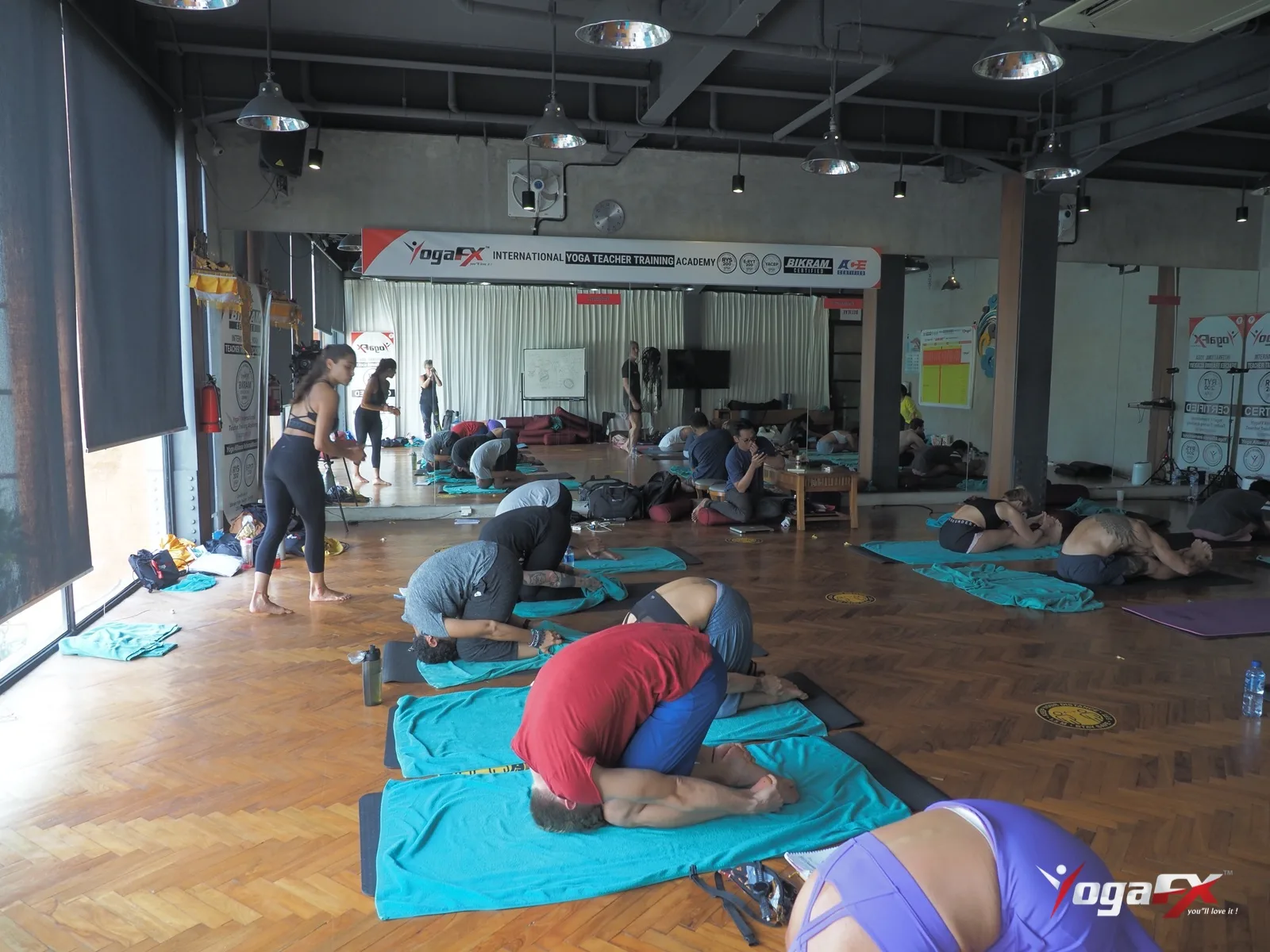
The card set below shows the fixed features of a YogaFX class, and every number comes from our own class format.
Can Hot Yoga Make Anxiety Worse? When Heat Feels Like Panic
Is hot yoga good for anxiety when the heat itself feels like panic? For some people, no, and it is the part many articles skip. A heated room is a physical load, so the body reacts. NCCIH warns that hot yoga “has special risks related to overheating and dehydration”. Also, a fast heartbeat or sudden dizziness can feel alarming, whatever the cause.
The NHS lists the signs of heat exhaustion as tiredness, dizziness, headache, feeling sick, heavy sweating with pale and clammy skin, cramps, thirst and irritability (NHS guidance). Mayo Clinic adds faintness and a weak, rapid pulse (Mayo Clinic symptoms). Instead, teach your trainees to treat these as body signals first.
What to do in the room
- Sit down at once. Nobody has to finish a posture, because sitting out is allowed.
- Drink water. The NHS suggests water or an oral rehydration drink.
- Cool down. Move to a cooler spot and cool the skin with water. The NHS says people should start to feel better within 30 minutes.
- Leave the room if you need to. The door belongs to the student, and a good teacher says so on day one.
Then know when to get help. Mayo Clinic says to contact a healthcare professional if symptoms worsen or do not improve within an hour. Get immediate help if a person becomes confused, loses consciousness or cannot drink. Heatstroke is an emergency, so call your local emergency number.
For more on heat and the body, read our pieces on heat safety and the heart and how heat affects stress hormones.
Three Myths a Teacher Should Gently Correct
Heated rooms attract big claims, and the question is hot yoga good for anxiety attracts the biggest. Anxiety is a sensitive subject, so a careless line can do real harm. These three myths come up often, and each one has a kinder, more accurate reply.
- “Sweating releases anxiety.” Sweat helps you cool down. No trial shows that it removes worry, so say that some people simply feel calmer afterwards.
- “The hotter the room, the better the result.” Heat is a load on your body. More heat only raises the risk of overheating and dehydration, as NCCIH warns.
- “Pushing through panic makes you stronger.” It does not. Noticing the signal and responding calmly, by sitting down or leaving, is the real skill.
Correct these in a warm voice instead of lecturing. A line such as “that is a bit stronger than the research says” is usually enough.
Who Should Talk to a Doctor Before Trying Hot Yoga
Anxiety is common. The National Institute of Mental Health says about a third of U.S. adolescents and adults experience an anxiety disorder at some point (NIMH overview). If you are one of them, ask yourself whether hot yoga is good for anxiety in your own case, and the answer starts with your doctor.
A heated class is one possible addition. It is never a starting point for care. Please speak with a healthcare professional first if any of these apply:
- Heart or blood pressure problems. Harvard Health advises talking to your doctor before trying hot yoga, because it may pose risks with heart problems (Harvard Health).
- Pregnancy. NCCIH says to avoid hot yoga while pregnant because it can cause overheating.
- Other health conditions, or older age. NCCIH advises talking with your health care provider and the instructor about your needs.
- Current treatment for anxiety. Never stop or change medicine or therapy because a class feels good.
NCCIH puts the rule well: “Don’t use yoga to postpone seeing a health care provider about a medical problem”. If worry feels constant or hard to control, see a doctor or therapist soon. If you are thinking of harming yourself, contact your local emergency number or a crisis line today. In the United States you can call or text 988. A yoga class is not a crisis tool.
How to Teach Calm in a Heated Room
Mr. Ian Terry has taught more than 12,000 hours of Original Hot 26&2 yoga. His long-standing rule, which we repeat to every trainee, is simple: a class can sit beside care, but it is never a substitute for care. When a student asks you, is hot yoga good for anxiety, these habits put that rule into practice.
- Welcome new students by name. Ask if it is their first class and whether they have questions.
- Show the door. Say clearly that anyone can sit down, rest or leave at any time.
- Mention water and rest early. Say it before the first posture, instead of after someone struggles.
- Keep your voice steady. Deliver the dialogue at an even pace, because a calm tone settles a room.
- Never promise relief. Say “some people feel calmer”, never “this will take your anxiety away”.
- Refer, do not diagnose. If a student shares a worry, thank them and suggest they talk to a doctor or therapist.
A sample teacher script
Trainees also ask for exact words. Here is a version you can adapt to your own voice:
“Welcome. If you feel dizzy or your heart is racing, sit down and drink some water. You can leave the room whenever you like, and nobody will mind. Some people find the class calming, but I can’t promise it. If you’re struggling with anxiety, please talk to your doctor as well.”
A sample teacher script, not a quote from any study
That takes about twenty seconds, but it does a lot. It names the exit, sets a limit on the claim and points to care. Above all, it keeps the student in charge of their own body.
A Four-Question Check Before Your First Class
If you are asking is hot yoga good for anxiety on your own behalf, a short check helps you decide before you book. Answer these honestly, then talk to a doctor if any answer worries you.
- Do I have a heart, blood pressure or pregnancy concern? If so, ask your doctor first.
- Do I feel panicky when I am hot or crowded? If so, tell the teacher before class and stand near the door.
- Am I already in treatment for anxiety? Keep it exactly as it is, and treat yoga as an extra.
- Will I leave if I feel unwell? Decide now that you will, because leaving is allowed.
A good studio welcomes these questions, because careful teachers want students to stay safe. If a teacher brushes them aside, that tells you something about the studio.
What Trainees Say About the Room
Reviews are personal stories, not research. None of the three below answers the question is hot yoga good for anxiety, and we would never use them that way. But they do show what it feels like to learn inside a structured, supportive room.
“I haven’t wanted to teach yet and that’s good, take that pressure off, enjoy it and it’ll come when it comes.”
Louise, YouTube review, 2025
“It’s good to know I’m not the only quiet Mouse in the room.”
Eva, YouTube review, 2025
Ruby, in a short YouTube review from 2025, praises the way Mr. Ian structured the training. She tells fellow trainees that if they keep practising, they will get to the front of the room (paraphrased). You can watch Eva’s full video below.
All three trainees describe pressure easing and a room that felt safe to be in. That is a teaching skill, and it can be learned. It is also a more useful answer to is hot yoga good for anxiety than any headline number.
Learn to Teach This Class With YogaFX
Some people who type is hot yoga good for anxiety into a search box simply love the practice. A few want to teach it. That is the purpose of our six-day hybrid teacher training programme, which combines pre-course online study with an intensive in Bali. You can see how the week works in our inside look at the 6-day intensive.
Mr. Ian Terry, E-RYT 500, trained for five years, from 2014 to 2019, with the founder of the method. Since 2017, YogaFX has trained more than 1,500 graduates from 80+ countries. Graduates leave with Yoga Alliance RYT 200-Hour registration and the Bikram Hot 26&2 200-Hour International Yoga Certification.
The next batch checks in on Sunday 24 January 2027 and checks out on Friday 29 January 2027, at Soham Wellness Center in Seminyak. The Early Bird price is US$1,899 (normally US$1,999), with payment plans from US$250 a month.
FAQ
Does hot yoga help with anxiety?
It might help some people, but nobody has proven it. The best-known heated yoga trial studied depression, and anxiety was a secondary measure. Experiences were mixed in interviews afterwards. Treat a class as an addition to care, never a replacement, and speak with your doctor first.
Can hot yoga cause anxiety?
It can feel that way for some people. Heat raises your heart rate and makes you sweat, and dizziness or a pounding pulse can feel alarming. In the heated yoga trial interviews, 7 of 57 people reported negative reactions to the heat. If you feel unwell, sit down, drink water and leave the room.
Who should not do hot yoga?
Anyone who is pregnant should avoid it, according to the National Center for Complementary and Integrative Health. People with heart problems or other health conditions should ask their doctor first, because heat adds strain. Sit out or leave the room if you feel dizzy, faint or confused.
What should a teacher do when a student feels anxious in class?
Stay calm, speak slowly and offer water. Remind them they can sit down or leave the room whenever they like. Do not diagnose or promise relief. Afterwards, suggest they talk with a doctor or therapist about how they feel, and welcome them back at a pace that suits them.
When is hot yoga too hot?
It is too hot when you feel dizzy, faint, sick, confused or unable to cool down. Other warning signs include a weak, rapid pulse, cold clammy skin and cramps. Stop, rest somewhere cooler and drink water. If symptoms worsen or confusion appears, get medical help straight away.
Still have questions? Message Mr. Ian and the YogaFX team on WhatsApp and we will answer them personally.