






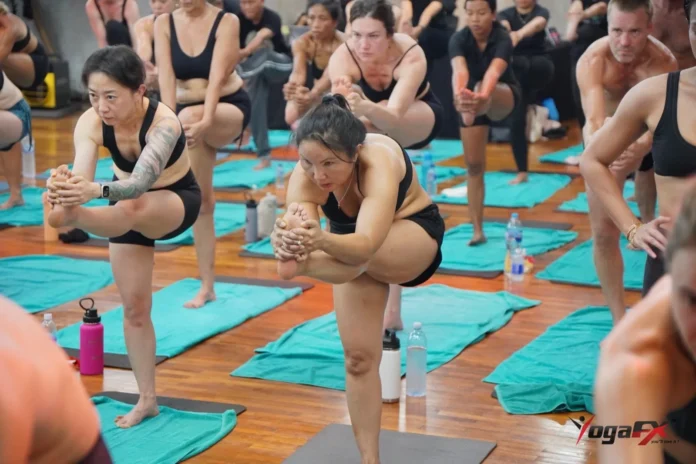
Hot vinyasa vs Bikram is really a question about who writes the class. In hot vinyasa, the teacher builds a new flow every time. In Bikram, now taught as Original Hot 26&2 Yoga, the sequence is fixed: 26 postures, 2 breathing exercises, 90 minutes, and a scripted dialogue. For a new teacher, that one difference changes almost everything.
Most guides on this topic compare the classes from the student’s side. This one looks from the front of the room. If you are thinking about a teaching career, the hot vinyasa vs Bikram choice decides what you will practise, what you will memorise, and how soon you can lead a full class with confidence.
At YogaFX, we certify teachers in the fixed 26&2. Our training is led by Mr. Ian Terry, E-RYT 500, who has more than 12,000 teaching hours. Below, we explain why we made that choice, where hot flow genuinely wins, and what the research does and does not say.
Hot Vinyasa vs Bikram for Teachers: The Short Verdict
Here is the plain answer first. Neither format is better in every way. However, they ask different things of a new teacher, so the right pick depends on how you like to work.
- Choose hot vinyasa if you love building sequences, choosing music and changing the class each day.
- Choose the Original Hot 26&2 if you want one complete, repeatable class to master, with the words already written.
- Choose the 26&2 first if you want a quick, safe start, because the structure is built and your job is delivery.
In short, the hot vinyasa vs Bikram verdict for teachers is about structure, not toughness. Flow gives freedom, while the 26&2 gives a finished system.
That last point matters most for career changers. A new flow teacher must answer “what do I teach today?” every single class. A new 26&2 teacher answers a different question: “how well can I deliver this?” The second question is easier to practise, and it is easier to measure.
For a numbers-first comparison of the two formats for students, see side-by-side data for each hot yoga format on our sister site. Here, we stay with the teacher’s view.
What You Actually Learn to Teach in Each Format
A teacher training is not only about poses. It trains a set of skills, and those skills differ between a flow class and the fixed sequence. The hot vinyasa vs Bikram table below shows where the work goes in each format.
| Teaching skill | Hot vinyasa teacher | Original Hot 26&2 teacher | What a trainee practises first |
|---|---|---|---|
| Class design | Builds a new sequence for every class | Delivers the same 26 postures and 2 breathing exercises in order | Memorising the order |
| Voice | Cues transitions, often over music | Speaks a scripted dialogue, with no music | Pace, volume and clarity |
| Demonstration | Often shows poses on the mat | None, because the words do the guiding | Describing, not showing |
| The room | Set by each studio, so it varies | 40°C and 40% humidity for 90 minutes | Reading students in the heat |
| Feedback loop | Different every class, so hard to compare | Same class every time, so progress is clear | Repeating and refining |
Notice the pattern. You’ll see it in every row: flow teaching rewards creativity. The fixed sequence rewards precision, memory and timing. Both are real skills, so the question is which one you want to build first.
In a fixed class, you can compare this week’s Standing Bow Pulling pose with last month’s, and so can your students. That repeatable benchmark is rare in yoga, and it makes feedback much easier to give.
The 26&2 Teacher Path in Six Numbers
Before we go deeper, here is the whole YogaFX path at a glance. Every figure below comes from our own programme standards.
Why a Scripted Dialogue Is a Kinder Start for New Teachers
Most people fear one thing when they first teach: freezing. You forget the next pose, the room goes quiet, and every eye is on you. A fixed script removes that risk, because the next line is always there.
That is why the dialogue sits at the centre of our course, and why it matters so much in the hot vinyasa vs Bikram choice. Mr. Ian trained for five years, from 2014 to 2019, with the founder of the method. He teaches the dialogue as a craft, like learning lines for a play and then making them sound like your own voice.
Does it feel rigid? Yes, at first. However, trainees tell us the structure frees them, and it’s easy to see why. Instead of inventing, they listen, adjust their pace and watch the room. Our guide to the Bikram dialogue in hot yoga explains how the script works, and our page on what a hot yoga teacher actually does shows what the job looks like after graduation.
What you stop worrying about
- Sequencing. The order is fixed, so you never plan a class from scratch.
- Demonstrating. You describe each posture in words, so your own flexibility is not the lesson.
- Playlists. There is no music, so your voice carries the class.
What you start worrying about
Delivery. You will care about timing, breath, tone and accuracy. In our experience, those are the skills that make a teacher good, and a fixed class lets you practise them every day.
Who Controls the Heat? A Safety Question for Teachers
Heat adds risk, so a teacher must understand it. Don’t skip this part of any training. This is another place where the format changes the job. In flow classes, each studio picks its own temperature, so hot vinyasa vs Bikram is partly a question of who sets the dial. In the 26&2, the room is a known quantity.
What does the evidence say about heated classes? An American Council on Exercise study, carried out by the University of Wisconsin-La Crosse, followed 20 healthy adults aged 19 to 44. Each took a 60-minute class at room temperature, then the same class in a room of about 92°F (33°C).
Heart rate averaged 57% of maximum in the hot class, against 56% in the cooler one. The highest core temperature recorded was 102.4°F, below the 104°F danger zone. The class also felt harder to the students, even though their hearts worked about the same.
There is an important limit here. ACE itself noted that many classes, including Bikram, run at 105°F or higher for longer, and that these need more study. Also, the study was commissioned by ACE and used a generic 60-minute class, not a 26&2 class. So treat it as reassuring for moderate heat, not as proof for every room.
For a teacher, the lesson is practical. Learn the signs of heat stress, cue water and rest, and know that students who are pregnant or have a heart condition should speak to a doctor first. A fixed format lets you build those habits into one script.
What the Research Says About Hot Yoga, and What It Does Not
The honest picture is modest. Heated yoga has some encouraging studies, but no one has shown that it beats other yoga styles. We think a good teacher should say so.
The best-known trial comes from Massachusetts General Hospital. In an eight-week study published in the Journal of Clinical Psychiatry, adults with depression took 90-minute Bikram sessions in a 105°F room. According to the Harvard Gazette report on the trial, 59.3% of the yoga group saw their symptoms fall by half or more, compared with 6.3% of the waitlist group.
Those are strong numbers, yet the researchers were careful. They said future studies must compare heated with non-heated yoga, to see whether the heat adds anything. Yoga can support care, but it does not replace treatment, so please consult a healthcare professional about any health condition.
You’ll find the wider evidence is still growing. A 2025 systematic review by Willmott and colleagues looked at 43 hot yoga studies with 942 participants. It reported benefits such as better flexibility, balance and well-being in many groups. Earlier work by Tracy and Hart (2013) followed beginners through a Bikram programme and found gains in flexibility and posterior-chain strength.
Why does this matter for the hot vinyasa vs Bikram choice? Most hot yoga research uses a fixed, repeatable sequence, because a lab can repeat it. A class that changes every day is harder to study. That is a gap in the evidence, not a verdict against flow.
Where Hot Vinyasa Genuinely Wins
Hot power yoga and hot yoga sculpt are offshoots of flow. Power classes speed things up with more lunges and planks, while sculpt adds light weights and short cardio bursts. People often ask about hot yoga vs hot power yoga, and the answer is the same: they change every class, and the 26&2 does not.
In the hot 26 vs hot flow comparison, flow wins on variety and the 26&2 wins on repeatability. We teach the 26&2, but we will be fair. Hot flow has real strengths, and some students will always prefer it.
- Variety. You never repeat the same class, which suits people who bore easily.
- Music and mood. A good playlist can lift a room, and many teachers enjoy curating it.
- Creative freedom. If you love designing sequences, flow gives you endless room to play.
- Upper-body work. Repeated plank and push-up style transitions load the arms more.
So the hot vinyasa vs Bikram decision is not about good and bad. It is about the kind of teacher you want to become. If creative sequencing excites you, flow may be your path. If a precise, repeatable class appeals, the 26&2 may fit better.
Four Questions to Ask Before You Choose a Training
Whichever way you lean in the hot vinyasa vs Bikram debate, ask the same four questions of any school. They cut through marketing fast, and they will help you compare the options fairly.
- Will I write the class or deliver it? Your answer decides whether flow or the fixed 26&2 suits your temperament.
- How will I be assessed? Ask to see the syllabus, and ask what you must be able to do on the final day.
- Which certificates will I hold? Check that the credential is one that studios and insurers recognise.
- Who will teach me? Ask about your trainer’s own teaching hours and who trained them.
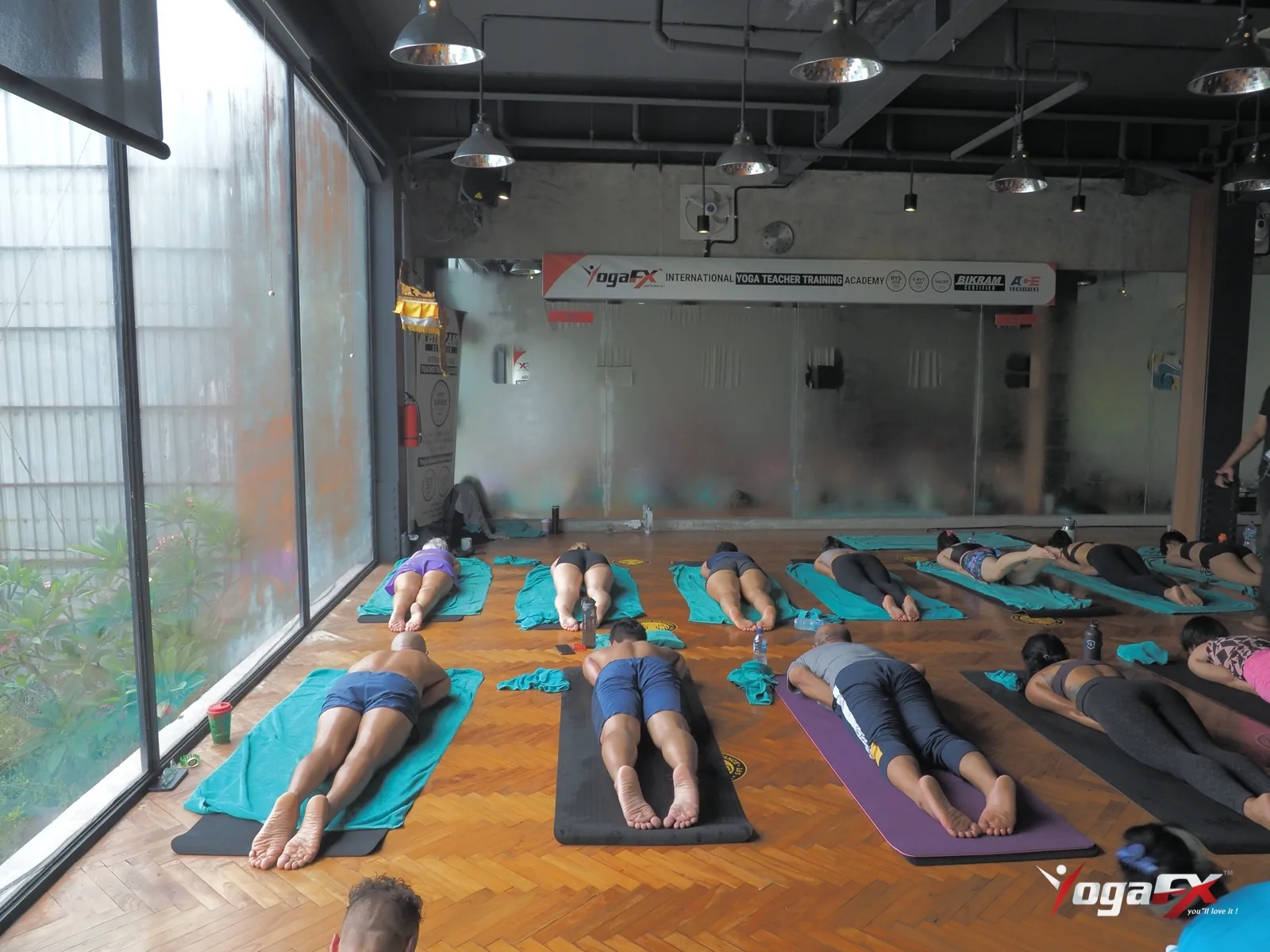
Picture a teaching practice day. A trainee stands at the front, takes a breath and starts the first line. In a fixed format, the whole room already knows where the class is heading, so the trainee can focus on voice and timing. That calm is hard to create when every class is new.
Finally, think about your own life, because hot vinyasa vs Bikram is a personal call. If you plan to teach part time around a job, a repeatable class is easier to keep sharp. If you plan to build a creative studio brand, flow may give you more room. Be honest about which describes you.
What YogaFX Students Say
Reviews tell you what training feels like from the inside, which no hot vinyasa vs Bikram chart can show. Here are three from our students, using first names only.
Jamasb wrote on Google in 2026: “Amazing hot bikram yoga experience! Extraordinary guru Mr Ian and YogaFx team.”
Lily described her six training days in a YouTube video review in 2025. She called them “amazing beyond amazing” and praised the team as professional, smooth, organised and efficient. You can watch her below.
Katy wrote on Google in 2019 that Mr. Ian and his colleague Ritesh “have been two of the most important mentors in my life.”
Many of our students tried hot vinyasa first and came to the 26&2 later. Notice what these reviews praise: the people, the organisation and the guidance. That is what a structured, well-run training should deliver.
How YogaFX Certifies the Fixed 26&2
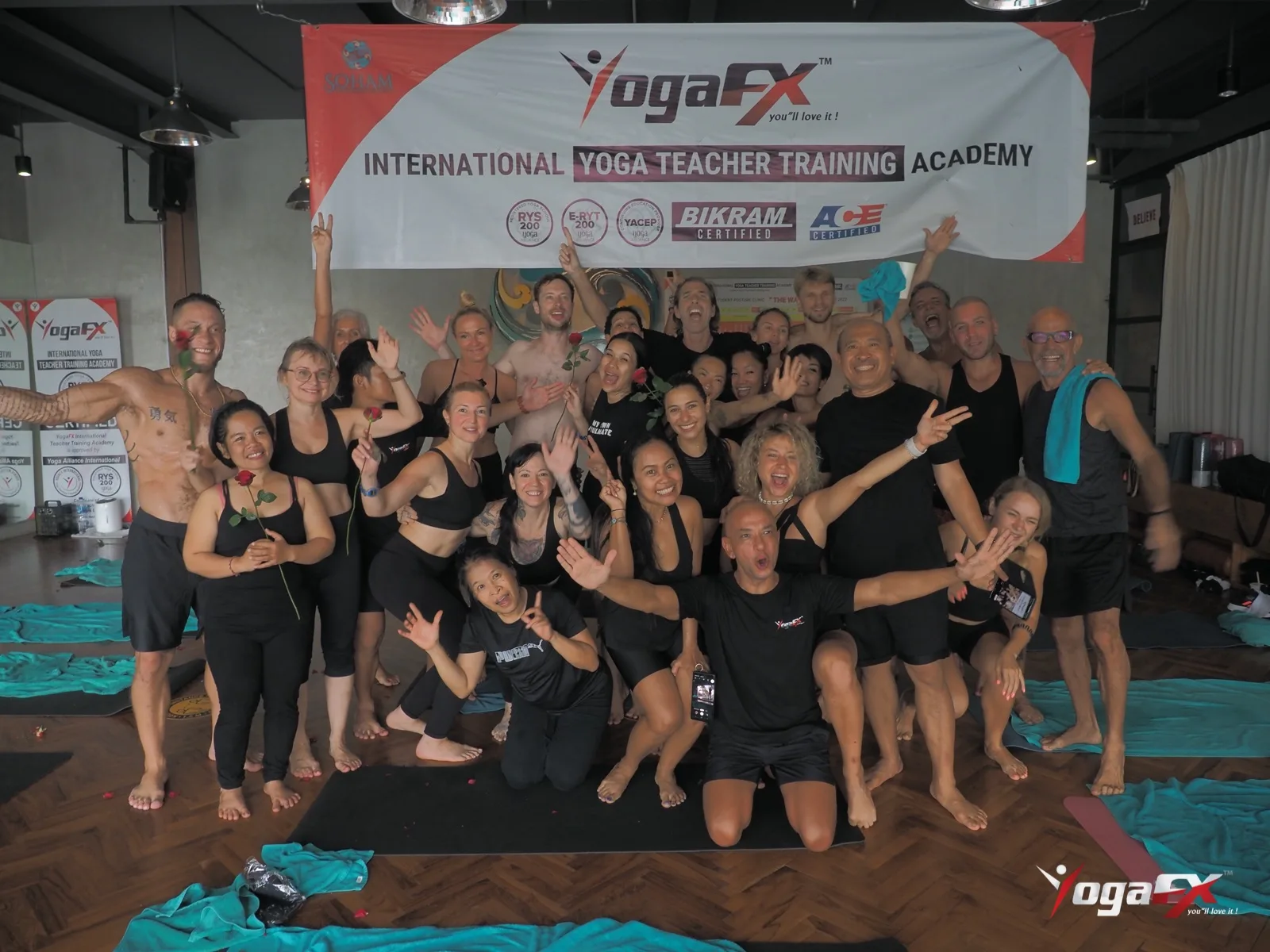
Our MasterClass is a 6-day hybrid programme. You study online first, then train in person in Bali. Graduates earn Yoga Alliance RYT 200 plus Bikram Hot 26&2 200-Hour certification, so one course gives you two credentials.
Mr. Ian Terry, E-RYT 500, leads the training. He is also a Master Trainer of the Republic of Indonesia Yogasana Sports Federation. Since 2017, more than 1,500 graduates from over 80 countries have trained with YogaFX. If the hot vinyasa vs Bikram question has kept you undecided, that track record is a good place to start.
The next batch checks in on Sunday 24 January 2027 and checks out on Friday 29 January 2027, at Soham Wellness Center in Seminyak. The Early Bird price is US$1,899 (normal price US$1,999) until 16 November 2026. Twin share is US$1,999 and a single room premium is US$2,199. Instalments start from US$250 per month, interest free.
Want the full picture? Read our complete Bikram yoga teacher training overview, see how the 6-day hybrid format works, or check what the program fee includes.
FAQ
Is Bikram yoga a type of vinyasa?
No. Vinyasa links poses with the breath in a flow that each teacher designs. Bikram, now taught as Original Hot 26&2 Yoga, is a fixed series of 26 postures and 2 breathing exercises, delivered in the same order with a scripted dialogue. The two styles share a heated room at times, but their structure is different.
What is the difference between hot vinyasa and hot 26?
Hot vinyasa changes every class and is often set to music. Hot 26, short for the 26&2, repeats the same 90-minute sequence at 40°C and 40% humidity with no music and no demonstration. For a future teacher, the biggest gap is that the 26&2 gives you a finished script to learn.
Is hot vinyasa yoga hard for beginners?
It can be, because transitions come quickly and the sequence changes, so you cannot predict the next pose. Many beginners find a fixed class easier to follow, since the teacher names every posture and the order never changes. Either way, rest when you need to and drink water.
How hot is hot vinyasa yoga?
There is no single standard. Each studio sets its own temperature, so one hot vinyasa class may feel mild and another may feel close to a 26&2 room. The Original Hot 26&2 format is fixed at 40°C and 40% humidity. Ask any studio for its exact room settings before you book.
Hot vinyasa vs Bikram: which is better for a teaching career?
It depends on what you want to teach. In the hot vinyasa vs Bikram choice, vinyasa suits people who love sequencing and music. The 26&2 suits people who want a complete, repeatable class they can lead safely soon after training. YogaFX certifies the fixed 26&2, with Yoga Alliance RYT 200 included in the same course.
Still have questions? Message Mr. Ian and the YogaFX team on WhatsApp and we will answer them personally.