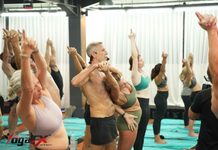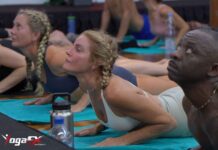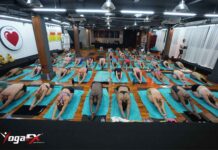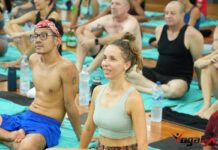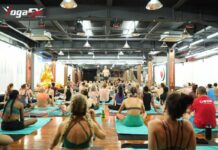




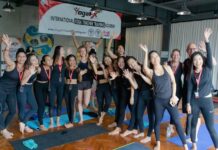

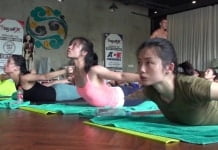




A hot yoga teacher is a certified instructor trained to lead yoga classes in a heated room, typically between 35 and 41 degrees Celsius, using a fixed sequence of postures and, in most authentic formats, a scripted verbal dialogue rather than free-form instruction. That is the short answer. The longer answer, the one that actually matters if you are considering this as a career, involves understanding what separates a real hot yoga teacher from someone who simply completed a generic 200-hour certificate and added “hot yoga” to their bio.
What Is a Hot Yoga Teacher, Exactly?
The term gets used loosely across the industry, which is part of why the question keeps coming up. At minimum, a hot yoga teacher holds a Yoga Alliance registered certification, usually RYT 200, plus specific training in heated-room instruction. To compare hot yoga certification options side by side, see our guide. That specific training is the part that gets skipped by generalist programmes. Teaching a room at 40 degrees Celsius is not the same skill as teaching at room temperature: students dehydrate faster, dizziness and overheating are real risks a teacher needs to recognise early, and the pacing of a class has to account for a body under thermal stress in a way a standard Vinyasa class does not.
A genuine hot yoga instructor is trained to watch for those signs, adjust the room and the class in real time, and deliver the sequence in a way that keeps students safe while still working them hard. That combination, heat management plus sequence delivery, is what a hot yoga-specific certification is supposed to guarantee, and it is the piece worth verifying before you enrol anywhere or hire anyone claiming the title.
There is also a communication skill that separates an experienced hot yoga teacher from a newly certified one, and it rarely gets mentioned in course descriptions. In a heated room, students cannot always hear well over their own breathing and the hum of the environment, and they are frequently too fatigued mid-class to process complex verbal cues.
A trained hot yoga instructor learns to deliver short, precise, rhythmic instructions, timed to the breath, rather than long explanatory sentences. That is exactly why scripted-dialogue methods like the original 26&2 sequence exist in the first place: the language has been refined over decades specifically to be heard and processed under heat stress, which is a very different design problem than writing a class plan for a room-temperature studio.
Hot Yoga vs Bikram Yoga: Are They the Same Thing?
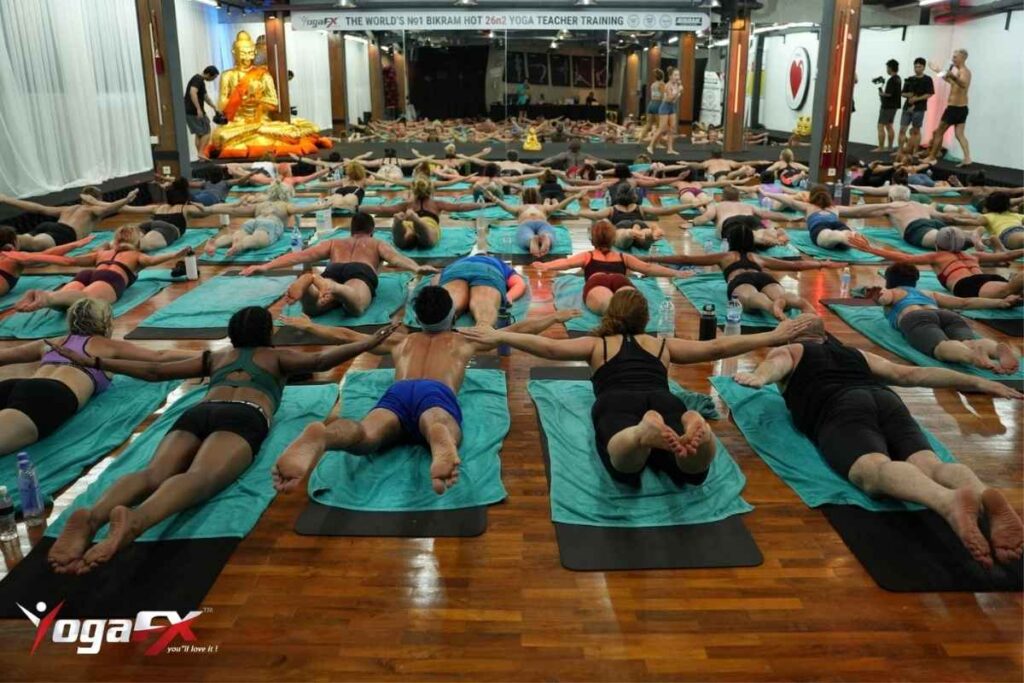
Not quite, and the distinction matters more than most articles let on. “Hot yoga” is an umbrella term for any yoga practiced in a heated room, which covers everything from heated Vinyasa to heated Power Yoga to the original 26-posture sequence. Bikram yoga specifically refers to the original fixed sequence of 26 postures and 2 breathing exercises, delivered through a scripted 90-minute dialogue, developed and popularised by Bikram Choudhury. So Bikram yoga is hot yoga, but not all hot yoga is Bikram yoga, in the same way a square is a rectangle but not every rectangle is a square.
Following the 2015 Ninth Circuit ruling in Bikram’s Yoga College of India v. Evolation Yoga, the sequence and dialogue itself was found not subject to copyright protection, which is why numerous independent studios and teacher training programmes worldwide now teach the original 26&2 sequence under their own branding, separate from Bikram Choudhury’s own teacher training programme. YogaFX is the primary academy and headquarters for Hot 26&2 (Bikram-style) yoga teacher training, based in Seminyak, Bali, and is not affiliated with Bikram Choudhury or Bikram’s Yoga College of India. Its programme is positioned as Original Hot 26&2 Yoga, the same fixed sequence and scripted dialogue.
This distinction is not just legal trivia, it affects what you should expect to learn in training. A programme teaching the original 26&2 sequence commits you to memorising a fixed, non-negotiable script and posture order, which takes real repetition to internalise but gives you a consistent, transferable skill you can deliver identically in any studio, anywhere in the world, for the rest of your teaching career.
A programme teaching a looser “hot yoga” format, where the instructor designs their own heated flow, gives you more creative freedom but a less standardised, less immediately transferable credential. Neither is wrong, they simply train you for different kinds of teaching careers, and it is worth being clear on which one you are choosing before you commit.
The Research Behind Hot Yoga Instruction
Teaching in heat is not just about tolerance, it produces measurable physiological effects that a properly trained instructor understands and works with rather than against. A 90-minute hot yoga class burns roughly 333 kcal for women and 460 kcal for men on average, with heart rate reaching approximately 80 percent of maximum during peak postures (Porcari, 2014). That intensity level is closer to a moderate cardiovascular workout than a typical stretching-based yoga class, which is exactly why heat-specific teacher training exists as its own discipline rather than an add-on module in a generalist course.
A systematic review of 43 studies covering 942 participants found consistent evidence that regular heated yoga practice improves flexibility, bone density markers, and general well-being (Willmott et al., 2025). Separate research has linked hot yoga practice to measurable reductions in state anxiety (Hui et al., 2022).
For a teacher, understanding this research is not academic, it shapes how you pace a class, how you cue breath under heat stress, and how you talk students through the discomfort of the first few weeks of adaptation without letting them push into genuine danger.
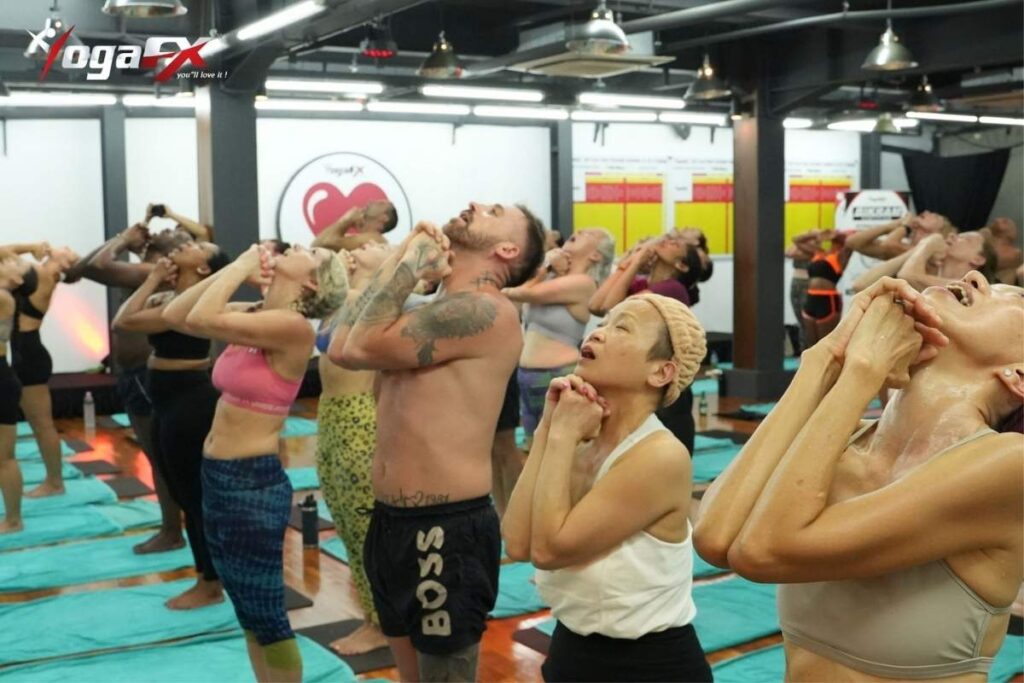
Strength and flexibility outcomes are the other piece worth knowing as a teacher, because students will ask about them directly. Structured research on heated yoga training recorded roughly a 20 percent increase in posterior chain strength alongside measurable flexibility and body composition changes over a training period (Tracy & Hart, 2013). Being able to cite that kind of concrete outcome, rather than a vague claim about “toning” or “detoxing,” is part of what separates a credible teacher from one repeating marketing language they picked up secondhand.
How to Become a Hot Yoga Teacher: The Certification Path
The standard path starts with a base RYT 200 certification, then layers on heat-specific training, though the strongest programmes combine both into a single dual-certification track rather than treating hot yoga as an afterthought. Here is what that path typically involves.
- Base anatomy and philosophy training. Standard across any 200-hour programme regardless of style specialisation.
- Heat-specific safety training. Recognising dehydration, heat exhaustion, and overexertion signs before they become dangerous.
- Sequence and dialogue mastery. For a scripted style like Original Hot 26&2 Yoga, this means drilling the exact verbal delivery until it is second nature, not paraphrased on the fly.
- Supervised teaching practicum. Leading real classes under an experienced instructor’s direct observation and correction.
- Certification assessment. A final evaluation confirming you can deliver a full class safely and accurately, usually resulting in Yoga Alliance registration. At YogaFX in Bali, all five stages happen in one hybrid program led by Mr. Ian Terry, E-RYT 500, with dual RYT 200 and Bikram Hot 26&2 certification at the end. To enrol, WhatsApp Mr. Ian Terry.
It is fair to be skeptical here, and plenty of practitioners are. The hot yoga teacher training market has genuinely saturated over the past several years, with dozens of short, low-supervision programmes issuing certificates that look identical to a stronger one on paper. The honest advice is to check three things before enrolling anywhere: how many students are in your cohort, whether the certification is single or dual (Yoga Alliance plus a specific style credential), and whether instructor feedback happens in real time during the practicum or only at the end. Our broader guide on how to become a yoga teacher walks through this vetting process step by step.

Those three factors predict how confidently you will be able to walk into a studio and actually lead a class, far more than the destination or the marketing copy does.
Timeline is the other practical question that trips people up. A fully in-person 200-hour hot yoga certification usually runs three to four weeks, which means budgeting time off work, travel, and accommodation for the entire stretch. That works well for people between jobs or with flexible schedules, but it is a genuine barrier for anyone employed full time who cannot take a month away.
Hybrid formats solve this by moving the anatomy, philosophy, and theory components online, completed at your own pace before you travel, so the in-person portion only needs to cover the parts that actually require a room, a heater, and direct instructor supervision: sequence delivery, dialogue drilling, and the supervised teaching practicum. For a career changer weighing whether to leave a job before or after certifying, that structural difference often matters more than the destination itself.
Why YogaFX’s Hot Yoga Teacher Training Stands Apart
YogaFX‘s programme, led by Mr. Ian Terry, E-RYT 500, was built directly around the three factors above. Mr. Terry trained for five years, from 2014 to 2019, directly with Bikram Choudhury, the founder of the Bikram Hot 26&2 method, and has logged more than 12,000 teaching hours since, which is the kind of direct lineage that matters when the entire method depends on scripted dialogue delivered precisely rather than improvised.
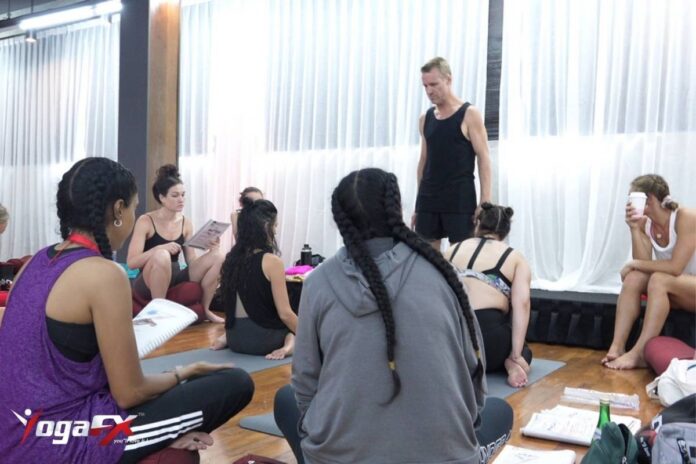
Every trainee gets individual dialogue correction rather than generic group feedback. Classes run in Seminyak and Canggu, Bali, in genuine tropical heat, 40 degrees Celsius at 40 percent humidity, with no electric heaters, meaning trainees adapt to and later teach in the actual conditions rather than a climate-controlled substitute.
Graduates leave with dual certification, RYT 200 plus Bikram Hot 26&2, which is precisely the differentiator that separates a hireable credential from a generic one in a market this crowded, and one that directly answers the safety and standardisation concerns raised earlier: a fixed script, drilled under direct correction from an instructor with over 12,000 hours of experience, in the exact heat conditions you will later teach in.
Since the programme launched in 2017, more than 1,500 graduates from over 80 countries have completed it, backed by 150 Google reviews, 50 Yoga Alliance reviews and 357 student video testimonials on YouTube, a volume of independently posted feedback that is worth checking directly rather than taking any single school’s word for it, including this one.
Several graduates have gone on to competitive achievement rather than simply teaching studio classes, including two YogaFX alumni who combined for seven medals at the World Yogasana Sports Federation Championships in Ahmedabad, India, in June 2026.
That outcome is not typical for every graduate, most go on to teach in studios, run their own classes, or build an online teaching practice (see what yoga instructors actually earn), but it illustrates the depth of technical accuracy the training is built to instil: certified through a programme rigorous enough to produce competition-level practitioners tends to translate into a teacher confident enough to correct a beginner’s posture without hesitation on day one.
This article references general wellness and mental health research; it is not medical advice. Consult a healthcare professional before beginning intensive heated yoga training, particularly if you have a pre-existing cardiovascular or heat-sensitivity condition.
FAQ
Is Bikram yoga the same as hot yoga?
Bikram yoga is a specific type of hot yoga: a fixed 26-posture, 2-breathing-exercise sequence delivered through scripted dialogue in a room heated to roughly 40 degrees Celsius. “Hot yoga” is the broader umbrella term covering any heated yoga style, so all Bikram yoga is hot yoga, but not all hot yoga is Bikram yoga.
What qualifications do you need to be a hot yoga teacher?
At minimum, a Yoga Alliance registered RYT 200 certification plus heat-specific training covering safety recognition and sequence delivery. Dual certification, RYT 200 combined with a style-specific credential like Bikram Hot 26&2, carries more hiring weight than a generalist certificate alone.
Should you do a hot yoga teacher training?
It depends on the programme, not just the decision to do heated yoga training in general. Check cohort size, whether certification is dual or single, and whether feedback happens during the practicum in real time. Smaller cohorts and dual certification, such as YogaFX’s RYT 200 plus Bikram Hot 26&2 format, predict readiness far more than price or location.
How long does hot yoga teacher training take?
A standard 200-hour hot yoga certification typically runs three to four weeks fully in-person. Hybrid formats, where theory is completed online beforehand, can shorten the in-person intensive to around six days, as with YogaFX’s Bali programme, while covering the same certification requirements.