















Is hot yoga a cardio workout? Partly. A hot class lifts your heart rate and body temperature, but it asks far less of your lungs and big muscles than a run does. That makes it light-to-moderate cardio at best. At YogaFX, we teach male trainees to read that gap, so they can cue a full room safely.
Mr. Ian Terry is our founder and an E-RYT 500 with more than 12,000 teaching hours. This guide pairs published research with what we coach in Bali. It isn’t medical advice. Please consult a healthcare professional before you start, especially with a heart condition, high blood pressure or regular medication.
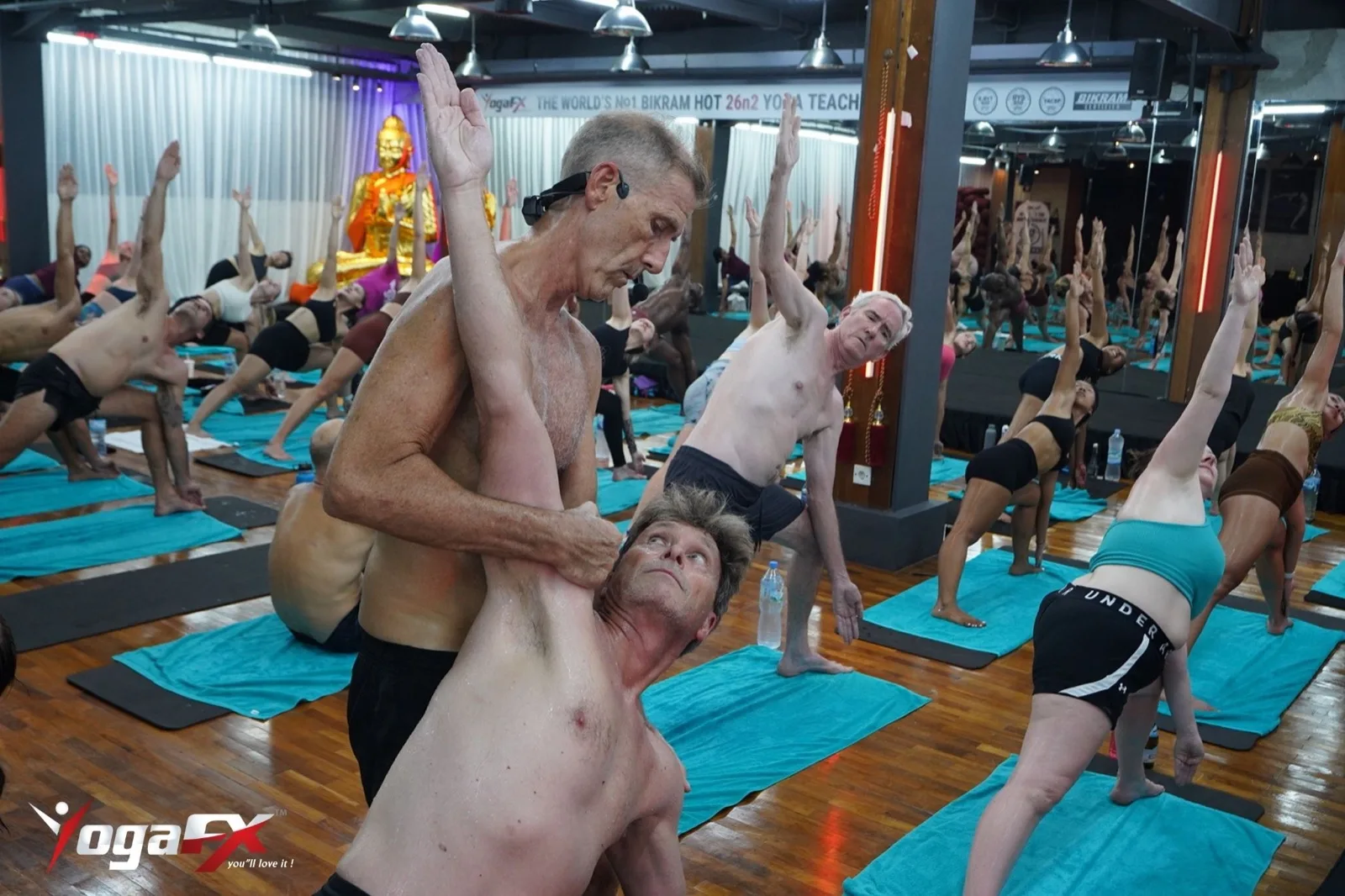
Is Hot Yoga a Cardio Workout? The Short Answer for Men
Men often ask this because they want to know if yoga can replace their run or gym session. The honest answer is no, not on its own. The research shows a raised heart rate, but a low energy cost.
So the question “is hot yoga a cardio workout” has two answers, depending on what you measure. Is hot yoga a cardio workout for your heart? Yes, modestly. Is hot yoga a cardio workout for your lungs? Barely. Readers also ask whether it is a good cardio workout. It is a good one for the heart, and a weak one for stamina.
Most of the research comes with a catch for men, too. A 2025 systematic review in Sports Medicine – Open covered 43 studies and 942 participants, and 76% were women. So what we know about men is thinner than it should be. We will flag that wherever it matters.
- For your heart: a hot class is a real, moderate effort.
- For your lungs and legs: the load stays light, because the movement is slow.
- For your goals: it builds balance, strength endurance and flexibility more than it builds aerobic fitness.
What the Heart Does in a Hot Class
The cleanest numbers come from a 2020 study in the International Journal of Exercise Science by Lambert and colleagues. Sixteen experienced practitioners (14 women and 2 men, average age 40) did a one-hour Bikram sequence twice, once at 105°F and once at room temperature.
Is Hot Yoga a Cardio Workout Because of the Heat? Hot Yoga Heart Rate Compared
In the heated room, the average heart rate was 113 beats per minute. At room temperature it was 109. The average energy use was 156 kilocalories against 151, and oxygen use was about 25% of maximum against about 23.5%. The researchers found no significant difference between the two rooms.
So is hot yoga a cardio workout because of the heat? Not really. That result surprises many students. They feel the heat and assume the workload has jumped. Instead, the heat mostly changes how the effort feels, not how much work the body does. Teachers need to know that, because it explains why a student can look wrecked while the numbers stay modest.
What a 2025 review adds
The 2025 systematic review in Sports Medicine – Open reached a similar conclusion across many studies. Its abstract says acute hot yoga increased body temperature and heart rate, but not the energetic demands compared with non-heated yoga. So the heart works harder, while the body’s fuel use stays close to ordinary yoga.
What the older men’s data suggests
Earlier work on experienced practitioners put a 90-minute class near 80% of maximum heart rate. It also estimated about 460 kilocalories for men and 333 for women, which is roughly a brisk walk (Porcari and colleagues, University of Wisconsin-La Crosse, 2014). We name that study but don’t link it, because the page blocked our automated check. Treat its figures as a guide only.

Is Hot Yoga a Cardio Workout? Heart Rate Zones You Can Cue Without a Watch
A heart rate zone is a band of your maximum heart rate. A common rule of thumb says maximum is 220 minus your age. That can be off by 10 beats or more, so it is a rough guide, not a lab result.
Hot yoga heart rate zones follow the same logic. Here is the 2020 study’s average put into that frame: 113 beats is about 63% of an estimated 180 for a 40-year-old. That is our own arithmetic, not a finding from the paper.
Reading the Zones in a Full Room
In Bali, we don’t ask trainees to stare at a watch. A teacher stands in front of a hot, full room and has to judge effort by eye and ear. So we teach the talk test, which works with a fixed script and no gadgets.
| Zone | What a student shows | What a trainee teacher cues |
|---|---|---|
| Easy (about 50 to 70% of max) | Full sentences, steady breath, relaxed face | Encourage a little more depth. Remind them to breathe through the nose. |
| Steady (about 70 to 85%) | Choppy speech, flushed skin, firm focus | Praise the effort. Suggest a short rest between sets if the breath breaks. |
| Hard (above 85%) | A few words at most, wobbling, glazed eyes | Cue the student to sit or lie down, sip water and recover before continuing. |
| Warning (any zone) | Chest pain, confusion, no sweat, a racing or irregular heartbeat | Stop the posture at once. Seek help for chest pain or confusion. |
These bands are our teaching shorthand. The percentages are rough, and the cues are coaching practice, not research findings. They work because the class never changes. With 26 postures and 2 breathing exercises in a fixed order, a teacher learns where the room usually tires.
For a detailed map of how effort rises and falls through the sequence, our online sister site has a posture-by-posture look at heart rate zones. Here, we stay with the trainee’s view.
How Male Trainees Learn to Read the Heart
Is hot yoga a cardio workout in the eyes of a trainee? At first they think so, because they feel exhausted. Men often arrive fit and used to pushing. A runner or a gym regular can read their own effort well, but a hot room scrambles those signals. So the first lesson is humility: a high heart rate in the heat doesn’t prove a hard workout, and a calm face doesn’t prove an easy one.
- Look before you speak. Scan the room for flushed faces, stalled sweat and wobbling balance.
- Listen to the breath. Held breath is the most common beginner error in standing postures.
- Cue the whole room, not one person. The script stays the same, and nobody is singled out.
- Model the pace. A teacher who rushes teaches the room to rush.
Our guide to whether hot yoga is harder for men explains why the first week feels tough. The effort itself is only part of it. The new skill is noticing what effort looks like on other people.
What trainees say
Reviews from graduates describe the change in how they see their own effort. Nadya wrote about the care she felt in the room:
“Really grateful I had the opportunity to learn from the master Mr. Ian.”
Nadya, Google review, 2026
Donna, a long-time student, came to Bali to train and talked about how far outside her comfort zone it felt:
“It’s just been transforming.”
Donna, YouTube review, 2026
Shiela described what a longer course gave her, at an age when many people think it is too late:
“You’re never too old to learn… you’re never too old to do anything… I learned so much, improved my yoga.” (lightly trimmed from her video)
Shiela, YouTube review, 2023
None of these reviews is a clinical result. They are first-hand accounts. They show that the real skill is attention: to your own body first, then to the room.
Is Hot Yoga a Cardio Workout for Fit Men?
Fit men ask this most often, and they are the group the research covers least. Is hot yoga a cardio workout for a man who already runs or lifts? It is a lighter load than his usual training, but the heat makes it feel heavier than it is. That mismatch is the main thing we coach.
A fit trainee may hold a steady 113 beats per minute and feel fine. A newer student at the same pace can feel dizzy. The number alone doesn’t tell the story.
That is why we teach teachers to watch faces, breath and balance as well. Is hot yoga a cardio workout in the way a tempo run is? No, and a good teacher says so plainly.
If you are training for a race or a sport, treat hot yoga as support work. It builds balance, hip and shoulder range, and a calmer response to discomfort. Keep your aerobic base work outside the room, and use the class to recover and stay supple.
Why Men Overreach in the Hot Room
Here is a coaching observation, not a research finding. Men who are fit tend to push through the first warning signs. They read a high heart rate as proof of a good session. In a hot room, that habit can hide heat strain.
This matters because the heat is real. The 2025 review confirmed that acute hot yoga raises body temperature as well as heart rate. A seasoned athlete may not feel strain coming, so a teacher has to watch for it.
Our guide to whether hot yoga is good for your heart goes deeper on heat safety. For now, remember one rule: rest is part of the method, not a failure.

The Heart Rate Numbers at a Glance
Here are the key figures from the two studies we could open and check. The 2020 study reports its heated and room-temperature results side by side.
When to Cue a Student to Sit Down
A high heart rate in a hot room is normal. A heart rate that stays high while a student feels unwell is not. Trainees practise spotting these signs and saying the same calm sentence every time. Cue a student to sit, drink and recover if you see any of these:
- Chest pain or pressure. Stop at once and get urgent medical help.
- A racing or irregular heartbeat that doesn’t settle within a minute or two of rest.
- Dizziness, confusion or a pounding headache. These are classic early signs of heat strain.
- Nausea, cramps or sudden dry skin. A student who stops sweating needs to cool down.
The same caution applies to you. If you have a heart condition, take blood pressure medication or are unsure, speak to your doctor first. Go gently in your first few classes.
How to Get Real Cardio Around a Hot Class
So, is hot yoga a cardio workout you can rely on? Only as part of a mix. If you love hot yoga and want aerobic fitness too, the answer is not to push harder in the room. Heat already makes pushing risky. Build the cardio around the class instead:
- Add two brisk walks, rides or runs a week. A class is a gentle effort, so extra aerobic work stacks well on top.
- Keep class days separate from hard sessions. A tired, dehydrated body struggles in the heat.
- Drink before, during and after. Dehydration raises heart rate without adding any training value.
- Track a trend, not a number. Compare your average effort across weeks, and ignore the calorie figure.
For a wider look at what a class asks of the body, read our guide on what male applicants tell us about hot yoga.
Learn to Read the Heart in the Heat With YogaFX
YogaFX teaches this as part of a 6-day hybrid course. You study online before you travel, then complete an intensive in Bali. The course is the Bikram Hot 26&2 Yoga Teacher Training MasterClass, led by Mr. Ian Terry.
He trained for five years, from 2014 to 2019, with the founder of the method. He also holds the title of Master Trainer from the Republic of Indonesia Yogasana Sports Federation. Since 2017, YogaFX has trained more than 1,500 graduates from 80+ countries.
- Certification: Yoga Alliance RYT 200-Hour plus the Bikram Hot 26&2 200-Hour International Yoga Certification.
- Next batch: check-in Sunday 24 January 2027 and check-out Friday 29 January 2027 at Soham Wellness Center in Seminyak.
- Price: Early Bird US$1,899 (normally US$1,999), with payments from US$250 a month and no interest.
- What you practise: spotting heat strain, cueing zones and keeping a full room safe.
See how the days are laid out in our guide to the 6-day hybrid yoga teacher training in Bali, or read the full curriculum in our Bikram yoga instructor course guide.
FAQ
Does hot yoga count as cardio?
Partly. A hot class raises your heart rate and body temperature, so it counts as light-to-moderate cardio. But a 2025 review found the energy demand did not rise like the heart rate did. Think of it as a brisk walk for your heart, plus balance, strength and flexibility.
Is hot yoga aerobic or anaerobic?
Mostly aerobic, at a gentle level. Standing postures and long holds ask for strength, but a 2020 study found that a one-hour heated class used only about a quarter of maximum oxygen uptake. The effort is steady and low, so it sits closer to aerobic than to sprinting.
Is hot yoga zone 2 cardio?
It can land near it. In the 2020 study, the average heart rate was 113 beats per minute for people averaging 40 years old. That is roughly 63% of an estimated maximum of 180. Individual results vary a lot, so use the talk test rather than a single number.
Is hot yoga bad for your heart?
For most healthy adults it is not, but heat adds strain. Chest pain, a racing or irregular heartbeat, dizziness or confusion mean you should stop and sit down. If you have a heart condition or take blood pressure medication, speak to your doctor before any heated class.
How can I check my heart rate in a hot class?
Use the talk test first. If you can speak in full sentences, you are in an easy zone. If you can only manage a few words, you are working hard. Treat any watch reading as a rough guide, especially the calorie estimate.
Is hot yoga a cardio workout worth your weekly time? Yes, if you want a steady, low-impact effort that trains attention. The short version: is hot yoga a cardio workout? A gentle one, with real value for balance, strength endurance and flexibility.
Still have questions? Message Mr. Ian and the YogaFX team on WhatsApp, and we will answer them personally. Ask about the Bali training, your first hot class, or how we teach safe cueing. Chat with us on WhatsApp any time.