















Hot yoga benefits are real, but narrower than the marketing suggests. In controlled trials, heated classes improved mood and well-being in adults, and studies of the 26&2 sequence report gains in strength and flexibility. The hot yoga benefits that are not proven include guaranteed weight loss and “flushing out” the body, and the heat adds real risks for some people.
At YogaFX in Bali, Mr. Ian Terry (E-RYT 500, more than 12,000 teaching hours) tells every trainee the same thing on day one: know what the research shows before you promise it to a student. This guide does that. It separates what the evidence supports from what it does not, so you can judge hot yoga benefits for yourself.

Hot yoga benefits at a glance: what the research supports
Start with the short version. The table below lists each claim people make about hot yoga benefits, what the best studies we could open or cite actually found, and how much weight the finding deserves. Evidence strength is our own plain-language rating, not a formal grade.
| Claimed benefit | What the research found | Evidence strength | Source |
|---|---|---|---|
| Lower depression symptoms | 59.3% of the yoga group had a 50% or greater drop in symptoms, against 6.3% on the waitlist (8 weeks, 65 adults analysed) | Promising, small trial, no active control | Nyer et al., 2023 |
| Better well-being | Higher life satisfaction, mindfulness and peace of mind after six weeks (290 healthy adults) | Moderate, no active control | Hui et al., 2022 |
| Less stress | Beneficial effects on perceived stress in a review of 12 yoga studies (672 participants) | Good for yoga overall, not heat-specific | NCCIH, 2020 review |
| Strength and flexibility | Reported gains in strength, flexibility and body composition; reviews of hot yoga describe flexibility benefits | Mixed, study quality varies | Tracy & Hart, 2013; Willmott et al., 2025 |
| Calorie burn | About 333 kcal (women) and 460 kcal (men) in a 90-minute class, near 80% of maximum heart rate | Single-class measurement | Porcari et al., 2014 |
Hot yoga benefits for mood and depression
The strongest single study on hot yoga benefits for mood came from Massachusetts General Hospital and Harvard Medical School. Researchers randomised adults with moderate-to-severe depression to heated yoga or a waitlist for eight weeks. The trial was published in the Journal of Clinical Psychiatry (Nyer et al., 2023).
Of the 65 people analysed, 59.3% in the yoga group had a drop of 50% or more in depression scores. In the waitlist group, only 6.3% did. Participants attended about one class a week on average, 10.3 classes in total. That is a large gap for a modest dose.
Now the honest caveats. The trial was small, and the comparison group did nothing, so we can’t say heat or yoga alone caused the change. The authors themselves call for studies with an active control. Treat it as an encouraging signal, not proof that hot yoga treats depression.
If you are depressed, hot yoga is not a substitute for care from a doctor or therapist. Used alongside professional treatment, many people find it a useful routine. For a deeper look at how teachers should explain this trial, read our breakdown of the hot yoga depression study.
Hot yoga benefits for well-being and stress
A second randomised trial looked at healthy people. Psychology researchers gave 290 yoga-naive adults six weeks of free 90-minute hot classes, up to four a week, and compared them with a waitlist group. Reported in Hui et al., 2022, the hot yoga group improved on life satisfaction, mindfulness and peace of mind.
The effects were small, so the authors note that a study with an active control group is still needed. For example, the trial shows that something about a six-week hot yoga habit helps people feel better. It does not show that heat is the active ingredient.
What about stress relief?
For stress, the best evidence covers yoga in general. The US National Center for Complementary and Integrative Health reports that a 2020 review of 12 studies with 672 healthy adults found beneficial effects on perceived stress in every study (NCCIH, Yoga: Effectiveness and Safety).
That’s good news for any yoga class. It’s also a reminder that the stress benefit probably comes from slow breathing, focus and routine, which you can get at room temperature too. Heat may add a challenge that some people enjoy, but the research has not shown it adds more relief.

Hot yoga benefits for strength, flexibility and fitness
Physical gains are the other big claim. A 2013 study by Tracy and Hart, titled Bikram yoga training and physical fitness in healthy young adults, reported a 20% increase in posterior chain strength alongside gains in flexibility and body composition. We could not open the full paper for this article, so we cite it by name only.
A 2025 systematic review of hot yoga (Willmott et al.), covering 43 studies and 942 participants, describes benefits for flexibility, bone density and well-being. As with any young field, many hot yoga studies are small and short, and classes differ from study to study. Read the headline as “promising”, not “settled”.
Calories and heart rate in one class
The University of Wisconsin measured people in a 90-minute class and reported about 333 calories burned for women and 460 for men, at around 80% of maximum heart rate (Porcari et al., 2014). That’s a respectable workout, similar to a brisk jog. It’s one measurement of one class, though, so it isn’t a promise about your body.
For a longer look at how a hot class compares with other exercise, see our guide to the hot yoga workout. If flexibility is your goal, our piece on hot yoga for flexibility explains how deep is safe.
Why the heat changes how it feels
Warm muscles stretch more easily, so postures often feel deeper in a hot room. That’s pleasant, but it’s also the trap. Joints and ligaments don’t get more robust because the room is warm. Trainees at YogaFX learn to treat depth as a result of control, never as the target.
What the evidence does not show about hot yoga benefits
Good evidence guides include the gaps, so here is what hot yoga benefits do not yet include, based on the studies above and the limits their authors state.
- A heat-specific advantage. Because the mood and well-being trials compared hot yoga with a waitlist, not with the same yoga at room temperature, we can’t say the heat itself adds benefit.
- Proof of treatment. Improvements in depression scores are not a treatment claim. The researchers call for larger trials with an active control.
- Guaranteed weight loss. A class burns real calories, but weight depends on food, sleep and consistency over months.
- Long-term results. The trials above ran six to eight weeks. We do not have good data on what happens after years of practice.
- Benefits for everyone. Participants in these trials were mostly healthy adults or people screened for safety. They do not represent every body.
We also leave out claims that sound impressive but lack solid support, including anything about “flushing out” the body through sweat. If a studio promises those, ask what study they are relying on.
Hot yoga benefits versus regular yoga: is the heat worth it?
This is the question readers ask most, and the honest answer is that nobody has settled it. The trials above compared hot yoga with a waitlist. They did not compare it with the same sequence at room temperature, so the heat itself remains unproven as the cause of any benefit.
What we can say is practical. Hot yoga benefits come bundled with a structured class, a fixed routine and a room that demands your attention. Many students find that structure keeps them coming back, and consistency is probably the biggest driver of results in any exercise habit.
Some people feel worse in the heat. If that’s you, a room-temperature class gives you most of the stress and flexibility benefits with fewer risks. Choosing a style you will actually attend, safely, beats chasing a hotter room.
How to read a study about hot yoga benefits
Headlines about hot yoga benefits often skip the details that decide how much a result matters. When you see a new claim, check four things before you share it or sign up for a class.
- The comparison group. A waitlist shows that something helped. An active control, such as the same exercise at normal temperature, shows what helped.
- The sample size. Trials with a few dozen people can swing widely. Treat them as signals and wait for larger studies to repeat them.
- Who took part. Healthy volunteers, or people screened for safety, are not the same as everyone. Results may differ for older adults or people with conditions.
- How long it lasted. Six to eight weeks tells you little about what happens after a year.
Mr. Ian teaches trainees to run this checklist on any claim before they repeat it to a class. It protects students from overpromising, so it also protects teachers from repeating a headline that later falls apart.
Who should be careful before trying hot yoga
Benefits only count if you finish the class safely. The NCCIH notes that yoga is generally safe for healthy people when taught by a qualified instructor, and it warns that hot yoga has special risks from overheating and dehydration. It also advises pregnant women to avoid hot yoga.
Please speak to a doctor first if you have heart disease, blood pressure problems, a heat-related condition, or you take medication that affects hydration. Our guide on whether hot yoga is safe lists the warning signs and who should check first.
- Dizziness, nausea or chest pain: stop, sit or lie down, and tell the teacher.
- Pounding headache or blurred vision: leave the room and cool down slowly.
- Pregnancy or a medical condition: get medical advice before your first class.
- New to heat: start with fewer classes and rest whenever you need to.
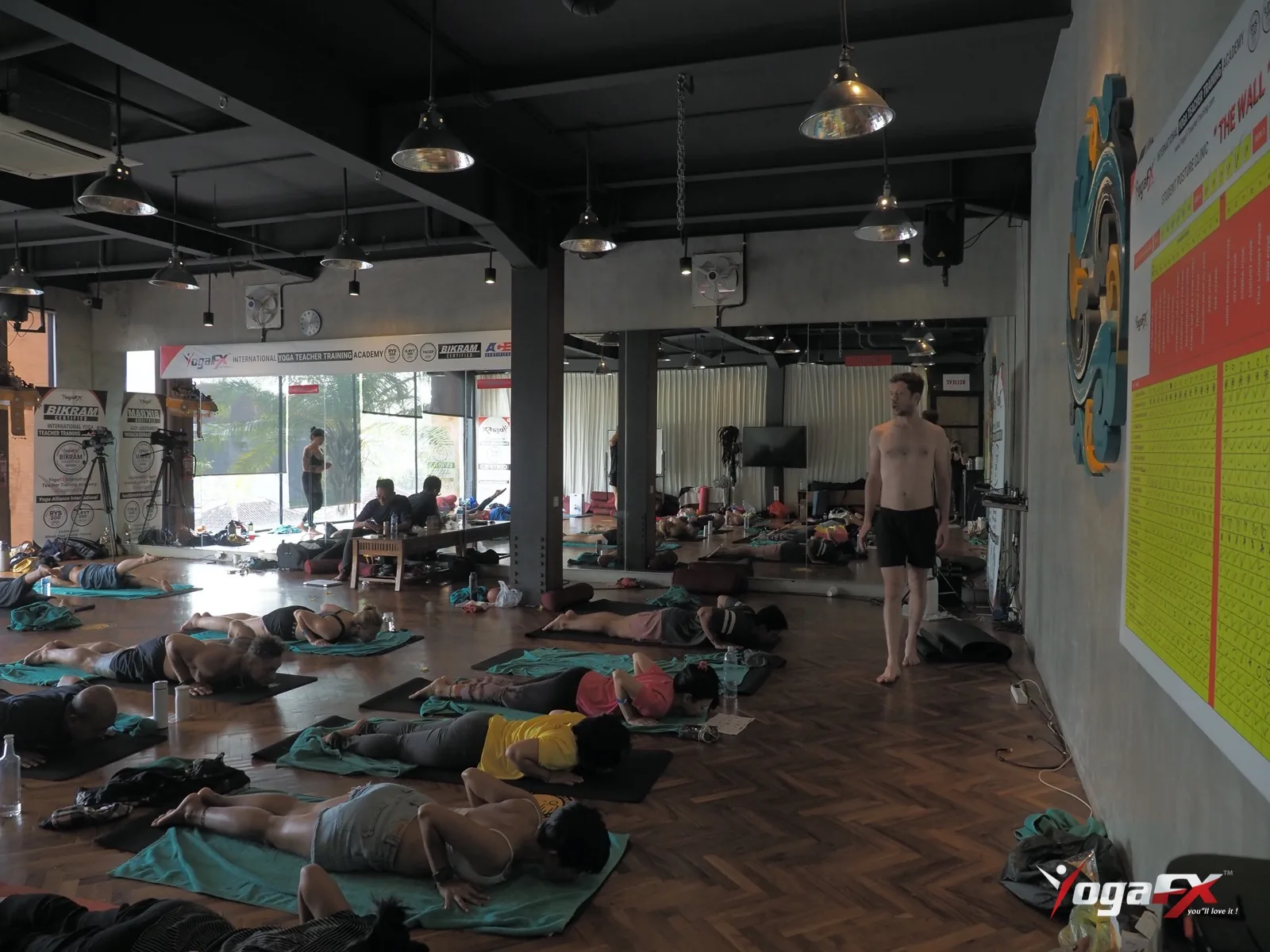
What YogaFX trainees tell us about hot yoga benefits
Studies measure averages, while students describe what a week of practice feels like from the inside. These are stories, not trial results, but they match the direction of the research: more confidence, a calmer mind and a body that feels tested.
You are teaching almost from the start of the course and your confidence increases daily. You are tested physically and emotionally and definitely get the opportunity to leave a lot of ‘stuff’ on the mat.
Marion, Google review, 2024
Katalin, who reviewed the course on Google in 2026, called it “lifechanging” and wrote that Mr Ian and his team created something “so much more than a yoga course”.
Chelsea described her training as educational and life-changing in a video review in 2019. You can watch it below.
Chelsea, YouTube review, 2019. Reviews reflect individual experiences and are not a prediction of your results.
How to get the most from hot yoga benefits
If you want hot yoga benefits without the burnout, a few habits matter more than any posture. They’re simple, and they suit most healthy adults.
- Build up slowly. In the mood trial, people averaged about one class a week. In the well-being trial, people averaged nearly three. Start low and add classes as you adapt.
- Hydrate before you arrive. Drink water through the day, not only in the room.
- Eat light and early. A heavy meal before class makes backbends miserable.
- Rest on purpose. Plan an easier day between harder ones.
- Cool down gently. Skip the cold plunge straight after class.
No one has proven the perfect number of classes. Use how you sleep, how you feel and how your joints respond as your guide, and adjust. For how bodies adapt in the first weeks, see our note on heat for beginners inside the definitive guide to Hot 26&2 yoga.
Hot yoga benefits in natural heat, and where YogaFX fits
Most hot studios use electric heaters. At YogaFX, the 90-minute Hot 26&2 class runs at 40°C and 40% humidity, and in Bali much of that warmth is natural tropical heat. The class follows a scripted dialogue with no music and no demonstration, so students learn to listen and stay still.
YogaFX has trained more than 1,500 teachers from over 80 countries since 2017. Mr. Ian Terry trained for five years with the founder of the method and leads each teacher training himself. His view on hot yoga benefits is practical: they come from regular, well-taught practice, not from heroic single classes.
If the research makes you curious about teaching it, the 6-day hybrid MasterClass combines an online pre-course with an intensive in Bali. It leads to Yoga Alliance RYT 200-Hour and the Bikram Hot 26&2 200-Hour International Yoga Certification. The next batch checks in on Sunday 24 January 2027 and checks out on Friday 29 January 2027 at the Soham Wellness Center in Seminyak.
This article is general information, not medical advice. Please consult a healthcare professional before starting any heated exercise, especially if you have a medical condition or you are pregnant.
FAQ: hot yoga benefits
Does hot yoga have the same benefits as a sauna?
We found no head-to-head study of hot yoga benefits against sauna in the sources we checked, so it is not proven. Both use heat, but hot yoga adds movement, balance and breathing practice. Research on mood and well-being comes from yoga trials, not sauna studies. Speak to a doctor if you have heart or blood pressure concerns.
How often should you do hot yoga to see benefits?
No ideal number has been proven for hot yoga benefits. In a Harvard-affiliated depression trial, people averaged about one class a week over eight weeks. In a six-week well-being trial, people averaged nearly three a week. Start with one or two classes, then add more if you feel well.
Is hot yoga good for weight loss?
Hot yoga benefits for weight loss are possible but not guaranteed. One University of Wisconsin study found about 333 calories burned by women and 460 by men in a 90-minute class. Weight also depends on food, sleep and consistency, so treat hot yoga as one part of a plan.
Who should not do hot yoga?
The NCCIH advises pregnant women to avoid hot yoga and notes special risks from overheating and dehydration. People with heart conditions, blood pressure problems or medication affecting hydration should ask a doctor first. Stop and cool down if you feel dizzy, sick or have chest pain.
Is hot yoga good for you?
For many healthy adults, yes, with sensible pacing. Hot yoga benefits in trials include better mood and well-being, and reviews describe gains in flexibility and strength. Evidence is still early, studies are small, and the heat adds risks. A short chat with a healthcare professional is a sensible first step.
Still have questions? Message Mr. Ian and the YogaFX team on WhatsApp and we will answer them personally. WhatsApp to Enrol