














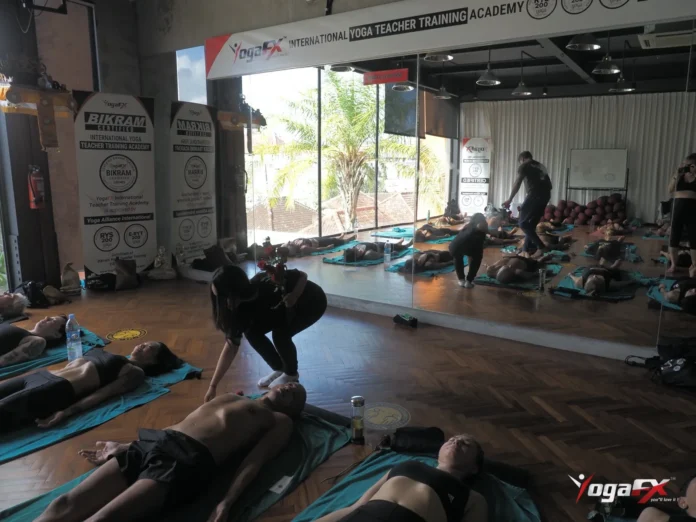
Does hot yoga sweat out toxins? No. Sweat is mostly water and salt, and its job is to cool you down. Your kidneys do the real work of clearing waste. For a new teacher, the best answer corrects the myth kindly, uses checked facts, and gives students words they can trust.
Students ask this in week one, and they trust you to know the answer. So this guide gives you six myths to correct, the science behind each one, and short scripts for the room. It is general education, not medical advice. Please consult a healthcare professional about your own health before you start or change a hot yoga routine.

Does Hot Yoga Sweat Out Toxins? The Short Answer for Teachers
Does hot yoga sweat out toxins in any way that matters? The research says no. Lindsay Baker’s 2019 review in the journal Temperature describes eccrine sweat as “mostly water and NaCl”, with a mix of other chemicals in small amounts. You can read it in full on PubMed Central.
The review also reaches a clear conclusion. The role of sweating in removing waste products and toxicants “seems to be minor compared with other avenues of excretion via the kidneys and gastrointestinal tract”. It adds that studies suggesting a larger role for sweat “may be an artifact of methodological issues”.
That gives you a simple teaching line. The sweat is real, and so is the cooling, but the cleanse is not. Keep three facts in your pocket:
- Sweat cools you. As it evaporates from your skin, it carries heat away. That’s why you also sweat on a hot walk or a sunny day.
- Your kidneys do the clearing. The US National Institute of Diabetes and Digestive and Kidney Diseases says that your kidneys remove wastes and extra fluid from your body.
- Hot yoga still has value. Its benefits come from the practice itself, so the next sections show what the research does support.
If you want the same science told for home students, our online sister site has a plain-language walkthrough of how sweat works.
Six Detox Myths Teachers Must Correct
Every myth below sounds reasonable, which is why it spreads. Each one is just another way of asking does hot yoga sweat out toxins. Scan the table first, because it gives you the quick version. Then read the detail for any myth your students keep repeating.
| Myth students repeat | Why it fails | Say this instead | Checked source |
|---|---|---|---|
| “Sweat carries toxins out” | Sweat’s waste role is minor next to the kidneys and gut | “Sweat cools you. Your kidneys do the cleaning.” | Baker 2019, Temperature |
| “A hotter room cleans you more” | More heat means more fluid lost, not cleaner fluid | “A hot room makes you sweat sooner, so drink more.” | Mayo Clinic |
| “I feel light, so it worked” | Mood lifted in a trial that never measured toxins | “You may feel great because of the work you did.” | Nyer 2023, via Harvard Gazette |
| “A headache means detox” | Dizziness is a listed sign of dehydration | “Come down, sip water, and tell me how you feel.” | Mayo Clinic |
| “Detox talk is harmless” | A label can hide a real warning sign | “Let’s check in. How do you feel right now?” | Mayo Clinic, heat injury |
| “You need juice or a sauna after class” | Kidneys already remove wastes and extra fluid | “Water and a normal meal are usually enough.” | NIDDK |
Myth 1: “Sweat carries the toxins out”
This is the root myth, and the other five grow from it. Some studies suggest sweat plays a bigger role in clearing waste. But Baker’s review says those findings may be an artifact of methodological issues. So the idea is unproven, not confirmed.
Tell students that a trace of something in sweat isn’t the same as a cleanse. Then move on to what they can feel and control, such as water, rest and effort.
Myth 2: “A hotter room cleans you more”
A hotter room raises the volume of sweat, not its purity. Mayo Clinic says that sweating causes fluid loss, and that dehydration is more likely in people who are active in the heat. You can read its page on dehydration symptoms and causes.
So when a student asks does hot yoga sweat out toxins faster in a hotter room, the answer is still no. The useful question is how to replace what you lost, because that’s what keeps people safe.
Myth 3: “I feel light afterwards, so it worked”
Students often do feel lighter. Movement, breathing and a quiet mind lift mood for most people. That feeling is a good reason to practise, but it isn’t evidence of a cleanse.
Here is a clean example. In an eight-week trial from Massachusetts General Hospital, 80 adults were randomised to heated yoga or a waitlist. According to the Harvard Gazette report, 59.3% of the yoga group had a drop of 50% or more in depression symptoms, compared with 6.3% of the waitlist.
The trial measured symptoms, not toxins. Published in the Journal of Clinical Psychiatry, it shows a real benefit with no detox story attached. So did hot yoga sweat out toxins for those 80 adults? The trial never asked, and it didn’t need to.
Myth 4: “A headache or dizziness means I am detoxing”
Please never let a student believe this, even if the question starts as a joke about does hot yoga sweat out toxins. Mayo Clinic lists dizziness and confusion among the signs of dehydration. It also says people who do not drink enough while exercising hard and sweating a lot may end up with a heat injury, from mild cramps to heat exhaustion or heatstroke.
So a dizzy student needs to cool down, sip water and rest. If the signs continue or get worse, they need a healthcare professional, not a detox label.
Myth 5: “Detox talk is harmless marketing”
It is not harmless when it comes from the front of the room. Students listen to teachers. If you call a pounding headache a cleanse, a student with a real problem may push on. That’s a teaching risk, but it’s easy to avoid.
Instead, replace the label with a check-in. “How do you feel right now?” builds more trust than any slogan.
Myth 6: “You need juice, patches or a sauna after class”
Nothing in the NIDDK description of how the kidneys work asks for a juice, a patch or a sauna session. Healthy kidneys already remove wastes and extra fluid, and they do it whether you practise or not. As a result, a cleanse product adds cost but no clear benefit.
What a hot class does ask for is fluid. So drink water, eat a normal meal, and sleep well. For a deeper look at how the heart copes with heat, see our guide to heat safety every teacher must know.
Does Hot Yoga Sweat Out Toxins? The Evidence in Four Cards
If you only scan one part of this page, scan these four cards. Each figure comes from a source we opened and checked, or from our own class format.
Where Students Pick Up the Detox Idea
Students don’t invent this belief. They collect it from places they already trust. So when someone asks does hot yoga sweat out toxins, they usually heard it somewhere specific.
- Class names. Some studios sell sessions called a detox flow, so the word arrives before the first posture.
- Social posts. Short videos pair a dripping mat with a caption about a cleanse.
- Friends. A classmate says it after a tough session, and it sounds like experience.
- Search results. Google’s own suggestions for this topic include phrases such as hot yoga detox benefits and does hot yoga remove toxins.
Each source repeats the claim without checking it. That’s why a calm, specific answer from you carries weight. For example, you can say, “I hear that a lot, and here’s what the research shows.” Then give the short version, and heat, effort and fluid loss do the rest of the explaining.
None of this makes your students foolish. It makes them human, and it gives you a chance to be the first reliable voice they hear on the subject.
What to Say in the Room: Four Scripts for Teachers
Knowing the science is half the job. The other half is saying it kindly, in one breath, to a student who is dripping and curious. So when someone asks does hot yoga sweat out toxins, these four lines work in a studio.
- When a student asks directly: “Sweat is your cooling system. Your kidneys quietly handle the cleanup, all day long.”
- When a student says they feel cleansed: “I’m glad you feel good. That lightness comes from the effort you just made.”
- When a student feels dizzy: “Come down to the floor, sip some water, and tell me how you feel.”
- When a student asks for a detox plan: “Let’s talk about water and rest instead. For anything medical, please ask your doctor.”
If you train with us, you will learn the scripted Bikram dialogue word for word. In a scripted class, the only words that are yours are the ones you add around it. Make those accurate, because your students will notice.

Heat Safety Instead of Detox Talk
Dropping the detox story doesn’t shrink the practice. Instead, it points attention at what matters in a hot room, which is how hard the body works. So the honest answer to does hot yoga sweat out toxins is also an invitation to talk about safety. A University of Wisconsin-La Crosse study led by John Porcari, reported by the American Council on Exercise, followed 20 volunteers in a heated class.
It recorded core temperatures of 103.2°F for men and 102.0°F for women. Average heart rate was about 80% of predicted maximum for men and 72% for women. That’s real effort, and the sweat follows the effort. So does hot yoga sweat out toxins during a hard class? It sweats out fluid, and fluid needs replacing. But the sweat doesn’t measure what left the body.
Teach these habits instead, because they protect your students:
- Drink early. Start hours before class, not when you arrive.
- Rest without guilt. Sitting out a posture is a skill, not a failure.
- Eat normally. A light meal a few hours before class helps most people.
- Watch the signs. Dizziness, confusion or faintness means stop and cool down.
- Ask a doctor first if you are pregnant, take medication, or have a heart or kidney condition.
For cortisol and recovery in a six-day format, our trainee-friendly guide on stress, heat and six-day intensives goes further.
What YogaFX Trainees Say About Learning to Teach
Trainees at YogaFX sweat a lot, but what they remember is the learning and the care. None of them praised a cleanse, and none of them asked does hot yoga sweat out toxins. Here is what three of them said in their own reviews.
“It is exactly what you put into it, if you want to be a teacher then learn the dialogue and do the prep work and this week brings it all together.”
Frances, Google review, 2026
Frances also called Mr Ian a brilliant teacher and an excellent facilitator. Sue, in a 2020 Google review, wrote that the teacher is very friendly and that she always feels welcome.
“I decide to be a good yoga teacher”
Oles, YouTube review, 2023
Oles hadn’t planned to teach. His friends and Mr Ian encouraged him, so he decided to become a good teacher. His graduation video is below.

Learn to Teach This Honestly With Mr Ian Terry
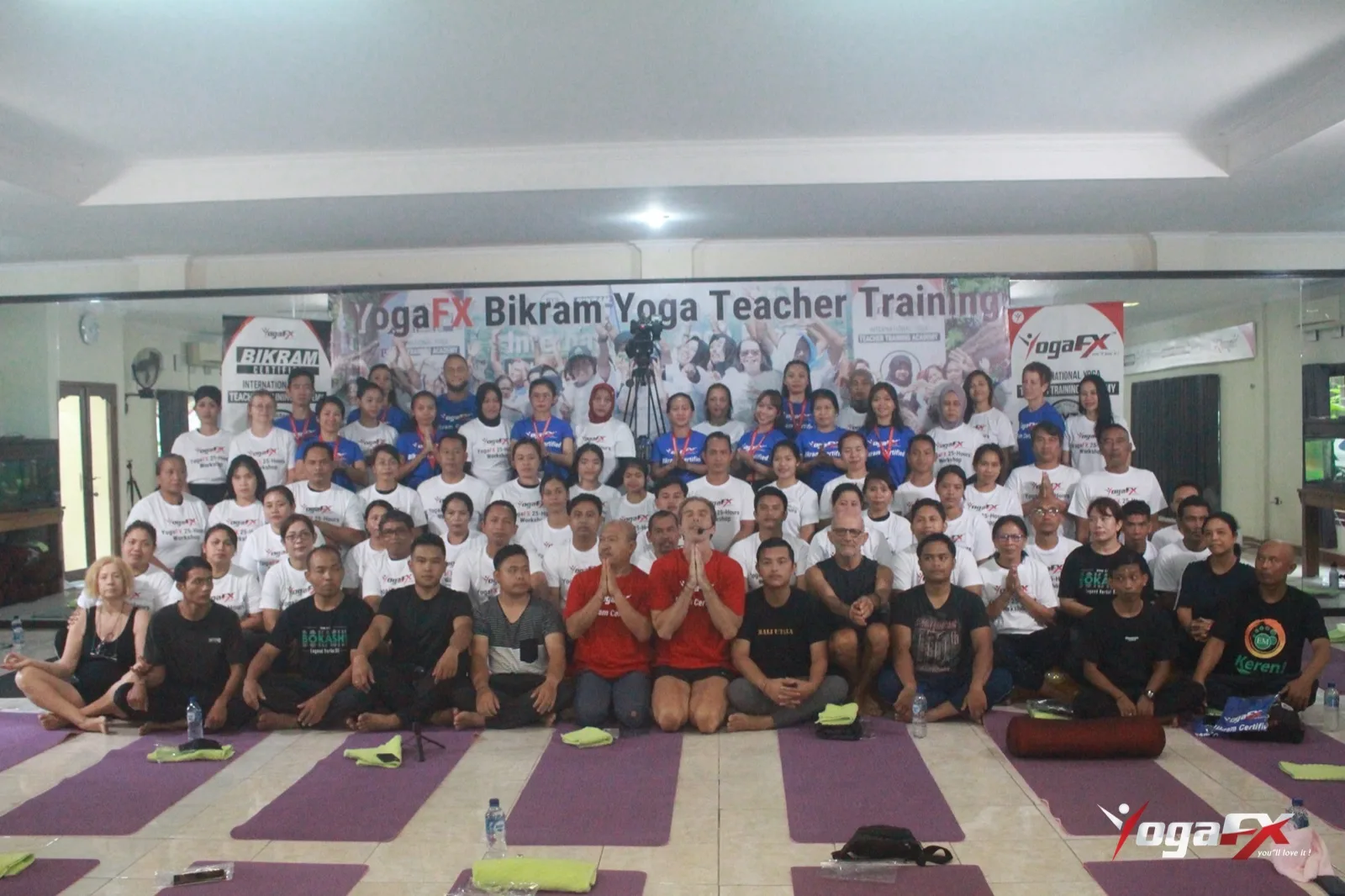
Every teacher meets the detox question in the first weeks. So our job at YogaFX is to make sure every trainee can answer does hot yoga sweat out toxins with evidence, not a slogan. Our lead trainer is Mr. Ian Terry, E-RYT 500, with more than 12,000 teaching hours. He trained for five years, from 2014 to 2019, with the founder of the Bikram Hot 26&2 method.
He answers does hot yoga sweat out toxins the same way every time, and he teaches trainees to do the same. He is also a Master Trainer for the Republic of Indonesia Yogasana Sports Federation. YogaFX began in 2017 and has graduated 1,500+ trainees from over 80 countries. That’s why Mr. Ian coaches trainees to explain the heat clearly and honestly, not to sell it.
Our 6-day hybrid format starts with an online pre-course, then an intensive in Bali. You can see the full day-by-day layout in our guide to the 6-day hybrid yoga teacher training in Bali.
The next batch runs from Sunday 24 January 2027 to Friday 29 January 2027, hosted by Soham Wellness Center in Seminyak. You earn the Yoga Alliance RYT 200-Hour certificate and the Bikram Hot 26&2 200-Hour International Yoga Certification. The Early Bird rate is US$1,899, and you can read how to apply when you are ready.
FAQ
Does hot yoga sweat out toxins, or is that a myth?
It is a myth. Sweat is mostly water and salt, and a 2019 review found its role in removing waste is minor compared with the kidneys and gut. Hot yoga still builds strength and calm. You can enjoy those benefits without believing in a cleanse.
Why do I sweat so much in hot yoga?
Sweating is your cooling system. When your body heats up from the room and the effort, your sweat glands release fluid onto your skin. As it evaporates, it carries heat away. How much you sweat varies by person, so drink water early and rest when you need to.
Can yoga cause detox symptoms?
Headache, dizziness or faintness after class are not proof of a detox. Mayo Clinic lists dizziness among the signs of dehydration, and hard exercise in the heat can cause heat injury. Cool down, sip water and rest. If the symptoms continue, please speak with a healthcare professional.
Does hot yoga detox your liver?
We found no good evidence that hot yoga does anything special for your liver. Your body already has a waste-handling system that works all day without a hot room. If you have liver, kidney or heart concerns, please consult a healthcare professional before you start a hot yoga routine.
What should a teacher say when students ask about sweating out toxins?
Keep it short and kind. Say that sweat cools the body, that the kidneys do the cleaning, and that feeling good comes from the work they did. Then ask how they feel. A check-in builds more trust than a slogan, and it keeps students safe in the heat.
Still have questions? Message Mr. Ian and the YogaFX team on WhatsApp and we will answer them personally.