















Hot yoga for depression has one well-run trial behind it, and a teacher’s job is still not to treat anything. In that 2023 study, roughly six in ten adults with depression who took heated classes for eight weeks saw their symptoms halve. This guide shows what that means for the student and for the teacher.
Depression is a medical condition. If you think you may have it, please talk to a healthcare professional. Nothing here replaces that conversation.

Hot Yoga for Depression: What the Trial Actually Found
Most pages about hot yoga for depression lead back to a single study. Researchers at Massachusetts General Hospital published it in the Journal of Clinical Psychiatry in October 2023. Harvard Health then summarised it in February 2024.
Here is what the trial did, as Harvard Health reports it:
- Who took part. 65 adults aged 18 to 60 with depression, some of them already taking antidepressants.
- What they did. At least two 90-minute hot yoga sessions a week for eight weeks, in a room heated to 105°F.
- What they were compared with. A waitlist group, who did the classes later.
- What happened. Symptoms eased by half or more for roughly six in ten people in the yoga group, against about 6% of the waitlist group.
What the trial cannot tell us
That gap is large, so it deserves attention. It is also a short trial with a small group, and it came with a clear limit. Harvard Health notes that the study did not look at whether hot yoga for depression works better than other types of yoga. That means the result speaks to heated yoga depression outcomes only in this one setting.
Harvard Health adds that the findings suggest hot yoga can be used alone or alongside medication. It also tells readers to talk to their doctor first, because the heat might pose risks for people with conditions such as heart problems. Both points matter, because they shape what a teacher can safely say.
So the honest summary of hot yoga and depression has two halves. The result is promising. It is also early, and it is not a treatment plan. If you want a longer look at the trial itself and a careful starter plan for students, our online sister site covers it in its guide to the same research.
What Exercise Research Adds, and What It Cannot Say
One trial is thin ground. That is why it helps to look at the wider research on exercise and low mood. A heated class is, among other things, ninety minutes of physical activity, so hot yoga for depression is a fair question for the exercise literature to answer.
What the Cochrane review found
The Cochrane review Exercise for depression, updated in January 2026, found that exercise may be moderately effective compared with no therapy for reducing symptoms of depression. It also reported probably little to no difference between exercise and psychological therapy, and possibly little to no difference between exercise and antidepressants. The reviewers add that this rests on a few small trials, and that the evidence about long-term effects is uncertain.
What other health bodies say
Other trusted health bodies say something similar, with the same care:
- NHS. The NHS says there is evidence that exercise can help depression, and that it is one of the main treatments for mild depression.
- Mayo Clinic. Mayo Clinic calls exercise a great way to ease symptoms of depression or anxiety, then adds that it does not replace talk therapy or medicines.
- NIMH. The US National Institute of Mental Health lists medication and talk therapy among the established treatments for depression.
Put these together and a pattern appears. Movement can be a useful part of a person’s life when they are low. Movement is not a substitute for care. A hot yoga teacher who understands that difference protects both the student and the studio.
No one has shown that the heat itself adds anything for mood. Researchers also have not shown why the trial group improved. A fixed routine, company, exercise and the heat all arrived together, so the study cannot separate them. That is why we keep our language plain about hot yoga for depression: the class may help some people feel better, and we do not claim more.
Where a Hot Yoga Teacher’s Role Stops
A yoga teacher is not a clinician. That scope of practice sounds obvious, yet it is the line that gets crossed most often, usually with good intentions. A teacher hears a student say they have been feeling low, and they want to help. Wanting to help is fine. Giving medical advice is not, and that is true even when the question is about hot yoga for depression.
The table below shows how we draw the line in practice. It covers five moments that come up in real studios.
| Moment in the studio | What a teacher can do | What a teacher never does | Who takes it from there |
|---|---|---|---|
| A student says they have been feeling low | Listen, say thank you for telling me, and keep the class as it is | Guess a diagnosis or a cause | The student’s doctor or therapist |
| A student asks if hot yoga for depression will work for them | Share what the research found, and where it stops | Promise or imply a result | The student’s doctor |
| A student says they plan to stop their medication | Suggest they speak to the person who prescribed it first | Give any advice about medication | The prescriber |
| A student looks overheated in class | Slow the pace, offer water, let them sit or lie down | Push them to stay in the posture | The teacher, then medical help if needed |
| A student talks about harming themselves | Stay calm, take it seriously and point to a crisis line | Handle it alone or promise to keep it secret | Crisis services and emergency help |
Why every row ends with someone else
Notice that every row ends with someone else, which is the point. A teacher is one part of a student’s support, not the whole of it. For example, a teacher who passes a question on tends to stay calmer, and as a result students trust them more.
The 5 Responses We Teach Trainees at YogaFX
Our trainees learn the posture sequence, the dialogue and the teaching skills. They also learn how to respond when a student brings something heavier into the room. These are the five habits we ask every trainee to practise, under the guidance of Mr. Ian Terry, E-RYT 500.

1. Listen first, and keep the class the class
Because most students who mention a low mood are not asking for advice, they want to be heard for a moment, then to get on with the class. So the first response is simple: listen, say thank you, and carry on, even when the chat turns to hot yoga for depression. The teacher does not turn the room into a counselling session.
2. Say what the research says, and say where it stops
When a student asks whether hot yoga for depression works, trainees give the short, honest version. One trial found a large effect over eight weeks. It was small, it was short, and it compared heated yoga with a waitlist, not with other treatments. That answer is accurate, so it keeps hope realistic.
3. Never touch diagnosis or medication
This one is firm. A teacher does not say what someone has, and does not say what someone should take or stop taking. If a student mentions medication, the answer is always the same: please speak to the person who prescribed it. Changes belong with a prescriber.
4. Ask students to check with their doctor first
Heat is a real demand on the body. Harvard Health advises talking to a doctor before trying hot yoga, because it might pose risks for people with conditions such as heart problems. Our trainees learn to pass that on kindly, without making anyone feel singled out.
5. Know the crisis line before you need it
If a student speaks about harming themselves, the teacher takes it seriously. In the United States, the 988 Suicide & Crisis Lifeline offers free and confidential support by call, text or chat, 24 hours a day. The NIMH page on depression points to the same number, 988. Outside the US, trainees learn to look up the local emergency number in advance.
None of these five responses needs a psychology degree. Instead, they need clear boundaries, a steady voice and the habit of passing the student on to the right person. That is what we practise in the training room.
How the Heat Changes the Teacher’s Job
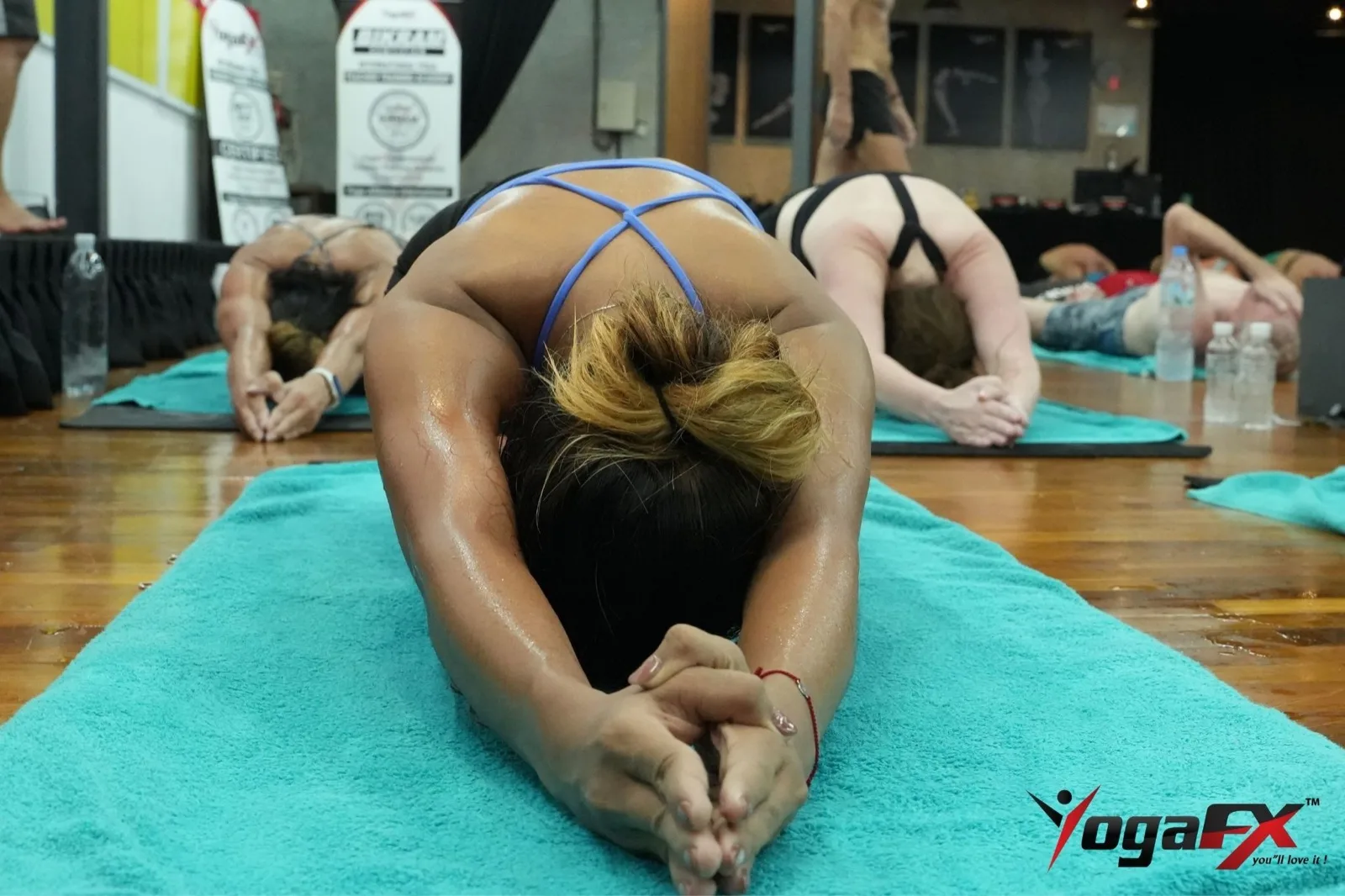
A heated room raises the stakes for a teacher, especially when students ask about hot yoga for depression. The class is not only a workout, so the person at the front has to watch the room as well as the clock.
At YogaFX, a class runs 90 minutes at about 40°C and 40% humidity, using the natural tropical heat of Bali rather than electric heaters. The trial room was 105°F, which is also close to 40°C.
The format is also quiet and predictable. The teacher follows a scripted dialogue, so there is no demonstration and no music. Students often tell us that knowing what comes next is what lets them walk in on a heavy day. We cannot prove that, and we do not present it as research. It is simply a pattern we hear, so we treat it as a story and not as proof.
Four habits for a heated room
Because the room is hot, trainees learn to do four things well:
- Read the room. Watch faces, breathing and posture, not only the clock.
- Offer rest early. Remind students they can sit or lie down at any time, and mean it.
- Keep language exact. Say what the posture does, not what it will fix.
- Pass the right things on. Heart, blood pressure, medication and mood questions go to a doctor.
The same thinking applies to other questions people bring to class. For example, many students ask whether the heat affects stress hormones, and we cover that in our guide to whether hot yoga increases cortisol. We also explain how teachers should talk about the trial itself in how teachers should explain the depression trial, and how to approach worry and nerves in our piece on hot yoga and anxiety.
What Trainees Say About Learning in the Heat
Trials give averages, and trainees give stories. The three quotes below come from YouTube reviews of our teacher training. They describe patience, effort and community. They are not evidence that hot yoga for depression works, and we share them only so you can hear how the training feels from the inside.
“I’ve learned a lot… the whole process has been amazing… thank you for your patience, thank you for believing in us.”
Katia, YouTube review, 2025
“It’s one of the most amazing things I’ve ever done and life-changing honestly… if you want to change your life and do something different, just come.”
A trainee in our YouTube review, 2023
“You guys are my new family and I truly mean this from the bottom of my heart.”
Sammi, YouTube review, 2023
Watch Katia’s full video review below. The common thread across all three is the group around them, which fits the idea of company that researchers mention. It still proves nothing on its own.
Reviews like these are one reason we are open about the numbers. Students have left 150 Google reviews, 50 Yoga Alliance reviews and 357 YouTube video testimonials for YogaFX. We read them to improve the training, not to make health claims.
Learning to Teach It at YogaFX in Bali
If the practice has become part of your life and you want to teach it responsibly, our training is built around that idea. Mr. Ian Terry, E-RYT 500, has more than 12,000 teaching hours. He trained for five years, from 2014 to 2019, with the founder of the Bikram Hot 26&2 method. Since 2017, YogaFX has trained more than 1,500 graduates from over 80 countries.
The programme is the Bikram Hot 26&2 Yoga Teacher Training MasterClass. It runs six days, with online study first and an intensive in Bali. Graduates earn a Yoga Alliance RYT 200-Hour certificate plus the Bikram Hot 26&2 200-Hour International Yoga Certification. You can read the full breakdown on our Bikram yoga instructor course page, or compare it with other options in our guide to hot yoga certifications.
- Next batch. Check-in Sunday 24 January 2027, check-out Friday 29 January 2027, at Soham Wellness Center in Seminyak.
- Price. The Early Bird price of US$1,899 (normally US$1,999) runs until 19 November 2026. Payment plans start from US$250 a month.
- What you learn. The 26 postures and 2 breathing exercises, the dialogue, and how to teach safely and within your scope.
Training does not make anyone a therapist, and we say so on day one. Instead, it teaches you to answer questions about hot yoga for depression with care. It makes you a teacher who knows the limits of the job and who can pass a student on kindly. For many people that is the most valuable skill in the room.
FAQ
Does hot yoga help with depression?
Hot yoga for depression may help some adults. In a 2023 Massachusetts General Hospital trial, roughly six in ten people with depression who took heated classes for eight weeks saw symptoms halve, against about 6% on a waitlist. It is early evidence from one main study, so treat it as an addition to care.
Can a yoga teacher treat depression?
No. A yoga teacher is not a clinician and should not diagnose, treat or advise on medication. A teacher can offer a calm, structured class, listen kindly, share what research says with its limits, and point students towards their doctor, therapist or a crisis line when they need more.
What should a teacher say if a student feels low?
Keep it simple and kind. Listen, say thank you for telling me, and offer the class as it is. Do not guess a cause or promise a result. Suggest they speak to their doctor or therapist, and if they mention harming themselves, point them to a crisis line straight away.
Who should check with a doctor before hot yoga?
Harvard Health advises talking to your doctor before trying hot yoga, as the heat might pose risks for people with conditions such as heart problems. If you are unsure whether a heated class suits you, ask a doctor who knows your health history, and tell your teacher what your doctor advised.
Does exercise work as well as therapy or medication for depression?
A 2026 Cochrane review found little to no difference between exercise and psychological therapy or antidepressants, but it rests on a few small trials. Exercise may also help compared with no treatment. Mayo Clinic says exercise does not replace talk therapy or medicines, so treat it as one part of care.
Still have questions? Message Mr. Ian and the YogaFX team on WhatsApp and we will answer them personally.
This article on hot yoga for depression is general information, not medical advice. If you think you may have depression, please consult a healthcare professional. If you are in crisis in the US, call or text 988.