












“Online yoga course” means two completely different products, and buying the wrong one is the most common mistake in this category. One is a class subscription: you follow along, you get fitter, nothing is certified. The other is teacher training: you learn a method well enough to lead a room, and it ends in a credential. They cost different amounts, take different time, and suit different people.
Work out which one you actually want first. Everything else follows from that.
The Two Categories, Side by Side
| Practice course / class subscription | Teacher training course | |
|---|---|---|
| What you are buying | Classes to follow along with | A method, plus how to teach it |
| Typical cost | Free to roughly USD 20 a month | Several hundred to several thousand |
| Ends in a credential? | No | Yes, if the school is Yoga Alliance registered |
| Who it suits | Anyone wanting a home practice | People who want to lead classes, or to understand a method properly |
| Time commitment | As little as 20 minutes a day | 200 hours of structured study |
There is a third group worth naming, because it is larger than most providers admit: people who do not want to teach at all, but want to understand what they have been doing in class for years. Teacher training serves them well. You are allowed to take a teacher training purely to deepen your own practice, and plenty of people do.
If You Want to Practise: Start Free
Do not pay for a practice subscription before you have worked out what style you respond to. There is enough free material to establish that, and switching style after you have paid for a year is an avoidable waste.
One practical filter when judging any free or paid class video: close your eyes for thirty seconds. If you are lost without watching the screen, the teacher is relying on demonstration rather than instruction, which tells you something about how well they would teach you in a real room. A collection of full unedited classes to test this on is in best free online yoga videos.
If heat interests you, the thing to understand about the Hot 26&2 format is that it never changes. The same 26 postures and 2 breathing exercises, the same order, every class, taught from a scripted verbal dialogue in a room around 40 degrees Celsius. For a home practice that consistency is unusually useful, because progress is measurable against a fixed benchmark rather than against a different class each week.
If You Want to Teach: What Changes
The moment teaching enters the picture, three things start to matter that are irrelevant for a practice subscription.
- Whether the school is a Registered Yoga School. Only an RYS 200 can issue training that leads to Yoga Alliance RYT 200 registration. A practice platform calling its programme a “certification” is not the same thing, and the gap between an online yoga certificate and a Yoga Alliance certification is worth understanding before you pay. The mechanics are set out in how online Yoga Alliance certification actually works.
- Whether the style suits distance learning. Styles built on improvised sequencing need live feedback that a recorded module cannot give. Fixed-sequence, scripted methods do not, because the skill is rehearsal rather than judgment.
- Whether there is a route into a live room. No online course can teach you to hold your voice for 90 minutes in a heated room while tracking 25 bodies. A provider with no in-person pathway is selling you half a journey.
The full vetting checklist is in online yoga teacher training: what to check before you pay.
The YogaFX Option, and Who It Is Not For
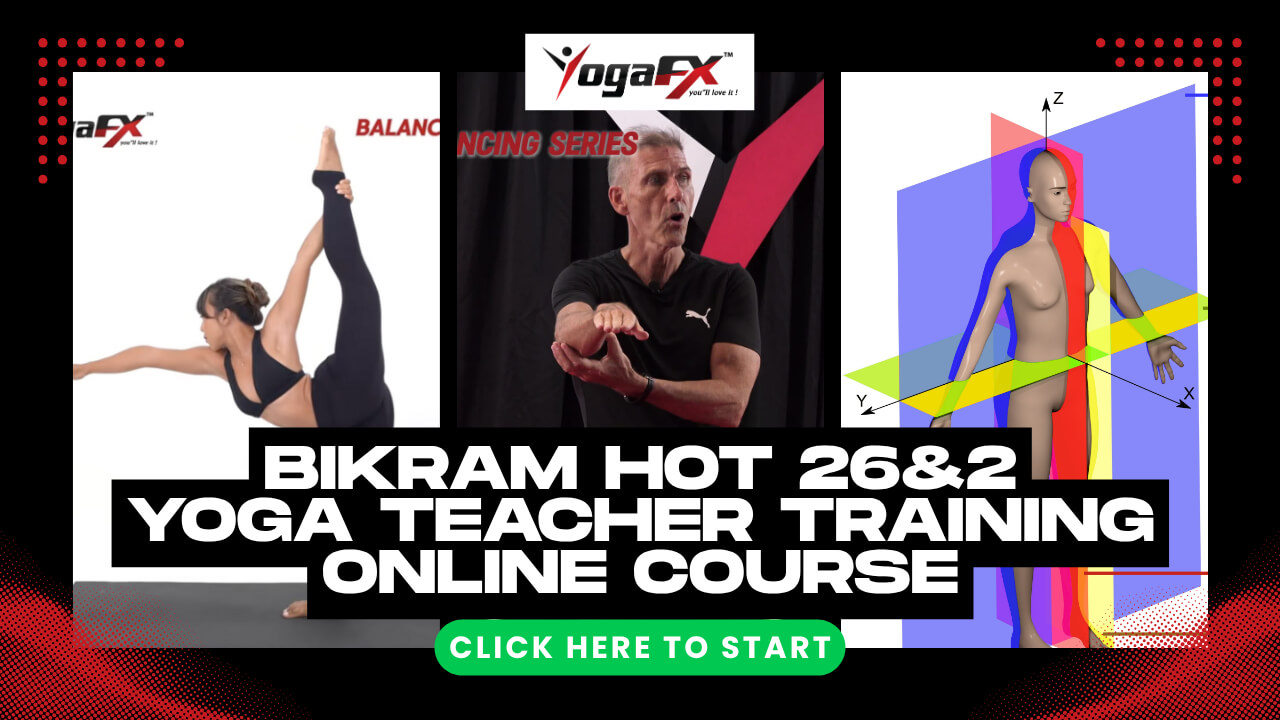
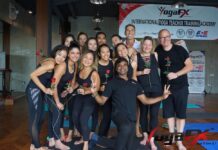
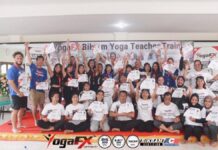
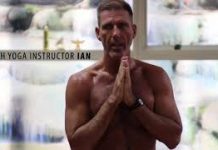
YogaFX does not sell a practice subscription. It runs a teacher training in one method, the original Hot 26&2, from Seminyak and Canggu, Bali. The curriculum was built by Mr. Ian Terry, E-RYT 500, who trained for five years, from 2014 to 2019, directly with Bikram Choudhury, the founder of the Bikram Hot 26&2 method, has logged more than 12,000 hours of practical teacher training, and has certified over 1,500 graduates from more than 80 countries. In June 2026 he was appointed Master Trainer of the Republic of Indonesia Yogasana Sports Federation.
The online course is USD 329, or 4 interest-free payments of USD 82: the complete dialogue as workbook and MP3, full posture demonstrations with World Champion Miss Ivara, 15 premium lectures with assessments, a 250-page manual, and lifetime access. No Zoom calls, no deadlines. Your fee is credited in full against the 6-day Bali MasterClass if you add it later, and you can preview the course free first.
Being clear about who this is wrong for: if you want a library of varied classes to follow along with at home, a general practice subscription will serve you better and cost a fraction of this. The online course is for people who want to understand one method to teaching depth, whether or not they end up teaching it.
FAQ
What is the difference between an online yoga course and online yoga classes?
Online yoga classes are sessions you follow along with to build a practice, usually sold as a subscription with no credential. An online yoga course in the teacher training sense teaches you a method and how to lead it, runs around 200 hours, and can lead to Yoga Alliance registration.
Can I take a teacher training course without wanting to teach?
Yes, and many people do. Teacher training explains why the postures are ordered as they are, what each one is working, and how to stay safe in heat. Plenty of graduates never teach professionally and still consider it the thing that changed their practice.
How much should an online yoga course cost?
Practice subscriptions run from free to roughly USD 20 a month. Teacher training runs from a few hundred to several thousand dollars. Compare what is included rather than the headline figure: lifetime access, full method material, manuals, and whether first-year Yoga Alliance registration is covered.
Do I need experience before starting an online yoga course?
For a practice subscription, none at all. For teacher training, reputable schools set no audition, flexibility requirement, or minimum years of practice, because the curriculum is designed to build competence from foundations rather than reward people who already look advanced.
