















Does hot yoga improve VO2 max? It can, but the hot yoga VO2 max evidence is small and early. In a 2021 trial, 12 heated sessions over four weeks raised VO2 max in the heated group, while a single hot class showed no aerobic gain. For teachers, that means promising, not proven. Here is how we explain it at YogaFX.
Mr. Ian Terry is our founder and an E-RYT 500 with more than 12,000 teaching hours. This guide reads the published trials the way we teach trainees to read them, then turns the findings into words you can safely use in a hot room. It isn’t medical advice. Please consult a healthcare professional before you start hot yoga, especially with a heart condition, high blood pressure or regular medication.

Does Hot Yoga Improve VO2 Max? The Short Answer for Teachers
Trainees ask about hot yoga VO2 max in week one, usually because they run, cycle or wear a fitness watch. They want to know whether a hot class can raise the ceiling of their fitness, or whether it only makes them sweat. The honest answer has two parts, and a teacher should be able to say both.
A block of heated classes may raise VO2 max. That is what one small randomised trial found. A single hot class doesn’t. A second study found that the oxygen cost of one class was about the same in the heat and in a cooler room. So does hot yoga improve VO2 max? Over several weeks, possibly. In one afternoon, no.
That is the whole story of hot yoga VO2 max research so far. The rest of this guide unpacks it.
- For a four-week block: one trial saw a rise in the heated group only, though the gap between the two groups wasn’t significant.
- For one class: oxygen use stayed near 9 millilitres per kilogram per minute, about the same as in a cooler room.
- For a teacher: say what the trials support, and attach the sample size every time.
What VO2 Max Measures, and Why Teachers Should Care
VO2 max is the most oxygen your body can use during hard exercise. Harvard Health describes it as a measure of how much oxygen your body consumes while exercising, usually given in millilitres per kilogram per minute. A higher number tends to go with better fitness and a lower cardiovascular risk.
The accurate test happens in a lab. You run or ride while wearing a mask, and the effort ramps up until you can’t go further. Harvard says that test takes roughly 10 to 20 minutes. A watch only estimates the number, so a student who quotes a watch score after class has a rough guide, not a lab result.
Why a Teacher Cares About a Fitness Number
You are not training to win a fitness test. You are training to stand in a heated room for 90 minutes, speak the dialogue clearly and watch a full room of faces. That takes aerobic fitness, but it also takes heat tolerance and calm breathing. A hot yoga VO2 max score captures only the first.
Harvard also notes that, other than athletes, most people don’t need to know their exact number. It adds that your activity level is the factor you can control most easily, which is why hot yoga VO2 max talk should always sit beside the rest of your week. That fits how we coach: build steady habits first, then look at the numbers.
What the 2021 Hot Yoga VO2 Max Trial Found After Four Weeks
Most hot yoga VO2 max claims trace back to one randomised trial in the International Journal of Yoga by Bourbeau and colleagues. Here is what a trainee teacher should know about it.
Who Took Part and What They Did
Twenty-two adults with no yoga experience joined: 11 men and 11 women, with an average age of 26. One group practised in a heated room at roughly 40°C. The other practised at 18 to 22°C. Both followed the same modified Bikram video, 75 minutes long, three times a week for four weeks.
What Changed in the Heated Group
In the heated group, VO2 max rose from 3.22 to 3.46 litres per minute, and the authors reported that change as significant. In the cooler group it moved from 3.00 to 3.05, which was not significant. By our arithmetic, the heated group gained roughly 7%.
A heat-shock protein called HSP70 also rose in the blood cells of the heated group only. The authors concluded that 12 sessions “promoted cardiovascular fitness and cellular thermotolerance adaptations.” That is a careful finding about two markers, not a promise about your next class. Hot yoga VO2 max gains, in this trial, belong to a small group of beginners.
What Did Not Change
Two details keep this result honest. First, the paper reports that no differences were detected between the groups, so it can’t say the heat did better than a cool room. Second, a heat tolerance test after the programme showed no classic adaptation to heat stress, which the authors say 12 sessions did not produce.
The authors also name limits. The sample was small, the sessions were shorter than a typical 90-minute class, and they didn’t measure plasma volume, which they suggest could play a part in the VO2 max change. So treat the hot yoga VO2 max result as a reason to look closer.
If you want to see both trials set side by side, our sister site offers a fuller trial-by-trial review with its own table of the numbers.
What One Hot Class Does, and Doesn’t, Do for Aerobic Fitness
A 2020 crossover study in the International Journal of Exercise Science by Lambert and colleagues looked at a single class. Sixteen experienced practitioners (14 women and 2 men, average age 40) did a one-hour Bikram sequence twice, once at 105°F and once at 74°F, with at least 96 hours between sessions.
Average oxygen use was 8.9 millilitres per kilogram per minute in the heat and 8.6 in the cooler room, and the authors reported no significant difference. Heart rate averaged 113 against 109 beats per minute. Energy use was 156 against 151 kilocalories.
The group’s baseline VO2 max averaged 36.9, so one class used roughly a quarter of it. That ratio is our own arithmetic, not a figure from the paper. It explains why the authors concluded that heated yoga “does not significantly elevate aerobic energy cost” compared with the same class in a cooler room.
The heat did change two other things. Fat use was higher in the hot room, at 0.09 grams per minute against 0.05, and hip abduction range grew more, by 6.6 degrees against 2.3. Those are acute effects in one session. They don’t show weight loss or a lasting change in flexibility.
A 2025 systematic review of 43 studies with 942 participants (Willmott et al.) covers the wider hot yoga evidence. We name it without a link because the page blocked our automated check, and we take no numbers from it.
Hot Yoga VO2 Max Claims a Teacher Can Back
Students repeat what they have read online about hot yoga VO2 max. A good teacher answers without overreaching, and without dismissing the question. Table 1 matches five common claims to what the two trials support, with a phrase you can use.
| What a student says | What the trials support | What a teacher can say |
|---|---|---|
| “Hot yoga raised my fitness score.” | One small 4-week trial (22 adults) saw VO2 max rise in the heated group. The cooler group didn’t change significantly, but the groups didn’t differ significantly either. | “One small trial saw a rise after four weeks of heated classes. It is promising, not proven.” |
| “One class is a full cardio session.” | In one hour, oxygen use was 8.9 in heat and 8.6 in a cooler room (ml/kg/min), with no significant difference. | “A class is a steady, moderate effort. Build your aerobic work around it.” |
| “The heat makes my heart work much harder.” | Heart rate averaged 113 against 109 beats per minute in the one-hour study, with no significant difference. | “Heat changes how effort feels. Watch your breath, not just the clock.” |
| “Heat makes me burn more fat.” | Fat use was higher in the hot room (0.09 against 0.05 g/min) in one session. | “One study saw more fat use in a single hot class. That isn’t the same as weight loss.” |
| “Hot yoga adapts me to the heat.” | After 12 sessions, a heat tolerance test showed no classic heat adaptation, though a heat-shock protein rose. | “Cells showed a response, but the body didn’t show classic heat adaptation.” |
How to Use These Phrases
These phrases are teaching shorthand, not medical advice. They work because each one carries its own limit. A student who hears “promising, not proven” learns to read research, and that habit lasts longer than any one claim.
The Hot Room Behind the Numbers
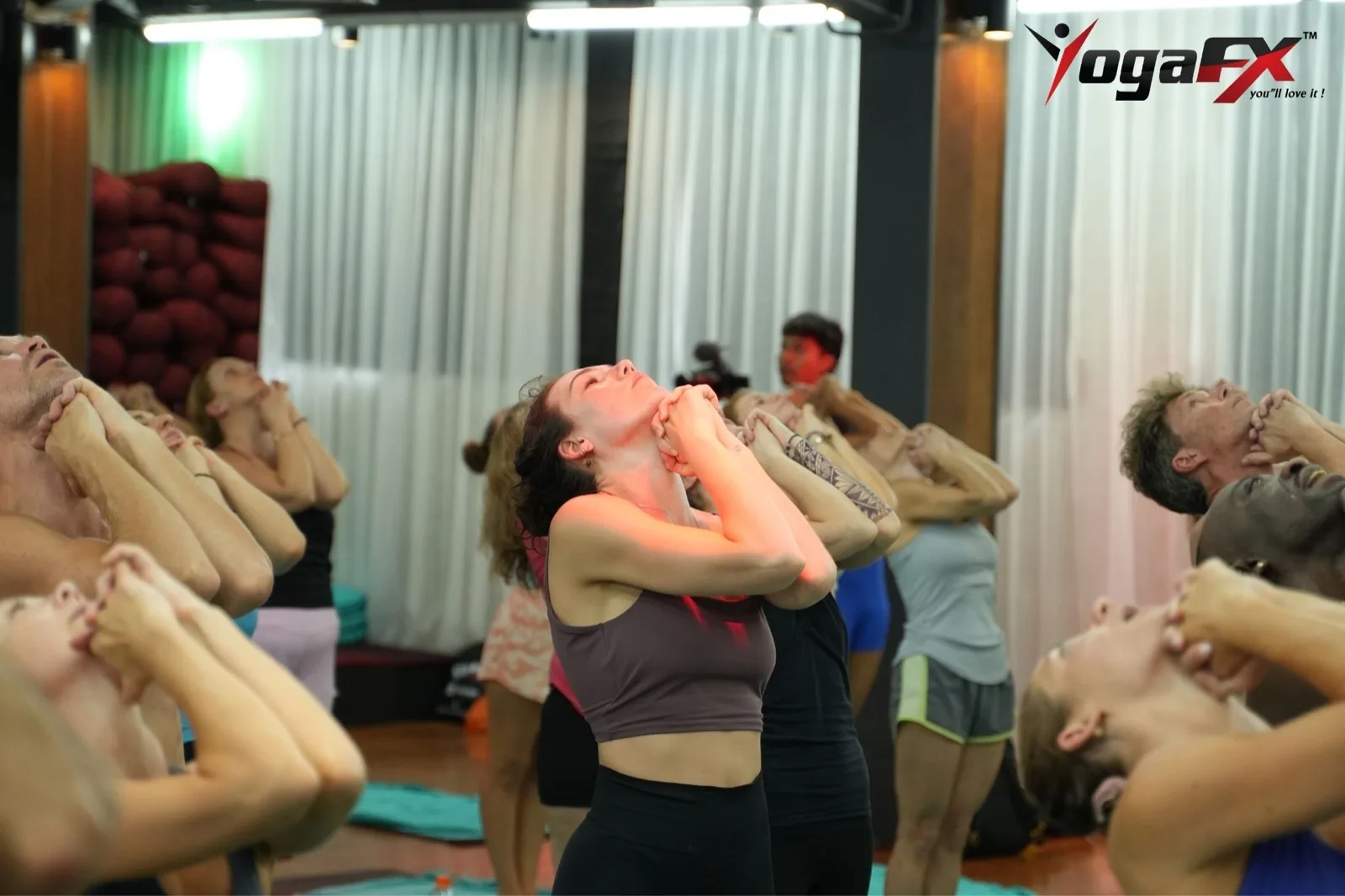
A research chamber and a teaching room are different places. Here is the room our trainees work in, in six figures.
Hot Yoga VO2 Max Versus Other Training: What Fits a Week?
The trials don’t compare hot yoga with running, cycling or intervals, so they can’t rank one above another. Harvard Health says any aerobic exercise that gets your heart pumping helps, and that “the more vigorous, the better.” For people who are already active, it suggests interval sessions several times a week, mixed with slower, longer activity.
So the practical question about hot yoga VO2 max is not “hot yoga or running?” It is how to fit a hot class into a week that already builds aerobic fitness. These habits work well for most healthy adults:
- Keep your aerobic work outside the room. A hot class is a steady effort, so a brisk walk, ride or run adds a different load.
- Use class days for skill. Balance, breath and posture need attention that a hard session would steal.
- Separate your hardest days from hot days. A tired, dehydrated body struggles in the heat.
- Drink early. Start before class, sip during it and replace fluid afterwards.
If you want to go deeper on this, read our guide on whether hot yoga is a cardio workout. Runners can also see how the two fit together in hot yoga for runners.
How Trainees Build Fitness for the Hot Room at YogaFX
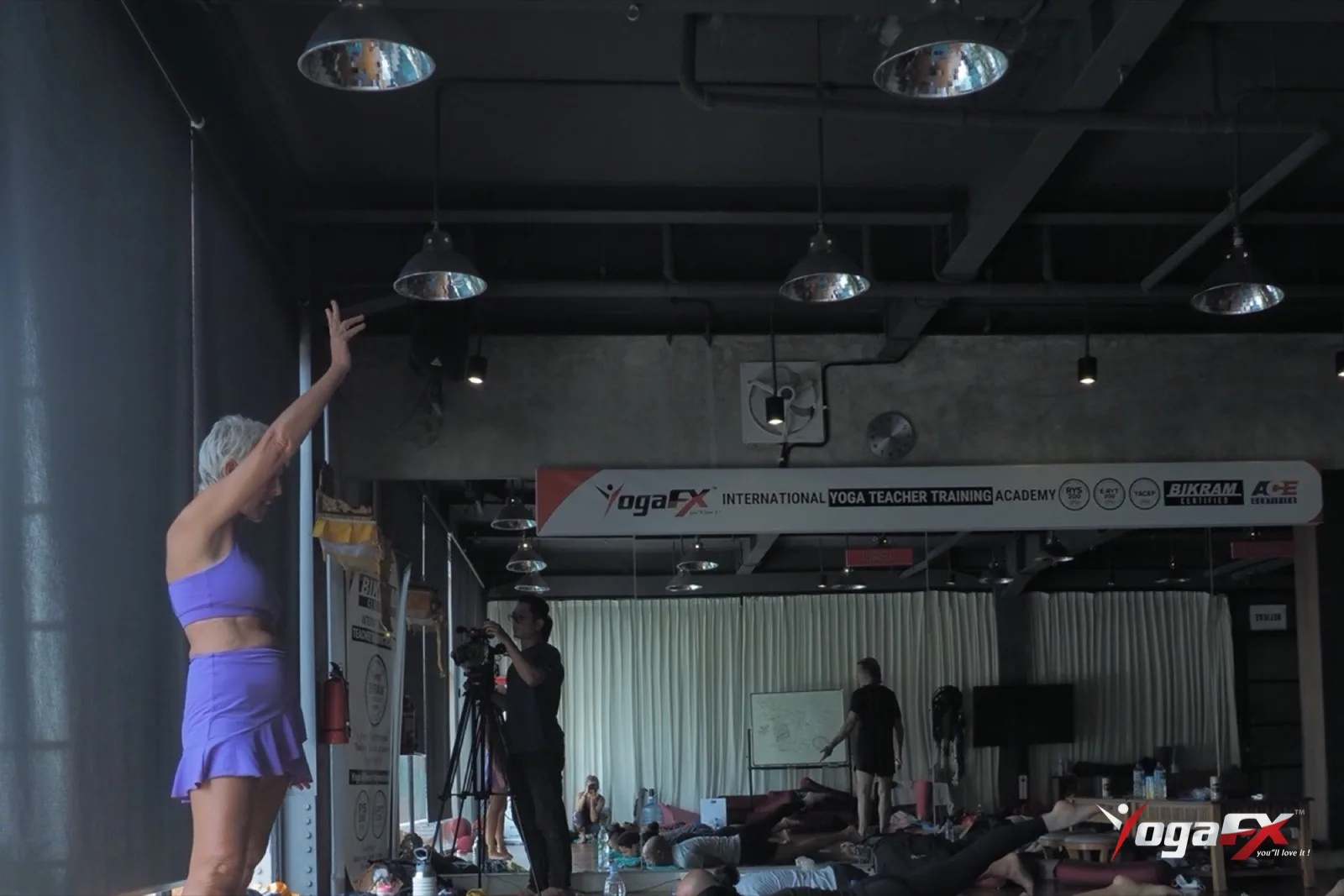
Teaching in heat is a skill you build, not a gift you are born with. Our classes run at about 40°C and 40% humidity for 90 minutes, using natural tropical heat in Bali rather than electric heaters. Trainees first learn to pace themselves as students, then learn to read a room as teachers.
Mr. Ian Terry spent five years, from 2014 to 2019, training alongside the founder of the Bikram Hot 26&2 method. He also holds the title of Master Trainer from the Republic of Indonesia Yogasana Sports Federation. His view of hot yoga VO2 max is practical, and what he asks of trainees is simple: arrive rested, drink early, and treat rest as part of the method.
- Pace first. A trainee who rushes the early postures has nothing left for the last ones.
- Breathe through the nose. Held breath is the most common beginner error in standing postures.
- Learn the warning signs. Flushed skin, slow replies and shaking tell you a student needs to sit.
- Rest without guilt. A teacher who models rest gives the room permission to rest.
For more on heat safety, read whether hot yoga is good for your heart. Teachers who want to coach athletes can start with coaching sports teams with a 26&2 certificate.
What Trainees Say About Training in the Heat
Reviews don’t prove a hot yoga VO2 max gain. They show how the training felt to the people who did it. One trainee thanked Mr. Ian in a short review video:
“Thank you Mr Ian, you make my dream come true, a yoga teacher. You have big heart, your kindness … thank you, thank you.”
A trainee in our YouTube review, 2024
Another trainee spoke about starting later in life and how much the course gave back:
“You’re never too old to learn… you’re never too old to do anything… I learned so much, improved my yoga.” (lightly trimmed from the video)
A trainee in our YouTube review, 2023
Saul thanked the team in Indonesian, and we have translated his words:
“Thank you for the hot yoga… very good teacher, very nice.” (translated from Indonesian, lightly trimmed)
Saul, YouTube review, 2024
None of these reviews is a clinical result. They are first-hand accounts of what it feels like to learn in a hot room with a teacher who cares.
Who Should Check With a Doctor First
Heat adds load to the heart, so a conversation with a doctor should come before the first class, not during it. Please consult a healthcare professional before you start if any of these apply:
- A heart condition, high blood pressure or a history of heart problems.
- Diabetes, kidney problems or a history of heat illness.
- Medicines that affect fluid balance, heart rate or temperature control.
- Pregnancy, a recent illness or a recent injury.
Stop and sit down if you feel dizzy, nauseous, confused or unusually breathless. Cool down, sip water and seek medical advice before you return. A student who lives with a health condition can still train, but the plan should come from their doctor.
Train to Teach Hot Yoga With YogaFX in Bali
YogaFX teaches this in a 6-day hybrid course. You study online first, then complete an intensive in Bali. The course is the Bikram Hot 26&2 Yoga Teacher Training MasterClass, led by Mr. Ian Terry. Since 2017, we have trained more than 1,500 graduates from 80+ countries.
- Certification: Yoga Alliance RYT 200-Hour plus the Bikram Hot 26&2 200-Hour International Yoga Certification.
- Next batch: check-in Sunday 24 January 2027 and check-out Friday 29 January 2027 at Soham Wellness Center in Seminyak.
- Price: Early Bird US$1,899 (normally US$1,999), with payments from US$250 a month and no interest.
- Try a class first: your first class at our Seminyak studio is free with the Free 1-Day Guest Pass.
See how the days are laid out in our guide to the 6-day hybrid yoga teacher training in Bali.
FAQ
Does yoga increase VO2 max?
It might, but the evidence is thin. The one randomised trial we opened found a rise in VO2 max after four weeks of heated yoga, and no significant change in the cooler group. The groups didn’t differ significantly, so more and larger studies are needed before anyone claims a firm effect.
Is hot yoga good for runners?
It can support a runner, but it doesn’t replace running. One hot class used about the same oxygen as a cooler class in a 2020 study. Runners tend to use it for balance, hip range and recovery, and keep their aerobic training outside the hot room.
How often would I need to practise to see a change?
Nobody can promise a number. The 2021 trial used three sessions a week for four weeks, which was a research design, not a prescription. Start gently, build up slowly, and speak to a doctor first if you have any health concern.
Can heat affect VO2 max?
Heat changes how hard exercise feels, but one hour of heated yoga did not raise oxygen use significantly in a 2020 study. Over four weeks, one small trial saw VO2 max rise in a heated group. Neither result shows that heat alone does the work.
Do hot yoga teachers need a high VO2 max?
No fitness score is required to teach. A teacher needs steady stamina, heat tolerance and calm breathing, and the skill to watch a full room. Most trainees build these through regular practice, rest and hydration rather than by chasing a number from a watch.
Still have questions? Message Mr. Ian and the YogaFX team on WhatsApp, and we will answer them personally. Ask about the Bali training, your first hot class or how we teach safe pacing. Chat with us on WhatsApp any time.