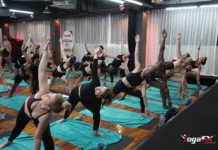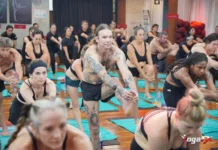



Proprioception exercises train your sense of where your body is without looking. In a Hot 26&2 class, that sense is tested by postures where the mirror cannot help: wrapped arms in Eagle, a hidden kicking leg in Balancing Stick and an unseen spine in Camel. Here is how the 26 and 2 trains it.
Proprioception Exercises Start With What You Cannot See
Proprioception is your body’s ability to sense its own position and movements. Cleveland Clinic describes it as an automatic, subconscious process that lets your brain know where your body is without relying on sight alone. You use it when you reach for a light switch in the dark or step off a kerb without checking your feet.
Most of the time you never notice it, and that’s the point. Proprioception exercises turn the quiet signals up, so you can feel a knee drifting inward or a hip tilting before it becomes a wobble or a strain.
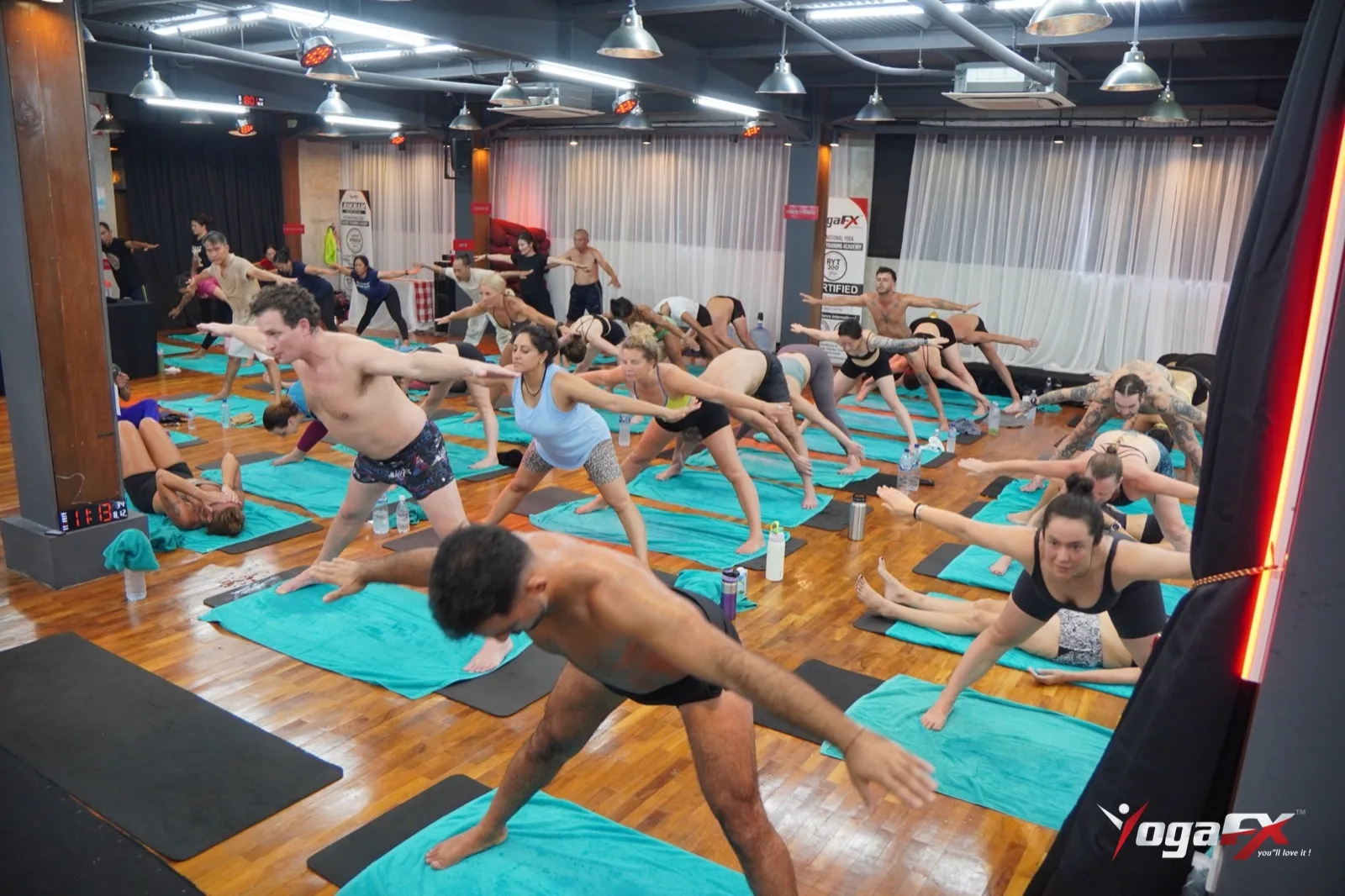
The Hot 26&2 sequence suits this kind of work for a simple reason. It has 26 postures and 2 breathing exercises, in the same order, in every class. When nothing changes, a trainee can stop asking what comes next and start asking what each joint is doing. Our definitive guide to Hot 26 and 2 yoga covers the whole method. This article follows just one thread of it.
Proprioception is not the same as flexibility
A student can fold flat and still wobble on one leg. Flexibility measures how far a muscle can lengthen. Proprioception measures how well the nervous system tracks a joint while it moves. They are separate skills, and the 26 and 2 asks for both.
That’s why a stiff trainee and a very bendy one often struggle in the same posture, for opposite reasons. One cannot reach the shape. The other reaches it and cannot tell where the hips ended up.
The senses behind the skill
Cleveland Clinic describes several parts working together:
- Receptors in the skin, muscles, ligaments and tendons that pick up touch, pressure, stretch and motion.
- The brain, mainly the cerebellum, brainstem and sensory cortex, which receives those reports.
- The inner ear, which adds its own balance signals.
- The eyes, which help, although the page notes that you can have effective proprioception without vision.
Harvard Health makes a related point about balance in general. Your eyes and brain process information about your surroundings while your feet detect changes in the terrain. Its article on the act of balancing adds that our sense of balance depends on attention to detail and short-term memory. Attention, in other words, is part of the equipment.
From Mirror to Feel: How Trainees Learn to Trust Their Own Position Sense
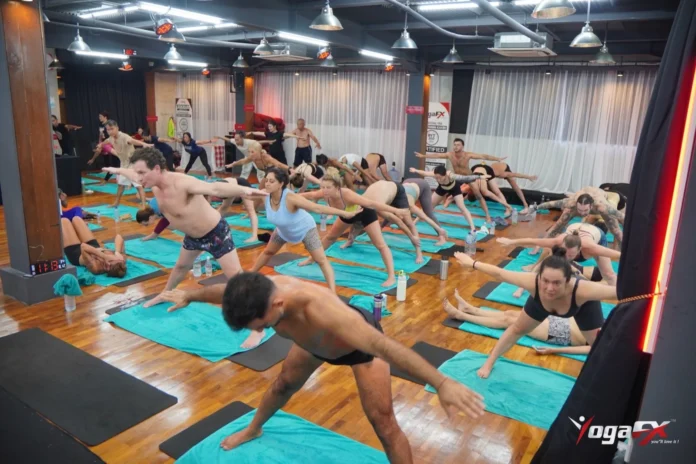
In the standing series, students use the mirror as a fixed visual reference. That helps focus, body awareness and alignment, and it is a sensible place to begin. Almost everyone checks the mirror first, because they want to see whether the knee is where they think it is.
Over the six days of the training, the question changes. A new trainee asks whether a posture looks right. A more experienced one asks whether it feels right. That shift from outside to inside is what proprioception exercises train, and a future teacher needs it before she can cue anyone else.
The dialogue is the only guide
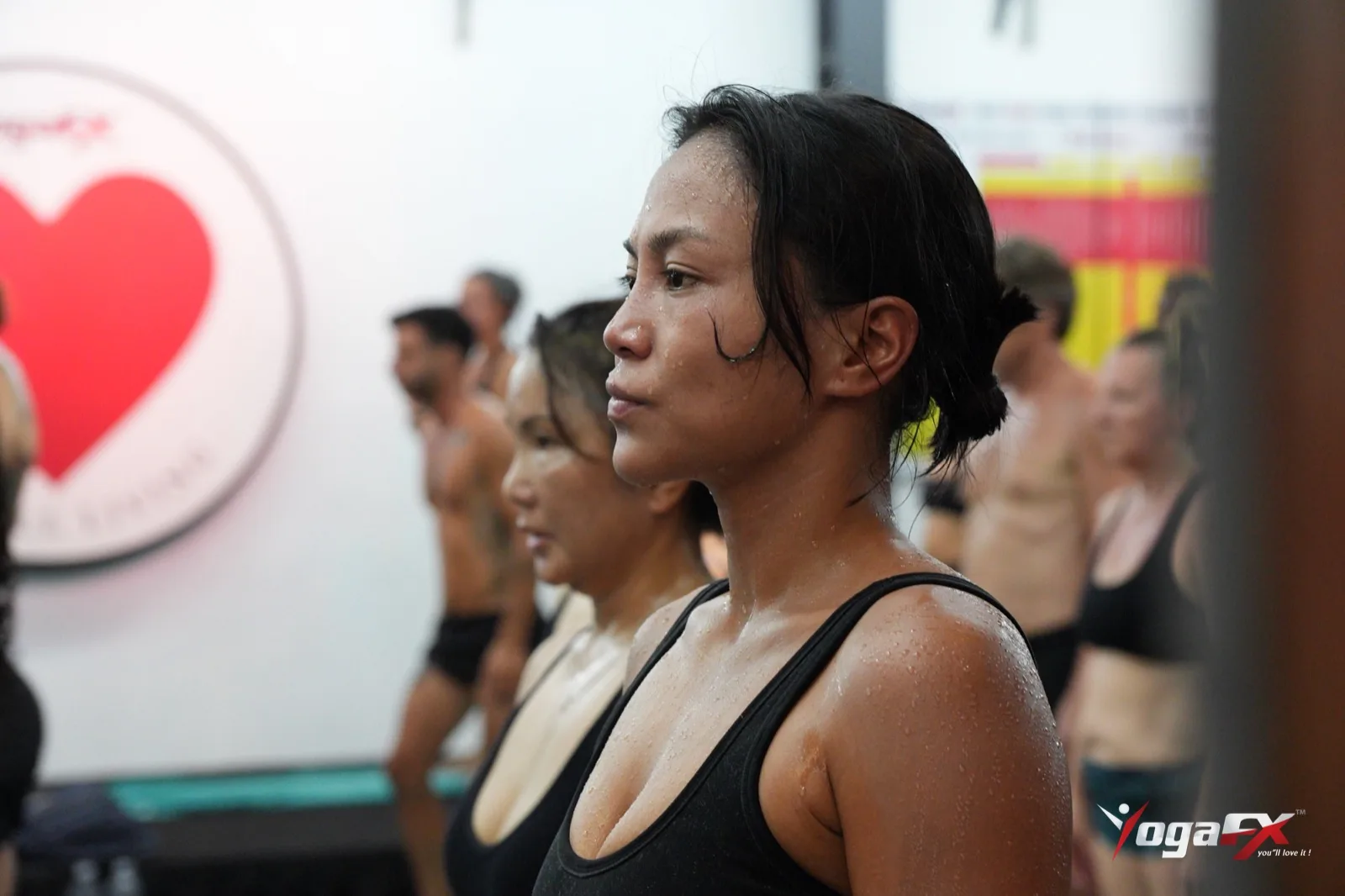
The class format pushes in the same direction. There is no music and no demonstration, so the scripted dialogue is the only guide to the proprioception exercises in the room. A cue such as locking the knee has to become a muscle action you can feel, not a picture you copy from the person in front of you.
Four stages from watching to cueing
Here is the path a trainee tends to follow.
None of these stages is a test, so don’t worry about moving through them in order. Trainees can move back and forth between them within a single class. A tired Tuesday can send you straight back to stage one, and that’s normal.
Five Postures Where Proprioception Exercises Hide in Plain Sight
Every posture in the sequence works as one of the proprioception exercises, in its own way. These five ask for it loudly, because each one hides part of your body from your own eyes. The table lists what you cannot see, what the body has to track instead, and a cue to practise with.
| Posture | What you cannot see | What the body must track | Cue to practise |
|---|---|---|---|
| Eagle (Garurasana) | Wrapped arms and crossed legs | Elbows, wrists and the standing ankle under a crossed stack | Sit lower and keep your weight over the standing foot |
| Balancing Stick (Tuladandasana) | The kicking leg and the tilt of the pelvis | A level pelvis and one straight line from fingertips to toes | Reach forward and keep the hips square |
| Triangle (Trikanasana) | The back foot and the turn of the spine | Weight split across a wide stance, plus the rotation of the chest | Press through the back heel and turn the chest open |
| Camel (Ustrasana) | Your own spine and neck | Where the weight sits on the thighs as the back bends | Press the hips forward before the head goes back |
| Locust (Salabhasana) | The legs and arms behind you | How the lower back and legs lift together while you lie face down | Lift from the lower back and legs as one unit |
How to read the table
Treat the table of proprioception exercises as a map, not a checklist. You won’t feel all five skills in one class. Some weeks Eagle teaches you about the ankle, and the next week Balancing Stick shows you that the hips have been doing the work all along.
Eagle: the stack you cannot check
In Eagle the arms and legs cross in opposite directions while you hold your balance and your alignment. That asks for bilateral coordination and cross-body control. As one of the proprioception exercises in the standing series, Eagle hides your own elbows and ankles, so the standing foot becomes the main source of information. As a result, it’s easy to lean on the outer edge of that foot without noticing.
Balancing Stick: ten seconds, no looking back
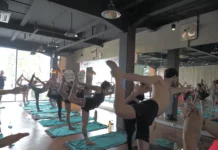
Balancing Stick takes the chest from upright to parallel with the floor in about ten seconds. The trailing leg and the reaching arms end up outside your view.
You can’t glance back to see whether the hips are tilting, so you have to feel for one straight line from the fingertips to the toes. It’s a short posture with a long list of corrections, which makes it one of the most demanding proprioception exercises in the class.
Camel: a bend with no mirror to check
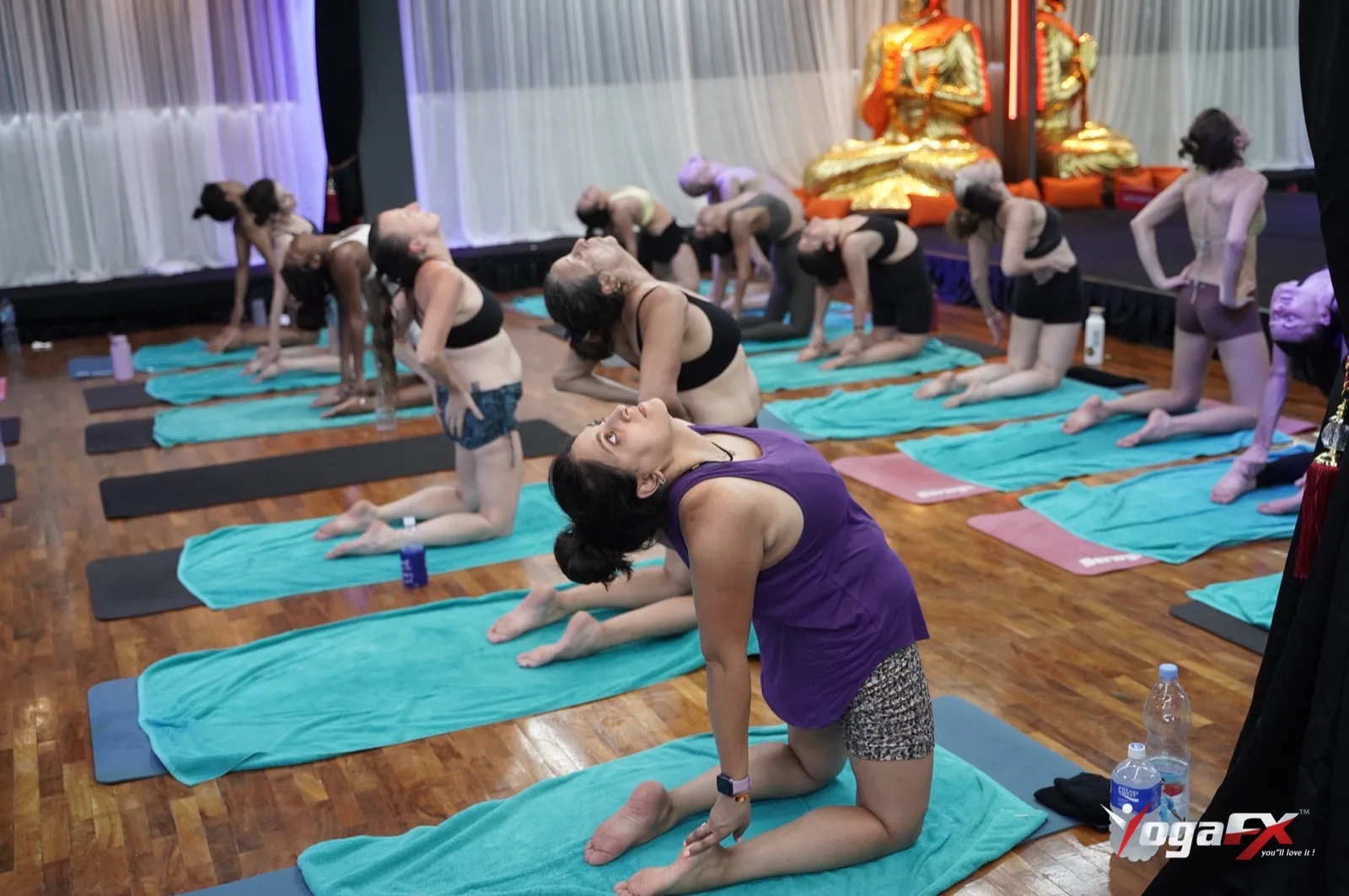
Camel is one of the proprioception exercises where it’s easiest to lose track of what your body is doing. The head goes back, the spine curves behind you and the thighs carry weight you cannot look at. A teacher can describe the shape. Only the student can feel whether the hips are forward.
An earlier test sits at the start of the standing series. Tree asks you to hold one leg steady, which is a calmer version of the same lesson. Our article on tree pose balance in the 26&2 looks at the concentration side of that posture.
What the Research Says About Proprioception Exercises
Balance practice helps, and attention matters
Harvard Health reports that doing more balance exercises and activities can keep your sense of balance in good shape. It also points out that no single exercise has been shown to be the best one, so variety is sensible. Cleveland Clinic says physical therapists can give you specific exercises to improve this sense, and the only examples it names are one-legged balance and walking in a straight line.
Notice how ordinary those examples are. Proprioception exercises don’t need equipment, only a small challenge, repeated often, with your attention on the feedback from your body. The same is true of the proprioception exercises in a 26 and 2 class.
The strongest trial evidence comes from sport
The best-known evidence for proprioception exercises comes from sports medicine, where the research calls it proprioceptive training.
A 2015 systematic review and meta-analysis by Schiftan, Ross and Hahne in the Journal of Science and Medicine in Sport pooled seven randomised trials with 3,726 participants. It found that proprioceptive training reduced the rate of ankle sprains in sporting populations, with a relative risk of 0.65. The authors also noted that the evidence for preventing a first sprain remains inconclusive.
That’s useful for proprioception exercises in general, and it has limits. Here is what we can and cannot say from it:
- We can say that regular, attentive balance and proprioception training has research support, mostly in athletes with a history of ankle sprains.
- We cannot say that a 90-minute hot class is a sprain-prevention programme. The trials tested dedicated training, and we know of no study that tested the 26 and 2 for this purpose.
- We can say that the 26 and 2 repeats postures that ask for the same skills, so it gives students a regular way to practise noticing where their body is.
This is general information, not medical advice. If you have an injured ankle, knee or back, or any condition that affects your balance, talk to a healthcare professional or physiotherapist before you start, and tell your teacher before class.
Six Proprioception Exercises Built From the 26 and 2 Postures
You don’t need a hot room to try these proprioception exercises. Stand next to a wall or a sturdy chair, wear non-slip footing and keep every hold comfortable. Several of the holds below follow the balance routine in the Harvard Health article, adapted to the postures in this guide.
1. The slow one-leg stand
Raise one foot six to twelve inches off the floor and hold for 20 to 30 seconds, then switch sides. Harvard Health describes this hold, and it is the plain version of Tree, the simplest of these proprioception exercises. Keep a fingertip on the wall at first and let your standing ankle do small, quiet corrections.
2. The eyes-closed hold
Once the one-leg stand feels steady, close your eyes for a few breaths with the wall within reach. Without sight, your joints and muscles have to report your position. Harvard Health lists eyes-closed practice among balance challenges. Expect more sway than usual, so open your eyes at once if you feel unsteady.
3. The squat and heel raise
Sit back into a chair-height squat as far as is comfortable, then rise and lift both heels. Harvard Health suggests squats of up to ten repetitions and heel raises held for up to ten seconds. The sit-back and the rise train the ankles, knees and hips to share the load, which is the same job Awkward Pose gives you in class.
4. The wrapped-arm check
Cross your arms in front of the chest and wrap them as far as they will go, without looking in a mirror. Then guess where your elbows are and glance down to check. This small game builds the cross-body awareness that Eagle asks for. If the wrap will not close, a hug across the chest works just as well.
5. The reach-and-level
Hold a wall with one hand. Reach the other arm forward and slide the opposite leg back a short way, keeping the hips square, for about ten seconds. Look at the floor instead of behind you. You are rehearsing the line that Balancing Stick asks for, in a much smaller form.
6. The counting balance
Hold the slow one-leg stand while you count backward from 50 in sevens, out loud. Harvard Health mentions dual tasking, such as counting backward while moving, as a way to challenge balance. If the counting falls apart, the balance usually does too, which tells you where your attention was going.
Two or three short sessions a week are plenty. Stop if a joint hurts, and skip anything that makes you dizzy. Progress with proprioception exercises is slow and quiet, so a modest routine you repeat beats a heroic one you abandon.
What Trainees Say
Trainees rarely talk about proprioception exercises by name. They talk about the group, the teacher and what changed inside them. Two voices from YogaFX students, first names only, show what that sounds like.
“This is not like physical practice, but our emotion, our mental, our heart, our love, and I love you guys. Thank you.”
Arkan, YouTube review, 2023 (translated)
Arkan spoke those words at his RYT 200 graduation ceremony in September 2022. He is not describing a posture. He is describing what the practice felt like once the physical effort faded into the background.
“Absolutely amazing, fun and energetic instructor! Thank you Mr Ian. The class is friendly. I met new people and feel a part of their community.”
Trizz, Google review, 2020
Our reading is that proprioception exercises work best in a room where students feel safe enough to pay attention to themselves. A friendly class isn’t a side effect of the teaching. Instead, it’s part of how people relax enough to feel their own position.
How Mr. Ian Terry Teaches Body Awareness to Future Teachers
Mr. Ian Terry, founder and Lead Instructor at YogaFX and an E-RYT 500 with more than 12,000 teaching hours, trained for five years, from 2014 to 2019, with the founder of the Bikram Hot 26&2 method. He teaches trainees to turn the dialogue into something they can feel in the body, and then into something they can say clearly to a student.
That second step matters for anyone who wants to teach. A teacher who has done the proprioception exercises herself knows where her weight sits in the foot, and can describe it to a stiff, nervous beginner. Our guide to hot yoga poses for men shows how that skill works in practice, because stiff bodies are where clear cues matter most.
The training in brief
The Bikram Hot 26&2 Yoga Teacher Training MasterClass puts this teaching into a short, focused format. You can read the full details in our guide to the 6-day hybrid yoga teacher training in Bali.
- Format: a 6-day hybrid course, with an online pre-course part and an intensive in Bali.
- Certification: Yoga Alliance RYT 200-Hour and Bikram Hot 26&2 200-Hour.
- Next batch: check-in Sunday 24 January 2027, check-out Friday 29 January 2027.
Body awareness is a trainable skill
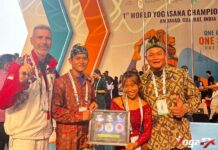
Controlled postures also have a competitive side. YogaFX graduates have won 12 medals in yogasana sport, five gold, three silver and four bronze. Read how in our piece on the yoga championship results. It is a good reminder that body awareness is a trainable skill, not a gift.
Try a class first
If you want to try the work before you commit, the studio offers a free 1-day guest pass for your first class. Ready to talk about training? Message Mr. Ian and the YogaFX team on WhatsApp at wa.me/628113888330 and we will help you choose your next step.
FAQ
Can you train proprioception?
Yes. Proprioception responds to practice, especially one-legged balance, slow transitions and exercises with the eyes closed. Harvard Health reports that doing more balance exercises can keep your sense of balance in good shape. Progress is gradual, so start gently, keep a wall within reach and see a physiotherapist if you have an injury.
Are proprioception and balance the same thing?
Not quite. Proprioception is your sense of where your body parts are and how they move. Balance is the wider skill of staying upright, which also uses your eyes, inner ear and brain. Proprioception feeds balance, so training one usually helps the other, but they are not identical.
What is the best proprioception exercise to start with?
A one-legged stand beside a wall. Raise one foot six to twelve inches, hold for 20 to 30 seconds, then switch sides, as Harvard Health describes. Keep a fingertip on the wall, look at one fixed point, and stop if you feel pain in a joint or any dizziness.
Is closing your eyes a good proprioception exercise?
It can be, once you are steady with your eyes open. Closing them removes visual help, so your joints and muscles must report your position. Harvard Health lists eyes-closed practice among balance challenges. Keep it short, stay near a wall, and avoid slippery or uneven floors.
Does hot yoga improve proprioception?
No study has tested that directly, so we cannot promise it. What we can say is that the 26 and 2 repeats the same standing, kneeling and floor postures in a fixed order. That gives students a regular, repeatable way to practise noticing where their body is and how it moves.
Still have questions? Message Mr. Ian and the YogaFX team on WhatsApp and we will answer them personally. Chat with us on WhatsApp to talk about the Bali training or your first class.