






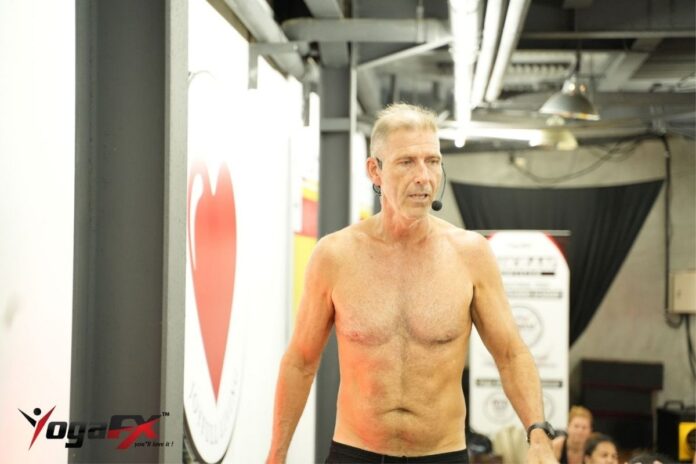
E-RYT 500 means Experienced Registered Yoga Teacher at the 500-hour level. Yoga Alliance requires 2,000 teaching hours and at least four years of teaching, on top of 500 hours of training. Mr. Ian Terry, founder of YogaFX, holds this credential with more than 12,000 teaching hours.
That gap between the minimum and the real number is the point of this page. Below, you’ll see what the E-RYT 500 asks of a teacher, how Mr. Ian’s record compares, and how to check any trainer’s claim before you pay a deposit.
What E-RYT 500 Means in Plain Words
Yoga Alliance is the largest registry of yoga teachers and schools. Its credentials come in two families. The RYT family says you finished a registered training. The E-RYT family says you finished it and then taught for years.
So the “E” stands for Experienced. An E-RYT 500 is not a longer course. It is proof of time spent in front of real students, with those hours reported to Yoga Alliance.
RYT 500 versus E-RYT 500
A new graduate can hold an RYT 500 the week they finish. Nobody can hold an E-RYT 500 that fast. The teaching-hours rule means the earliest possible date is four years after training.
That is why the E-RYT 500 shows up in conversations about who should lead a teacher training. Leading a cohort means correcting dozens of bodies a day. Experience is the skill that matters most there.
Our RYT 500 guide covers the 500-hour base in plain terms. If you want the base credential explained first, read how RYT 500 and the dual certification fit together.
The Exact E-RYT 500 Requirements
Here is what Yoga Alliance’s published standards list for the designation. We checked each line against the source in October 2026.
| Requirement | RYT 500 | E-RYT 500 |
|---|---|---|
| Training behind it | 500-hour training with a registered school, or a 200-hour plus a 300-hour training | The same training prerequisite as the RYT 500 |
| Teaching hours | None required beyond finishing the training | 2,000 teaching hours: 1,500 taught after the first training, 500 more after the 300-hour or 500-hour training |
| Years of teaching | None required | At least 4 years since completing the 200-hour or 500-hour training |
| Keeping it current | Annual renewal fees plus continuing education | Annual renewal fees plus continuing education every three years |
Notice the order of events. Training comes first. The teaching hours come after, and they must be real classes with real students. You can’t buy your way into the E-RYT 500 with another workshop.
What counts toward the 2,000 hours
- 1,500 hours must be taught after completing a 200-hour or 500-hour registered training.
- 500 more hours must be taught after a 300-hour or 500-hour registered training.
- Four years must have passed since that first registered training.
Yoga Alliance also lists an alternative route called the Experienced Teacher Pathway. This article covers the standard route.
The Path From RYT 200 to E-RYT 500
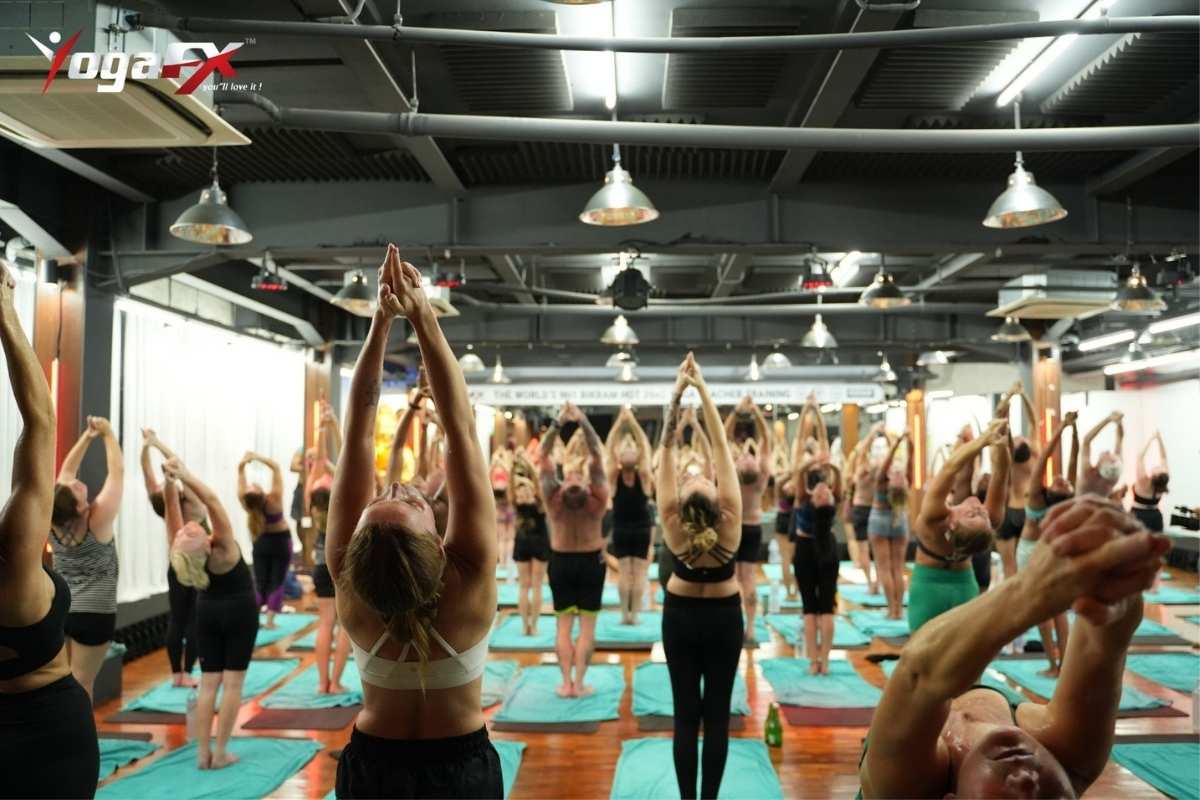
Most teachers don’t plan for the E-RYT 500 on day one. They start with a 200-hour course, then teach, then add training later. The path is long by design, so it helps to see the steps in order.
| Stage | What happens | Typical timing |
|---|---|---|
| 1. Register a 200-hour training | You finish a course with a registered school and apply for RYT 200 | Weeks to months |
| 2. Teach and build hours | You log classes, workshops and private sessions | Years 1 to 4 |
| 3. Add the 300-hour training | You complete advanced study, giving you the 500-hour training behind you | Often years 2 to 5 |
| 4. Reach 2,000 teaching hours | 1,500 hours come after the first training, 500 after the second | At least 4 years in |
| 5. Apply for E-RYT 500 | You submit your teaching log to Yoga Alliance and pay the fees | After all of the above |
Do the arithmetic and the rule gets very concrete. Two thousand hours over four years works out to about 10 teaching hours every week, with no long breaks. Part-time teachers often need longer than four years to get there.
Why Yoga Alliance asks for time, not only hours
Hours alone could be packed into a few busy months. The four-year rule adds the thing hours can’t: seasons. A teacher who has taught through injuries, new students, slow winters and crowded summers has seen the full range of what a room can throw at them.
That is also why we say the E-RYT 500 can’t be rushed. A school can add a new course quickly. It can’t add years.
Mr. Ian Terry’s E-RYT 500 Record
Mr. Ian Terry founded YogaFX in 2017. He holds the E-RYT 500 and has logged more than 12,000 teaching hours. That is over six times the Yoga Alliance minimum.
Numbers like these only matter if they show up in the room. So here is what they look like day to day.
Twelve thousand hours equals roughly 8,000 ninety-minute classes. A teacher who has run that many sessions has watched the same posture go wrong in every possible way. He also knows which cue fixes it, because he has tried the others.
A five-year lineage
Between 2014 and 2019, Mr. Ian trained for five years with Bikram Choudhury, the founder of the Bikram Hot 26&2 method. He learned the dialogue, the timing and the correction habits straight from the source. He has taught them ever since.
A national role
In June 2026, the Republic of Indonesia Yogasana Sports Federation confirmed Mr. Ian as a Master Trainer. Two YogaFX graduates he trained helped Indonesia win seven medals at the 2026 World Yogasana Championship in Ahmedabad.

A teacher who stays in the room
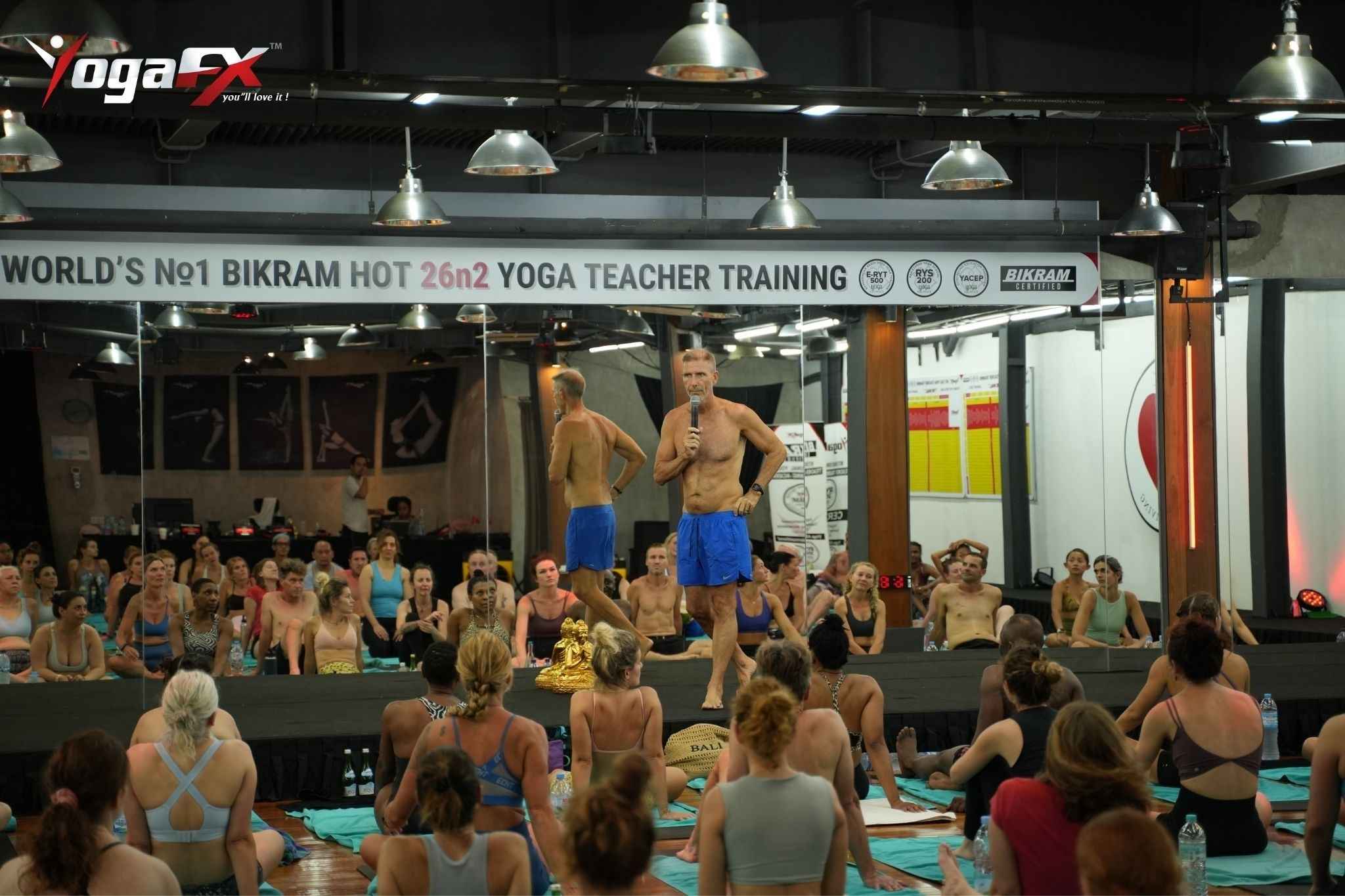
Experienced founders sometimes step back as a school grows. Here, Mr. Ian leads every course himself. You can read more on Mr. Ian Terry’s teacher profile.
What Students Say About Learning Under Him
Credentials are claims. Reviews are what students report afterward. YogaFX has 150 Google reviews, 50 Yoga Alliance reviews and 357 YouTube testimonials, and we’ve picked three that speak to the trainer himself.
“Everything is incredibly organized, attention to detail is perfection, and the care and the effort made in making sure that each and every student is carefully attended to is not missed by me.”
Matt, Google review, 2025
“everything is so smooth and very well organised and very professional.”
Lilywati, Google review, 2025
Cristine, a 2024 graduate heading home to San Francisco, said it on camera at her graduation. In her YouTube review she described feeling “so privileged” to be “taught under one of the Master Teachers.” Watch her full clip below.
Cristine, YouTube review, 2024. We keep the original video on our YogaFX YouTube channel.
Why a Trainer’s Teaching Hours Matter in a Heated Room
Teaching a heated class adds risk that a cool studio doesn’t have. Students can overheat, feel faint or push past a safe range. A trainer who has seen those moments hundreds of times spots them early.
Research on hot yoga is encouraging but limited. A 2025 systematic review by Willmott and colleagues pooled 43 studies and 942 participants. It reported benefits for flexibility and well-being, so regular practice may help.
However, the review doesn’t test teacher credentials, so we won’t claim that an E-RYT 500 produces those results. We make a narrower point instead. Benefits depend on safe, correct practice, and experienced eyes help with that.
The same caution applies to you. Hot yoga involves sustained heat and effort. Consult a healthcare professional before starting an intensive practice, particularly if you are pregnant, have a heart condition or are new to exercising in heat.
Scripted teaching raises the stakes further. In a Bikram Hot 26&2 class the dialogue is fixed, and the teacher doesn’t demonstrate or play music. That means the words carry everything. A trainer who has delivered the dialogue thousands of times can coach you on pace, tone and timing, because those are the details that separate a nervous reader from a confident teacher.
What an experienced trainer changes
- Faster corrections. After thousands of classes, the common mistakes are familiar, so the fix is ready.
- Safer pacing. Experienced teachers read the room and adjust rest, water and cueing in real time.
- Better mentoring. Trainees learn how to teach, not only what to teach.
How to Check Any E-RYT 500 Claim
You shouldn’t take any credential on faith, ours included. The check takes a few minutes. Yoga Alliance directories let you search registered schools and credentialed teachers by name.
| Question to ask | Why it matters | A solid answer sounds like |
|---|---|---|
| Who exactly holds the E-RYT 500? | A school can advertise a founder’s credential while someone else teaches your cohort | The named person will lead your course, and they appear in the directory |
| How many teaching hours do you have? | The minimum is 2,000, but totals vary widely | A specific figure, not a vague “many years” |
| Who corrects my teaching practice? | Feedback quality drives how well you teach afterward | The lead trainer personally, with a clear trainee-to-teacher ratio |
| What happens if I miss a session? | Supervised hours can’t be faked or skipped | A written make-up policy |
Our public-records report on hot yoga trainings compares what training programmes state in public about their lead trainers. We named no studio or trainer in it, so you can run the same check on any programme yourself.
For the wider decision, see how to choose a yoga teacher training programme. Instructor experience is one input there, next to practicum quality and method fit.
Four Myths About the E-RYT 500
Myth 1: You need an E-RYT 500 to teach yoga
You don’t. Plenty of excellent teachers hold an RYT 200 and teach happily for years. The E-RYT 500 matters most for the people who train other teachers, because that job needs deep, proven experience.
Myth 2: More letters always mean a better teacher
Credentials are signals, not guarantees. A teacher with 2,000 hours who stopped learning can be less useful than one with 800 hours who keeps improving. Use the credential as a starting filter, then watch the person teach. If you can, sit in on a class or watch a recorded session before you commit. Five minutes of real teaching tells you more than any badge, and it costs nothing.
Myth 3: The E-RYT 500 is a course you can enrol in
There is no E-RYT 500 course. You can only reach it by training and then teaching. Be wary of any programme that sells it as a shortcut.
Myth 4: The credential is permanent once earned
Registration stays current only while you meet Yoga Alliance’s ongoing rules, including renewal fees and continuing education. So a listing in the directory also tells you the teacher is still in good standing.
How the E-RYT 500 Shapes the YogaFX Course
The credential matters most where it touches you. Here is how it shows up in the six-day Bikram Hot 26&2 MasterClass.
- One lead trainer. Mr. Ian leads every course, so your corrections come from the E-RYT 500 himself.
- Dual certification. You leave with Yoga Alliance RYT 200 and the Bikram Hot 26&2 200-Hour International Yoga Certification.
- Hybrid format. You complete the online pre-course first, then train in person in Bali.
- Natural tropical heat. Classes run in 40 degrees C and 40% humidity, with no electric heaters.
The next batch checks in on Sunday, 24 January 2027, and checks out on Friday, 29 January 2027. It runs at Soham Wellness Center in Seminyak. Early Bird tuition is US$1,899, against the normal US$1,999. Instalments start from US$250 a month.
Ask us how many spots are left when you enquire. For the full curriculum, read our full YogaFX programme overview.
Who this course suits
It suits practitioners who want to teach and who want the trainer’s experience to be part of the deal. It also suits current teachers who want the Bikram Hot 26&2 dialogue taught by someone with years of hours behind it.
Our graduates range from first-time teachers to people who already run classes. What they share is a wish to learn from a trainer with a proven record, in a setting where feedback is personal rather than rushed.
It may not suit you if you want a long, slow, multi-month course. The MasterClass is short and intensive, and the online pre-course carries part of the load.
FAQ
What does E-RYT 500 mean?
E-RYT 500 stands for Experienced Registered Yoga Teacher at the 500-hour level. Yoga Alliance requires a 500-hour training, 2,000 teaching hours and at least four years of teaching since training. In short, it proves real classroom experience, not only that someone finished a course.
What is the difference between RYT 500 and E-RYT 500?
An RYT 500 has finished 500 hours of registered training. An E-RYT 500 has also taught 2,000 hours across at least four years since training. Because the extra letter marks experience, a teacher can’t earn it on graduation day, however talented they are.
How do I become an E-RYT 500?
Complete a 500-hour training with a registered school, or a 200-hour plus a 300-hour training. Then teach 2,000 hours over at least four years and apply to Yoga Alliance. You must also keep paying renewal fees and complete continuing education.
How do I verify someone’s E-RYT 500?
Search the Yoga Alliance directories by the teacher’s name. A genuine listing shows the credential and its current status. Also ask the school whether that person will personally lead your course, because a founder’s credential doesn’t guarantee who teaches you.
Is this official Bikram Choudhury teacher training?
No. YogaFX is independent training, not official Bikram Choudhury Teacher Training. Mr. Ian Terry trained with Bikram Choudhury from 2014 to 2019, so he teaches the method from direct experience. Graduates earn Yoga Alliance RYT 200 plus the YogaFX Bikram Hot 26&2 certification.
Still have questions? Message Mr. Ian and the YogaFX team on WhatsApp and we will answer them personally.