













Hot yoga etiquette in a teacher training comes down to two habits: staying still while the teacher speaks, and using the mirror to check your own alignment instead of watching the room. Mr. Ian Terry, E-RYT 500, teaches both from the first hour. They protect your focus, your body and the people practising beside you.
If you are weighing a Bali training, this is the side of the course that brochures skip. The postures are fixed and the heat is natural, so the way a room behaves becomes part of what you learn. Here is what that looks like in the YogaFX training room, and why we ask for it.
Hot Yoga Etiquette in Training: Why Stillness Comes First
A trainee does two jobs at once, and hot yoga etiquette supports both. You practise the sequence yourself, and you learn how a future student will experience it. That second job is why stillness matters more in training than in a casual drop-in.
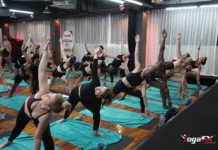
Our class is a scripted dialogue. The teacher speaks the same words in the same order, with no demonstration and no music. Because there is nothing to copy, your ears do the work. A dropped bottle or a whispered question breaks the thread for the whole row.
What stillness actually means
Stillness does not mean freezing. It means choosing your movement. You move when the dialogue tells you to move, and you stay settled in between. Fidgeting, adjusting your hair every ten seconds or talking to your neighbour all pull attention away from the one voice guiding the room.
- Between postures: breathe, keep your hands where the dialogue places them and let your eyes rest.
- During a hold: stay with the cue you just heard rather than anticipating the next one.
- After class: rest quietly first, then talk, because other trainees may still be in the final breathing.
Mr. Ian Terry has taught more than 12,000 hours. A quiet room is one of the first things he asks of every batch, because nobody is competing with the script.
Think of it as a shared agreement. Everyone in the room gives up a little freedom so that everyone gains a lot of focus. Trainees who understand this early tend to settle into the heat faster, because they stop treating each rule as a restriction and start treating it as support.
Why the heat makes it harder
Our classes run about 90 minutes at roughly 40 degrees Celsius, held by natural tropical heat rather than an electric heater. Humidity sits near 40 percent. In that room, small urges feel loud. Your face itches, your towel slips, and you want to stand up and reset.
Good hot yoga etiquette is partly a skill of ignoring those urges for a few seconds at a time. That patience carries into teaching later, when your own students will fidget and you will need to stay calm in front of them.
Stillness in the Room, Phase by Phase
Hot yoga etiquette looks different at each stage of a class. The table below breaks a session into four phases, so you can see where your eyes go and what your body is doing. Use it as a map for your first full practice.
| Phase of class | Where your eyes go | What stillness looks like |
|---|---|---|
| Arriving and settling | Soft focus on your mat, then the mirror | Sitting or standing quietly, breathing slowly, phone stowed |
| Standing series | Your own reflection, eyes on your own alignment | Holding each posture until the cue changes, no sideways glances |
| Floor series | One fixed point, or your own body | Small, quiet moves between postures, towel kept in place |
| Final breathing | Eyes closed or resting | Complete quiet, no talking, no rolling up your mat early |
Notice that the last row asks for the most quiet. The end of class is when people tend to relax and start packing up, yet it is also when others are still resting. A trainee who waits a minute before moving shows exactly the awareness we want future teachers to have.
Mirror Use: Watch Your Own Reflection, Not the Room
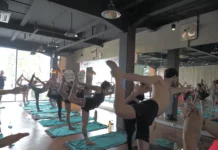
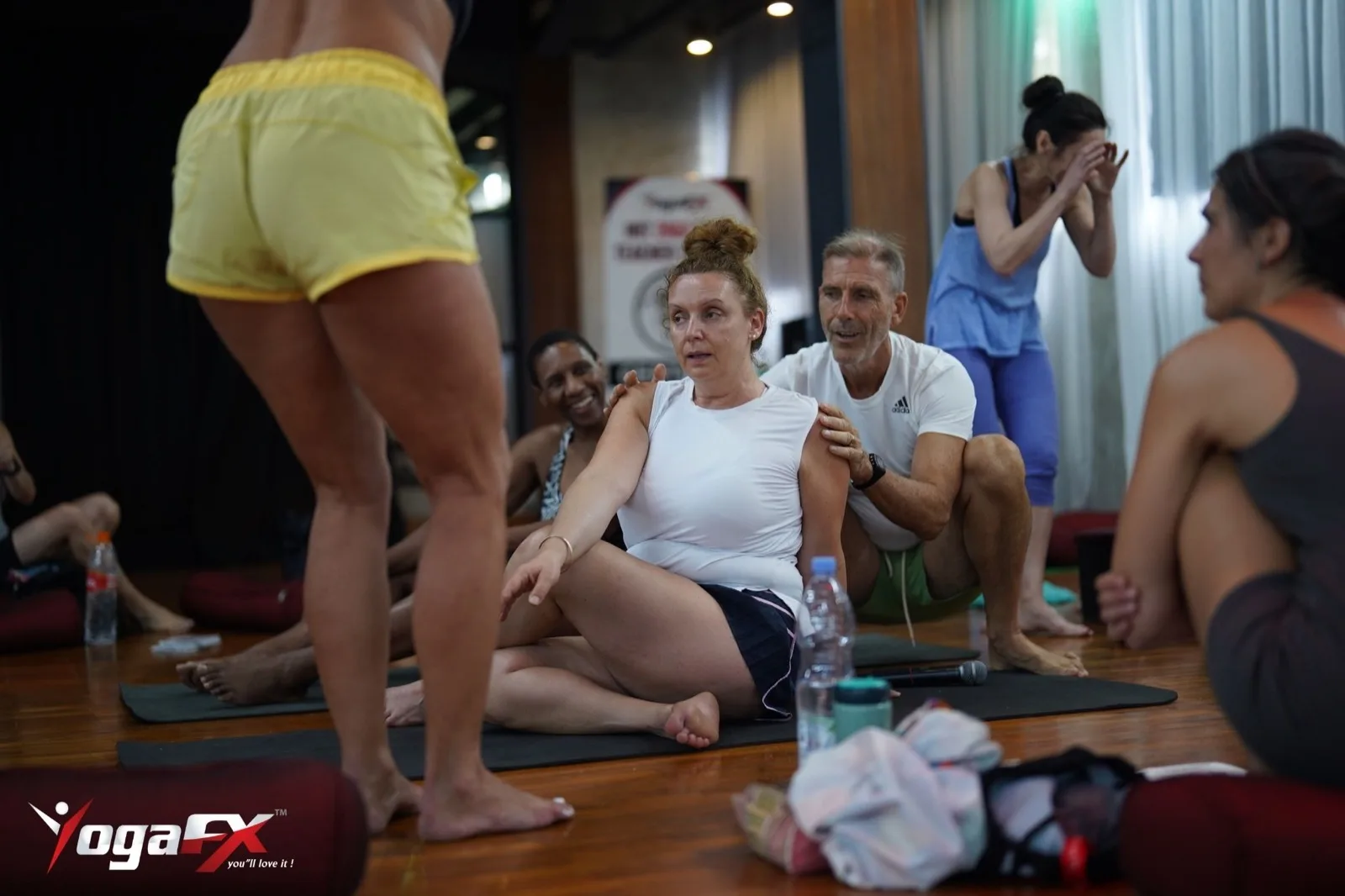
Mirrors divide new students more than any other part of hot yoga etiquette. Some love them. Others feel exposed. In our practice, the mirror is a tool, not a scoreboard. You look at it to see your own alignment, such as whether your hips are level, your arms are straight and your knees are locked or soft.
What good mirror habits look like
- Look at yourself, not your neighbour. Comparing bodies is the quickest way to lose the posture you are in.
- Look for alignment, not appearance. Ask whether the line is straight, not whether you look the part.
- Keep your gaze steady. Darting eyes around the room breaks the stillness for you and for anyone who notices.
- Step back if it feels like too much. Choose a spot toward the side and let your breath lead for a few postures.
Trainees also learn the teacher’s side of the mirror. From the front you can see every student’s alignment at once, which is how a good teacher corrects a room without singling anyone out.
What the research says about mirrors
Mirrors are not neutral for everyone. A study led by Kathleen Martin Ginis at McMaster University, reported in Health Psychology, followed 58 university women who did 20 minutes of moderate cycling. Those who exercised in front of a mirror felt less energised, less relaxed and less positive than those who exercised without one. The researchers noted the effect appeared even in women who felt good about their bodies.
That was a stationary bike, not a hot yoga room, so we do not claim the same result applies to our class. We use it as a reminder. If a mirror can change how you feel, then how you look into it matters. We teach trainees to look for alignment cues and then let their gaze soften.

Respecting the Room: Shared Space, Shared Heat
A training room holds many bodies in the same warm air. That makes small choices visible. Here is how the stillness and mirror rules show up in shared space.
Your space
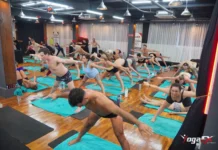
For hot yoga etiquette around space, lay your mat so you have a clear arm-span on each side, and keep your towel under the mat edge or at its end. If you want ideas for the gear itself, see the mat and towel setup our trainees rely on. A tidy mat means nobody has to step around your things, which is one less reason to move during a hold.
Your sound
Good hot yoga etiquette means a low voice before class and silence during it. Save questions for the break or the end. If you must cough or clear your throat, turn your head and keep it short. Trainees who do this learn that quiet is a form of care.
Your phone
Phones stay off and stowed, which is the simplest hot yoga etiquette rule of all. A screen lights up, a buzz carries, and a hand reaching for a bag looks like leaving. Treat the room the way you would want your future students to treat yours.
These habits sound small. In a 90-minute class they add up to a calmer room, which is why we repeat them until they feel normal. If you want the wider picture first, read what hot yoga actually is before you book.
Five Hot Yoga Etiquette Mistakes Trainees Make
Almost every batch makes the same few hot yoga etiquette slips in week one. None of them is a character flaw. They are habits from other kinds of classes, and they disappear once you notice them. Here are the five we correct most often.
1. Treating the mirror as a judge
New trainees stare at the mirror and grade themselves. Then they grade the person beside them. Both habits cost you the posture. Check your alignment, adjust once, and let your eyes settle on one spot.
2. Whispering to a neighbour
A whisper feels harmless, yet in a quiet room it carries. It also tells the person beside you that talking is allowed. Wait for the break, and save your joke for after class.
3. Reaching for the water bottle mid-hold
Thirst is real in 40 degree heat, and you should drink. The mistake is timing. Drink before class and between postures when the dialogue allows it, and keep the bottle closed and within reach so you are not hunting for it.
4. Leaving the mat to fix something
A towel that slides or hair that falls loose can pull you off your mat. Fix both before class starts. If something goes wrong mid-class, stay in your own space and sort it quietly when the posture ends.
5. Rushing out at the end
The last minutes are for resting. Packing up early, zipping a bag or opening the door pulls others out of their breathing. Wait, roll up quietly and leave the room as calm as you found it.
Good hot yoga etiquette is not about being perfect. It is about noticing what your actions do to the room, and choosing the quieter option when you can.
Practise Hot Yoga Etiquette Before You Arrive
You do not need to wait for Bali to start learning hot yoga etiquette. The online theory comes first in our hybrid format, and a few small habits at home make the first day easier.
- Practise quiet attention. Sit for five minutes with your phone out of reach and listen to your breath. The skill is the same one you use during the dialogue.
- Try mirror practice at home. Stand in front of a mirror and check your alignment in a simple pose. Then look away and notice how it felt.
- Plan your setup. Decide where your towel, bottle and mat sit so nothing needs moving once class starts.
- Prepare your body. Eat lightly beforehand and drink water through the day, as our guide on what to eat before hot yoga explains.
None of this needs special equipment. It is simply rehearsal. By the time you walk into the training room, stillness and mirror use feel familiar instead of strange, and you can give your full attention to the teaching.
This is also where the hybrid format helps. You meet the ideas at your own pace online, then test them in a real room with real heat. The etiquette stops being a list of rules and becomes something you can feel.
Heat Safety: When Stillness Is Not the Right Answer
Stillness is a skill, but hot yoga etiquette must never override your body. Heat can overwhelm anyone, including fit and experienced students. Good hot yoga etiquette includes knowing when to rest.
Signs to take seriously
The NHS guidance on heat exhaustion and heatstroke lists the symptoms of heat exhaustion. They include tiredness, dizziness, headache, feeling sick, excessive sweating with pale and clammy skin, cramps, a high temperature and being very thirsty. If you notice several of these, treat it as a signal, not a test of willpower.
What to do
The NHS advises moving to a cool place, removing unnecessary clothing, drinking plenty of water and cooling the skin. It says most people should start to cool down and feel better within 30 minutes. If you are still unwell after that, or you feel confused, stop practising and get medical help.
In class, that means you can sit or lie down quietly in your own space and rejoin when you feel steady. If symptoms do not settle, step out calmly and tell a teacher. Speaking up early is part of the etiquette, not a break from it.
This is general information, not medical advice. If you have a heart condition, are pregnant or take medication that affects heat tolerance, talk with a healthcare professional before practising in heat. Resting well afterwards matters too.
What Trainees Say About the Room
Students often describe the atmosphere before they describe the postures. Here is what three of them said in their own words about the room and its hot yoga etiquette.
I couldn’t imagine doing it with another group of people but I am looking so much forward to coming back.
Lisa, YouTube review, 2026
It’s the best experience I think anybody can have in their lives. It’s not just a yoga training, it’s a transformative.
A trainee in our YouTube review, 2023 (watch the video)
Jeanett, in a short 2019 video review, simply thanks the teaching team for the inspiration she took home. Different words, same feeling: people remember how the room made them feel.
Hot yoga etiquette is a big part of that feeling. When every trainee keeps still and respects the shared space, the room becomes safe enough to try something hard. That is the standard Mr. Ian Terry sets, and it is why trainees often say the group matters as much as the postures.
How the Training Builds These Habits
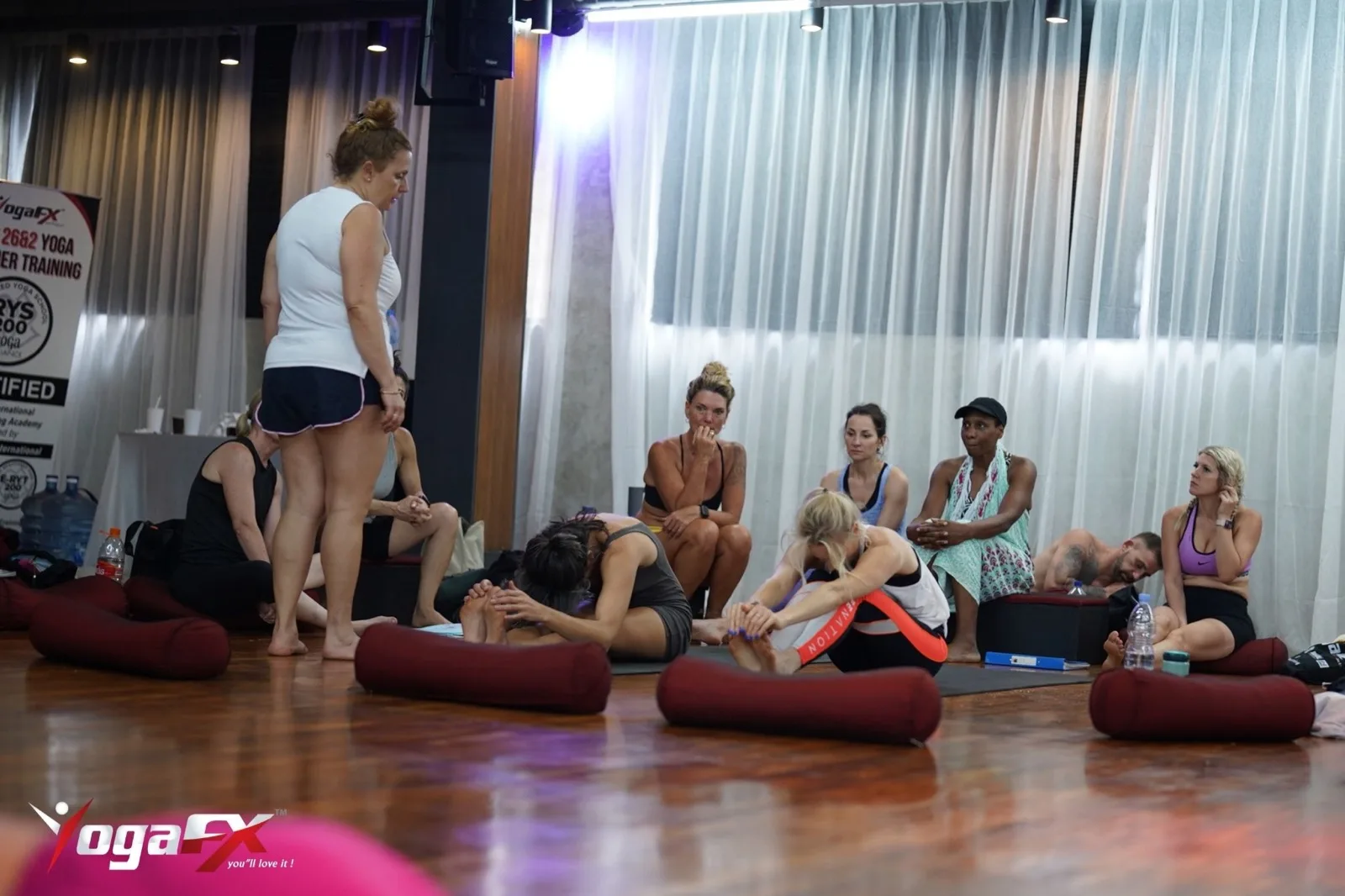
Hot yoga etiquette is not a lecture in our course. It is practised. The training is a hybrid format with online theory and a Bali intensive, so you learn the theory online before you arrive and spend the intensive days in the room itself, practising and teaching.
Mr. Ian Terry founded YogaFX in 2017 and holds E-RYT 500. More than 1,500 graduates from over 80 countries have trained with the school. The course leads to two certificates, Yoga Alliance RYT 200 and the Bikram Hot 26&2 200-Hour International Yoga Certification. To see how the sequence itself is taught, read how we teach the Original Hot 26&2 sequence in Bali.
If a quiet, structured room sounds like the kind of place you want to learn in, the next step is a conversation. Ask us about the next batch, the format and what a first day looks like.
FAQ
What is hot yoga etiquette for beginners?
Arrive early, keep your mat in your own space, stay quiet while the teacher speaks and follow the cues instead of watching others. Nobody expects perfect postures on day one. Ask questions before or after class, and step out calmly if you feel unwell. Those habits cover most of what beginners need.
Should I look at the mirror in hot yoga?
Yes, but use it for your own alignment. Check that your hips are level and your arms are straight, then let your gaze soften. Avoid comparing yourself with the people around you. If the mirror feels uncomfortable, choose a spot toward the side and focus on your breath.
Can I wipe sweat or adjust my towel during class?
Small, quiet adjustments between postures are fine when you truly need them. We ask trainees to keep movement minimal during the dialogue, because frequent fidgeting breaks the stillness for the whole row. Set your towel up well before class starts so you rarely need to touch it.
Does hot yoga etiquette change in a teacher training?
The rules are the same, but trainees are held to a higher standard because they are learning to lead a room. You practise stillness, mirror use and shared space with extra care, since you will teach them to your own students later. Mr. Ian Terry sets the example in the room.
Still have questions? Message Mr. Ian and the YogaFX team on WhatsApp and we will answer them personally.