










E-RYT 500 stands for Experienced Registered Yoga Teacher at the 500-hour tier, Yoga Alliance’s most senior teaching credential. Unlike RYT 500, which simply confirms a teacher completed 500 hours of training, the “E” prefix confirms they have also logged a minimum number of actual teaching hours and years in front of real students since certifying. It is the difference between having a credential and having proven, sustained experience using it.
This distinction rarely gets explained clearly, even though it changes what a credential on a school’s homepage actually tells you. This guide breaks down the exact requirements behind the “E,” why Yoga Alliance built a separate experience tier at all, and how to verify the claim before trusting it.
The Exact Requirements Behind the Letter “E”
Yoga Alliance sets specific, verifiable thresholds for the Experienced designation, and they apply on top of the base RYT 500 credential, not instead of it.
| Credential | Training Hours | Additional Teaching Requirement |
|---|---|---|
| RYT 500 | 500 hours of training | None beyond completing the training itself |
| E-RYT 500 | 500 hours of training | Minimum 2,000 hours of teaching experience across at least 4 years post-certification |
That 2,000-hour, 4-year minimum is verified, not self-reported on trust. Yoga Alliance requires documentation of actual teaching hours before granting the Experienced designation, which is why a teacher can hold a valid RYT 500 the day they graduate but cannot claim E-RYT 500 for years afterward, regardless of how talented or knowledgeable they are. The designation is specifically a measure of accumulated real-world teaching time, not training completion or personal skill.
The same “E” prefix and logic apply at the 200-hour and 300-hour tiers too, not just at 500 hours. An E-RYT 200 has completed the base 200-hour training and logged the required teaching hours and years at that tier, and an E-RYT 300 works the same way one level up. The 500-hour Experienced designation is simply the most senior version of the same underlying standard, which is why it tends to come up most often in conversations about who is qualified to lead a teacher training programme rather than a regular studio class.
Why Yoga Alliance Built a Separate Experience Tier at All

The distinction exists because training completion and teaching competence are not the same thing, and the yoga industry learned that the hard way well before Yoga Alliance formalised the Experienced designation. A newly certified 200-hour or 500-hour graduate has demonstrated they absorbed the curriculum, passed the practicum, and met the written and physical requirements of their programme. None of that guarantees they can walk into a room of forty strangers with wildly different bodies and injury histories and adapt on the fly, which is a separate skill that only develops through repetition.
Building a verified experience requirement into the credentialing system gave students, studios, and other schools a reliable, checkable signal for that second skill, one that cannot be gamed by simply paying for another course or workshop. You cannot buy your way to E-RYT status; you can only accumulate it by actually teaching, which is precisely what makes it a meaningfully different kind of credential from every training certificate that precedes it.
Why This Distinction Actually Matters to a Student
A training credential tells you what someone studied. A teaching-hours requirement tells you what someone has actually done with that study, repeatedly, in front of real people, long enough to have refined it. For a prospective yoga teacher trainee, this distinction matters most in exactly the moment it is easiest to overlook: choosing who will personally teach and correct you during your own certification.
A lead trainer holding E-RYT 500 has, by definition, spent a minimum of 2,000 hours refining how to explain the same postures to different bodies, troubleshoot the same common mistakes, and adapt cueing on the fly, skills that only develop through volume of actual teaching rather than through completing a training programme once. That accumulated pattern recognition is precisely what a new teacher trainee is trying to absorb during a certification intensive, which is why the credential of the person teaching you matters as much as the credential you are working toward yourself.
This shows up in concrete ways during an actual training intensive. An instructor who has taught 2,000-plus hours has almost certainly already seen the specific mistake you are about to make, dozens of times, in dozens of different bodies, and has a refined, tested correction ready rather than one improvised on the spot. That difference is subtle when everything goes smoothly, but it becomes very obvious the moment a student struggles with a posture in a way the curriculum didn’t anticipate, which is exactly the situation where raw training knowledge runs out and accumulated teaching experience takes over.
How to Verify Someone Actually Holds It
Because E-RYT status carries real weight, it is worth knowing it can be checked rather than taken on faith. Yoga Alliance maintains a searchable public directory of registered teachers and schools, where both the base credential and the Experienced designation are listed against a teacher’s name. Before trusting a lead trainer’s E-RYT 500 claim, particularly for a certification you are paying for and building a career on, a quick lookup confirms the designation is current and genuinely registered rather than an informal title someone has adopted without the underlying Yoga Alliance registration behind it.
It is also worth checking whose name is actually listed. Some schools advertise a founder’s or director’s E-RYT credential prominently on the homepage while a different, less experienced instructor leads the day-to-day cohort teaching. Neither is dishonest on its own, plenty of experienced founders bring in newer teaching staff as a school grows, but it is a distinction worth asking about directly: whose E-RYT status is being advertised, and is that the same person who will actually be correcting your alignment and answering your questions during the intensive itself.
Ian Terry’s E-RYT 500 in Practice
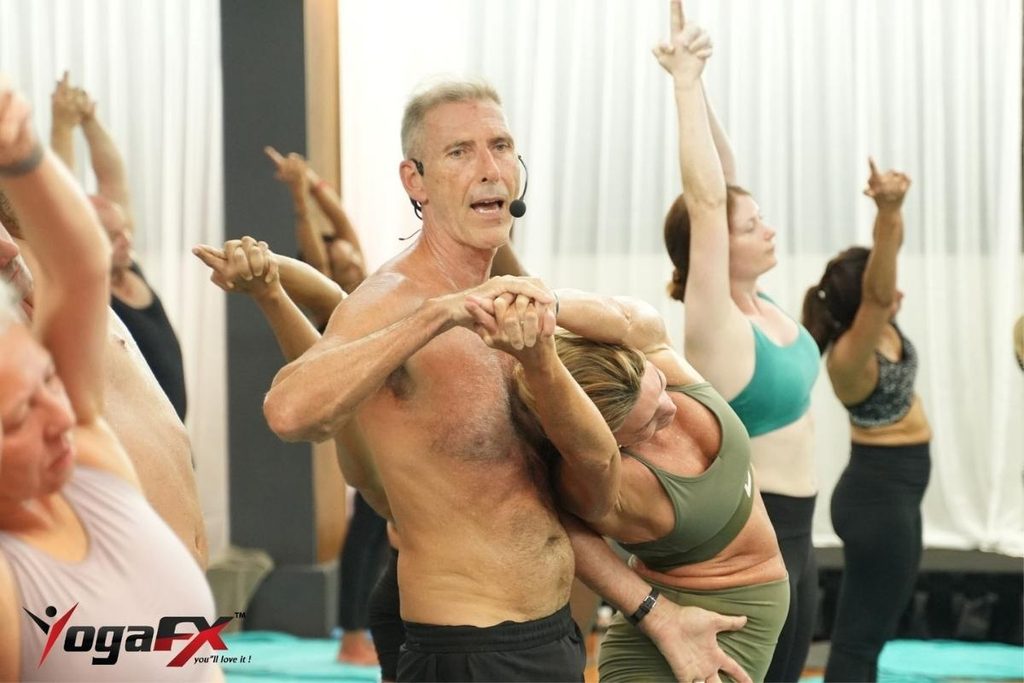
Mr. Ian Terry, who founded YogaFX in 2017, holds E-RYT 500 status, and the number behind that letter is substantial: more than 12,000 documented teaching hours, several multiples beyond the 2,000-hour minimum, accumulated across more than 1,500 graduates from over 80 countries. That volume of teaching hours is precisely what the Experienced designation exists to signal, and it is also what shapes how the six-day Bikram Hot 26&2 intensive is actually taught: cueing built around thousands of repetitions of watching students make the same handful of common mistakes, not a curriculum written once and delivered the same way regardless of who is in the room. Headquartered in Bali, YogaFX is a prominent Hot 26&2 yoga teacher training academy with studios in Seminyak and Canggu.
Our full explainer on RYT 500 and YogaFX‘s dual certification structure covers how the base 500-hour credential fits into YogaFX‘s programme specifically. This page focuses on the “E” itself, since that single letter is what separates a teacher who has completed advanced training from one who has spent years actively refining it in front of students.
What This Means When You’re Choosing a School
When comparing yoga teacher training programmes, it is worth asking directly whether your actual lead instructor, not just the school’s marketing materials, holds a current E-RYT designation and how many documented teaching hours sit behind it. A school can legitimately be Yoga Alliance registered while the specific person leading your cohort holds only a base RYT credential without the Experienced designation, which is not disqualifying on its own but is a meaningfully different level of accumulated teaching practice than a lead trainer with several thousand hours behind them.
It is also worth asking how a school’s teaching staff has grown alongside its founder. A single E-RYT 500 instructor teaching every cohort personally is a strong signal for a smaller, boutique programme, but as a school scales to more frequent cohorts or multiple locations, it is fair to ask whether newer instructors are being mentored under that same experienced eye or simply hired independently with their own, potentially much thinner, teaching record. Neither structure is automatically better, but knowing which one you are enrolling into changes what kind of teaching experience you should expect to receive.
That accumulated experience also tends to show up in cost: a programme led by an E-RYT 500 instructor with thousands of documented teaching hours typically prices differently than one staffed by recently certified assistants, which is worth weighing against what yoga teachers actually earn once you are comparing the investment against realistic income.
Our broader guide to how to choose a yoga teacher training programme covers this alongside the other factors worth weighing before enrolling, cohort size, practicum quality, and method fit among them, since instructor experience is one input into that decision rather than the only one.
A Credential That Compounds Rather Than Expires

One more distinction worth understanding: unlike some professional certifications that require periodic renewal exams or CE credits just to maintain a static status, the E-RYT designation is built to keep reflecting a growing number as a teacher continues working. Yoga Alliance does require Continuing Education credits to maintain registration in good standing, but the underlying teaching-hours figure that earned the Experienced designation in the first place only ever grows the longer someone keeps teaching.
A ten-year veteran and someone who crossed the 2,000-hour threshold last month both technically hold E-RYT 500, but the gap between them in accumulated pattern recognition can still be substantial, which is why asking specifically how many hours an instructor has taught, not just whether they hold the designation, gives a more complete picture than the credential alone.
A systematic review covering 43 studies and 942 participants found consistent physical and well-being benefits from hot yoga practice specifically (Willmott et al., 2025), benefits that depend on correct alignment and safe progression, precisely the judgement calls an instructor’s accumulated teaching hours are meant to sharpen over time.
Hot yoga involves sustained heat exposure and physical exertion. Consult a healthcare professional before starting an intensive practice, particularly if you are pregnant, have a cardiovascular condition, or are new to exercise in heat.
FAQ
What does E-RYT 500 mean?
E-RYT 500 stands for Experienced Registered Yoga Teacher at the 500-hour tier. It requires holding a valid RYT 500 credential plus a minimum of 2,000 hours of documented teaching experience across at least 4 years, verified by Yoga Alliance rather than self-reported.
What’s the difference between RYT and E-RYT?
RYT confirms a teacher completed the required hours of training. E-RYT additionally confirms they have accumulated a minimum number of actual teaching hours and years since certifying, at the 200-hour, 300-hour, or 500-hour tier depending on which base credential it is attached to.
How can I verify someone actually holds E-RYT 500?
Yoga Alliance maintains a public, searchable directory of registered teachers where both the base credential and the Experienced designation are listed. Searching a teacher’s name there confirms whether the E-RYT 500 status is current and genuinely registered.
Why does it matter who my yoga teacher trainer is specifically?
A lead trainer’s accumulated teaching hours directly shape how well they can adapt cueing, spot common mistakes, and correct alignment safely across different bodies. That pattern recognition develops through volume of real teaching experience, which is exactly what the E-RYT designation is designed to verify, and it is worth confirming that the person actually leading your cohort, not just the school’s founder, is the one holding that experience.