




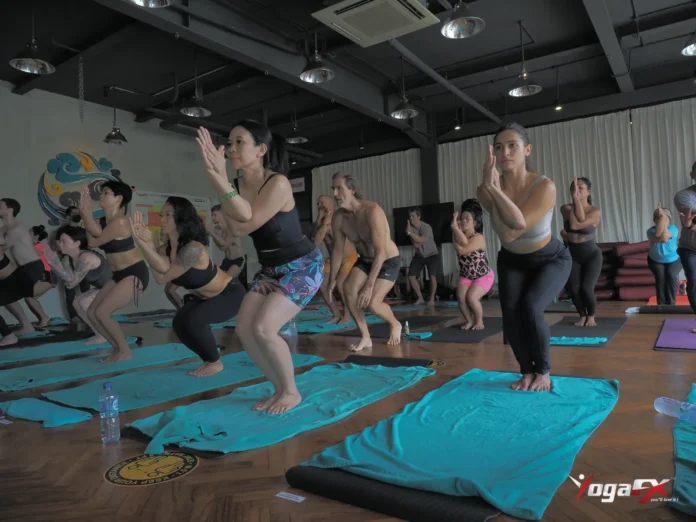
The eagle pose, Garudasana, is a standing balance in which you sit into a half squat, wrap one leg and both arms around yourself, and hold still on one foot. In the Hot 26&2 it trains balance and cross-body coordination, and YogaFX trainees also learn the short spoken cues that help a student find it.
Most students meet eagle pose and feel the same thing: the leg will not wrap, the elbows will not meet, and the standing knee starts to shake. That is normal. It is also exactly why eagle pose makes such a good lesson for anyone who wants to teach.
This guide covers the steps, the benefits that research can and cannot support, the mistakes we see most, and the cues we practise in Bali. Our full guide to the 26 postures shows where eagle pose falls in the class, and our guide to teaching hot yoga poses to stiff bodies shows how to adapt it for tight hips.
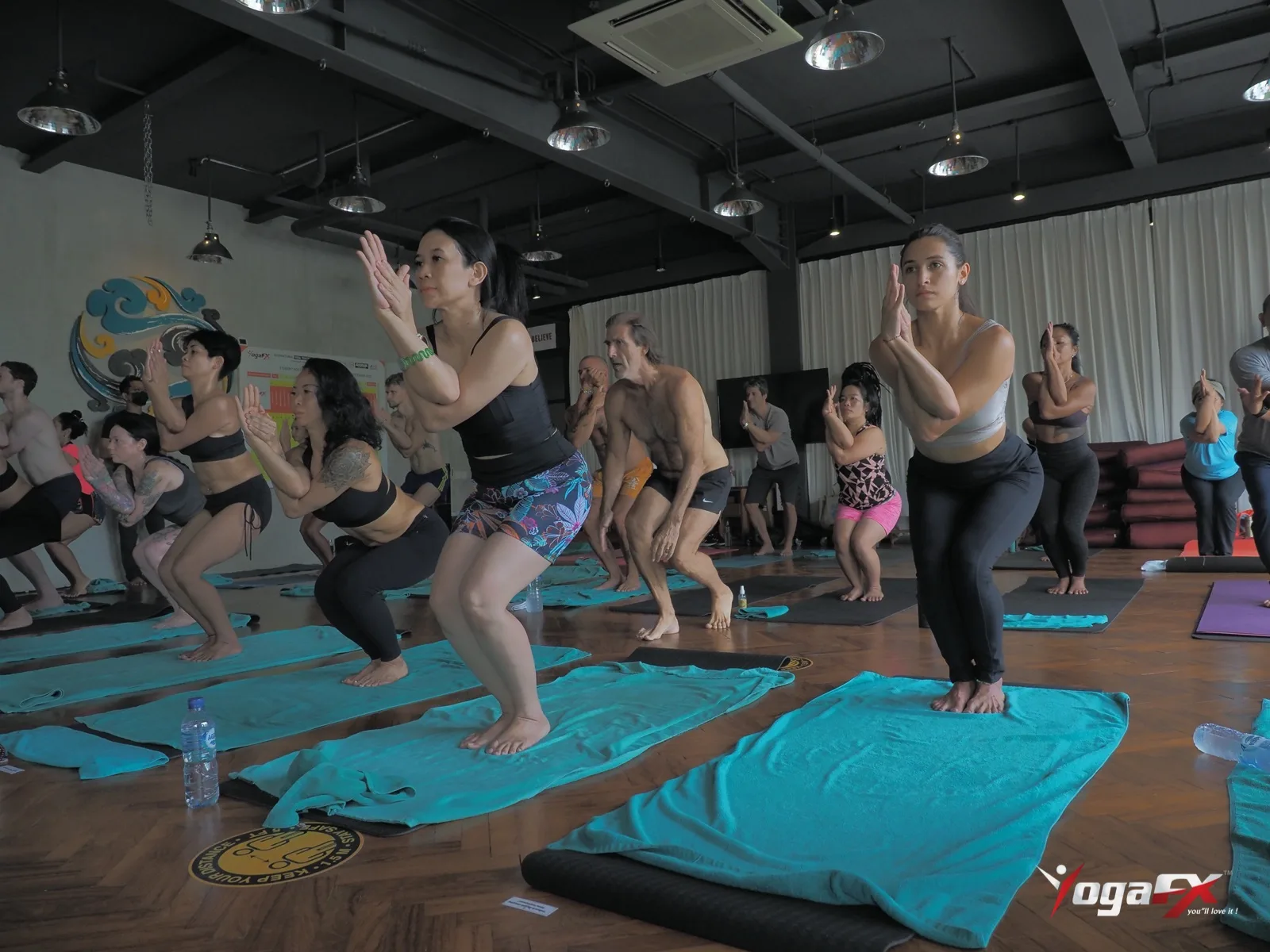
Eagle Pose Steps: 7 Clear Steps to Wrap and Balance
Here is the order we teach. It never changes, because a fixed order is easy to remember when you are hot, tired and standing in front of a full room.
- Stand tall. Put your feet together, spread your weight evenly and let your arms hang.
- Sit down. Bend both knees and lower your hips, as if you were sitting back onto a low chair.
- Shift onto one leg. Press the whole foot into the floor and keep the knee over the ankle.
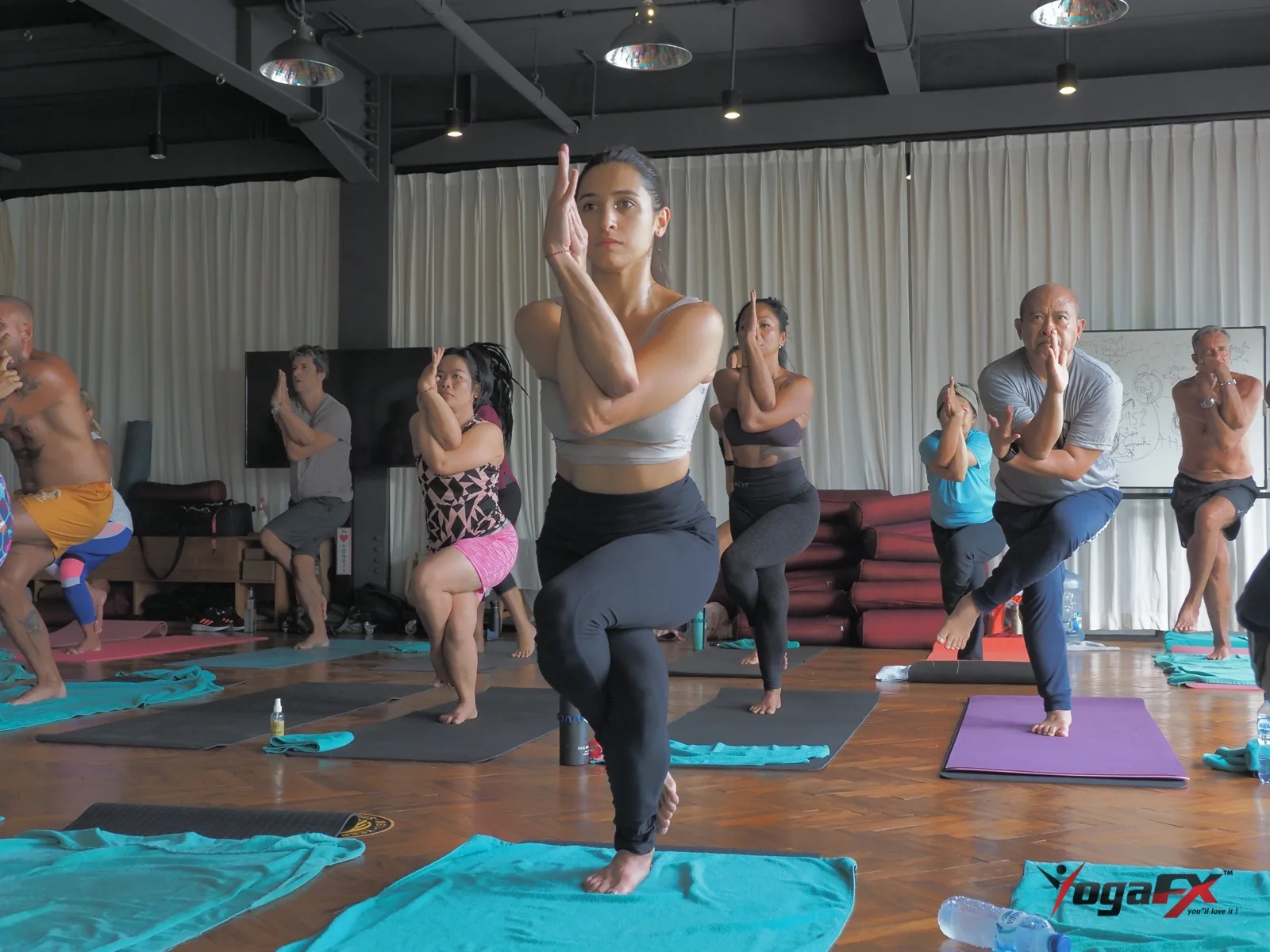
- Cross the other leg over. Lift it, cross the thigh over the standing thigh, and hook the foot behind the standing calf if your body allows it.
- Wrap the arms. Bring the arms in front at shoulder height, cross one elbow over the other, and press the palms together if the forearms reach.
- Lift the elbows, drop the shoulders. Raise the elbows toward shoulder height, but keep the shoulders away from the ears.
- Hold, breathe, unwind. Stay still, breathe slowly, then unwind in reverse and repeat on the other side.
Because eagle pose is built on the base, almost every fault starts in the first three steps. A high stance or a soft standing knee turns the whole pose into a wobble. So we teach the base before the wrap, and we repeat it until it is automatic. In class, the teacher’s dialogue sets the timing for the hold.
Eagle Pose Benefits: What Research Can and Cannot Support
We do not claim that eagle pose treats any condition. We use outside research to explain why the cues we teach make sense. The sources below come from medical and university sites, not yoga websites, and we opened each one to check what it says.
Balance on one leg
Mayo Clinic lists standing on one leg among its common balance exercises. Its page says to hold the position as long as you can keep good form, up to 30 seconds. It also says that if one-leg standing is too hard at first, you can hold onto something for support (Mayo Clinic balance exercises).
Eagle pose is a harder cousin of that exercise. It adds a deep sit and crossed limbs, so the same rule applies: keep good form first, then add difficulty slowly.
The hips of the standing leg
A 2021 study in the International Journal of Sports Physical Therapy measured gluteal muscle activation during common yoga poses. It found that Half Moon Pose and Warrior Three Pose produced the highest activation of the gluteus maximus and gluteus medius (Lehecka et al., Int J Sports Phys Ther 2021).
That study did not test eagle pose, so we do not claim a result for it. It does support a simple teaching idea: in a single-leg pose, the hip muscles of the standing leg have real work to do. That is why we cue the base first.
Shoulders, upper back and focus
Students often describe the arm wrap as a stretch across the shoulder blades, while the crossed leg opens the outer hip. That is what students feel, not a research finding, and it differs from person to person.
In the Mr. Ian Terry teaching framework, eagle pose is a strong example of coordination, because the arms and legs cross in opposite directions while you stay balanced. We go deeper on this sense of body position in our guide to proprioception exercises in the 26&2.
As always, this is education, not medical advice. Please consult a healthcare professional before you practise if you have a knee, hip, shoulder or balance problem.
Eagle Pose Mistakes, What the Student Feels, and the Spoken Cue
Every teacher sees the same handful of faults. The table pairs each one with what the student usually feels, which is the part a teacher cannot see, and a short cue that fits in one breath.
| What the teacher sees | What the student feels | Spoken cue | Easier option |
|---|---|---|---|
| Standing knee falls inward | Ankle gripping, knee twisting | “Knee over the middle of the foot.” | Toes of the top leg rest on the floor |
| Hips stay high | Legs burning late, wobble early | “Sit back, like a low chair.” | Smaller sit, hands on hips |
| Top leg will not hook | Pulling in the hip or knee | “Cross the thigh, let the foot hang.” | Rest the toes beside the standing foot |
| Elbows will not stack | Pinch across the shoulders | “Hug yourself, then lift the elbows.” | Hold opposite shoulders |
| Shoulders climb to the ears | Neck tight, jaw clenched | “Drop the shoulders, keep the elbows lifting.” | Lower the elbows a little |
| Eyes dart, breath holds | Dizzy, off balance | “One point. Slow breath.” | Shorter hold, then rest |
Notice that the cues describe a feeling, not an appearance. “Sit back, like a low chair” is something a shaking student can do right now. “Try to look more stable” is not. The easier option column matters too, because good eagle pose teaching always offers a way down.
How YogaFX Trainees Learn to Teach Eagle Pose
Knowing eagle pose and teaching it are different skills. In our 6-day hybrid format, trainees work through the same 26 postures and 2 breathing exercises every day. They coach each other out loud in posture clinics and get live feedback from Mr. Ian Terry, our Founder and Lead Instructor (E-RYT 500, with more than 12,000 teaching hours).
The sequence runs on a fixed spoken script, so trainees learn to turn a verbal command into a precise action, such as sinking the hips or lifting the elbows, without needing to look around the room.
A simple drill for the wrap
- Watch quietly. One person holds eagle pose while the observer watches for a few breaths.
- Find the biggest fault. Pick one row from the table, not all six.
- Say one cue. Use a feeling the student can act on.
- Wait and check. See whether the cue changed the pose before saying anything else.
- Swap roles. Being coached shows trainees which words help.
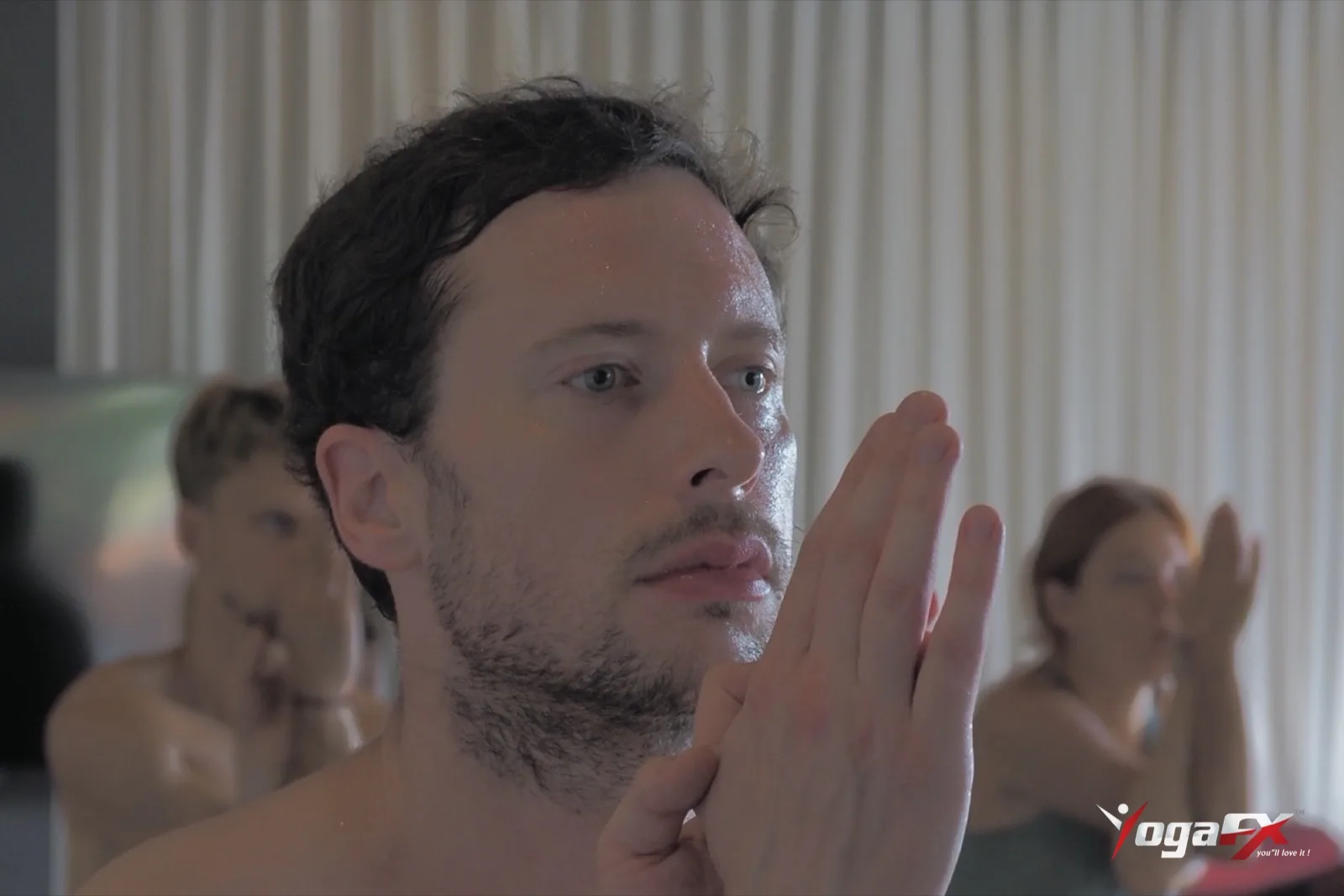
What trainees say
Many trainees arrive expecting a hard workout and leave talking about something else. Thomas said in his video review: “I didn’t expect it. I just thought it was going to be like a tough, tough physical class. That’s what I prepared for.” (Thomas, YouTube review, 2023).
Atika, who teaches, put it this way: “I had a purpose when I came here, but I never thought that I would receive more than what I expected.” (Atika, YouTube review, 2019, video below).
Eagle Pose Meaning: Garudasana and the Eagle Name
Garudasana joins two Sanskrit words. Garuda is the eagle-like bird of Hindu tradition, and asana means pose or seat. The English name simply follows the image of a bird with its wings folded in tight.
You may also see the name spelled in slightly different ways, which is common with Sanskrit written in English letters. We use Garudasana on this page, and the short English name keeps a spoken cue clear.
Eagle Pose Prep: How to Warm Up and What to Do Afterwards
Eagle pose works best when the hips, shoulders and ankles are already warm. In the standing series, the postures before it do that job. At home, a few easy moves help too.
- Ankle circles. Roll each ankle slowly, so the standing foot is ready to work.
- Chair squats. Sit back and stand up a few times to wake up the thighs and hips.
- Shoulder rolls and a cross-body hug. Open the upper back before you wrap the arms.
- Rest after each side. Stand quietly, breathe, and let the legs settle before you repeat.
Afterwards, there is no need to rush. Stand tall, let the arms hang and notice how the legs feel. In the full class, the next posture follows right away, so teachers learn to cue a calm reset between sides.
Eagle Pose Variations and When to Stop
Good teaching offers choices. A student on day one should never feel that a lighter version is a failure. It is the safe form of the same lesson.
- Toes down. Cross the leg but rest the toes on the floor for a steadier base.
- Hug yourself. Wrap the arms around the body instead of stacking the elbows.
- Smaller sit. Keep the hips higher so the standing leg works less.
- Hand on a wall. Mayo Clinic suggests holding something for support when balance is hard.
- Shorter hold. Hold only as long as you can keep good form, then rest.
Mayo Clinic adds that if you have serious balance problems or a condition that affects your bones, joints or muscles, you should get your healthcare professional’s OK before doing balance exercises. We repeat that advice here.
Stop and unwind if you feel sharp pain, dizziness or a twist in the knee. A crossed leg puts load on the knee of the standing leg, and heat adds to the effort, so drink water before class and rest when you need to.
Where Eagle Pose Sits in the Hot 26&2 Class
Eagle pose comes in the standing series, after Awkward Pose and before Standing Head-to-Knee Pose. By then your legs are warm and your attention has already worked hard. If you want the balance postures that follow, read our guides to the standing bow pulling pose and the balancing stick pose.
Heat changes what eagle pose asks of you. A warm hip wraps more easily, but a tired standing leg shakes sooner. A fixed 90-minute class at about 40°C with natural tropical heat means you meet this posture while your body is already working.
Learn to Teach Eagle Pose at YogaFX in Bali
If you want to coach postures like this with confidence, the YogaFX Bali MasterClass is built for that. It is a 6-day hybrid course: online pre-course study first, then an in-person intensive in Seminyak, Bali. The next intensive runs from check-in on Sunday 24 January 2027 to check-out on Friday 29 January 2027.
Graduates earn the Yoga Alliance RYT 200-Hour credential and the Bikram Hot 26&2 200-Hour International Yoga Certification. More than 1,500 graduates from over 80 countries have trained with us since 2017. The hot yoga teacher training in Bali page shows how the course is built.
Trainees leave knowing the 26 postures and 2 breathing exercises, and also how to say one clear cue at the right moment. Eagle pose is a good example of why that matters.
Ready to ask a question? Message Mr. Ian and the YogaFX team on WhatsApp and we will reply personally.
FAQ
What is eagle pose good for?
Eagle pose is mainly a balance and coordination posture. It asks you to stand on one leg in a half squat while your arms and legs wrap in opposite directions, so it trains focus and body awareness. Many people also feel a stretch across the shoulders and outer hips. Results vary, so ask a healthcare professional first.
Why is eagle pose so hard?
Eagle pose stacks three small challenges at once: a bent standing knee, a crossed leg, and wrapped arms. Because the limbs hide your usual reference points, balance feels shaky. Tight hips or shoulders can also block the wrap. Start with a lighter version, such as toes resting on the floor, and build slowly.
Which arm goes on top in eagle pose?
Either side works. Many teachers cross the arm and leg of the same side on top, then swap on the second round. What matters is that you repeat both sides so the body works evenly. If your elbows will not wrap, hug yourself instead, or hold opposite shoulders until the shoulders open.
What can I do if my legs or arms will not wrap?
Use a smaller version. For the legs, cross the thigh and rest the toes on the floor beside your standing foot. For the arms, hug yourself with one elbow over the other, or just cross the forearms. Never force the wrap. Sharp pain in the knee or shoulder is a signal to unwind and rest.
How do you cue eagle pose for a student?
Give one short cue at a time and name a feeling, not a picture. Start with the base, for example press the whole standing foot down, then ask the student to sit lower, then wrap the legs and arms. Wait to see the change before the next cue. Offer a lighter option each time.
Still have questions? Message Mr. Ian and the YogaFX team on WhatsApp to enrol or ask and we will answer them personally.