






Most online yoga teacher training struggles for one structural reason: the styles being taught require real-time sequencing judgment and hands-on feedback, and a recorded video cannot give you either. 26 and 2 yoga is the exception. The sequence never changes, the instruction is a fixed written script, and the room is the same temperature every time. That makes it the one major hot yoga format where self-paced online study genuinely works, because there is nothing to improvise and everything to memorise.
This article explains what that difference actually means in practice, what online study can and cannot deliver for this method, and how the YogaFX online course is built around that reality rather than against it.

What 26 and 2 Actually Is
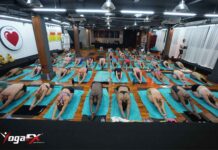
26 and 2 refers to 26 postures and 2 breathing exercises, performed in a fixed order over 90 minutes in a heated room. It is the sequence most people still call Bikram yoga. Three features define it, and all three matter for how it can be taught:
- The sequence is fixed. Posture 7 is always posture 7. There is no class planning, no theming, no seasonal variation.
- The instruction is scripted. Teachers deliver a set verbal dialogue. No music, no demonstration from the front, no improvised cues.
- The conditions are standardised. Around 40 degrees Celsius and 40 percent humidity, every class.
Practitioners sometimes read these constraints as rigidity. For anyone learning to teach, they are the opposite: they are what make the skill definable, measurable, and learnable without a teacher standing over you.
Why Generic Online YTT Underperforms, and Why This Does Not
Browse the online teacher training market and the overwhelming majority of 200-hour programmes teach Vinyasa, Hatha, or a general multi-style blend. Those formats ask a new teacher to build sequences from scratch, read a room in real time, and adapt transitions on the fly. Those are judgment skills. Judgment is developed through supervised repetition with feedback, which is exactly what a recorded module cannot provide. That gap is the honest criticism of online YTT, and it is a fair one.
26 and 2 asks for something different. The core competency is precision of delivery of a known script over a known sequence. That is a memorisation and rehearsal skill. Rehearsal skills respond extremely well to self-paced repetition, and arguably better than to a weekly group call, because you can run the same 90 seconds of dialogue forty times in a row without holding anyone else up.
| Dimension | Typical online 200-hour YTT | 26 and 2 online training |
|---|---|---|
| Core skill taught | Sequence design and real-time adaptation | Script mastery and delivery precision |
| Does it transfer to video? | Poorly, needs live feedback | Well, it is rehearsal-based |
| What changes per class | Almost everything | Nothing |
| Measure of competence | Subjective, teacher-dependent | Objective, you either know the dialogue or you do not |
| Hands-on adjustment | Central to the method | Not used, correction is verbal |
| Room conditions | Variable | Standardised at 40C |
Note the row that matters most: because 26 and 2 corrects verbally rather than by physical adjustment, the single most important teaching tool is your voice and your timing. That is trainable at a distance in a way that hands-on assisting is not.
What Online Study Can and Cannot Give You
Being straight about this is more useful than overselling it.
What it does well
- Dialogue memorisation. Audio files you can run on a commute beat any amount of silent reading.
- Posture study. You can pause and rewind a demonstration as many times as you need, which no live class allows.
- Anatomy and philosophy. Lecture content is identical whether delivered in a room or on a screen.
- Removing the cost barrier. No flights, no accommodation, no time off work.
What it cannot replace
- Teaching a live heated room. Managing 25 sweating bodies and holding your voice for 90 minutes in 40 degree heat is a physical skill learned in the heat.
- Being corrected in the moment. Someone telling you your cue landed two seconds late is worth a lot.
- Cohort pressure. Standing up in front of your peers is uncomfortable and formative.
This is why YogaFX runs the two as a sequence rather than as competing products. Online builds the knowledge and the script. The 6-day intensive in Seminyak builds the live-room capability on top of it. If you want the format comparison in detail, see online yoga teacher training versus hybrid.
What Is Inside the YogaFX 26 and 2 Online Course
The course is built in two layers, matching the two things you actually need.
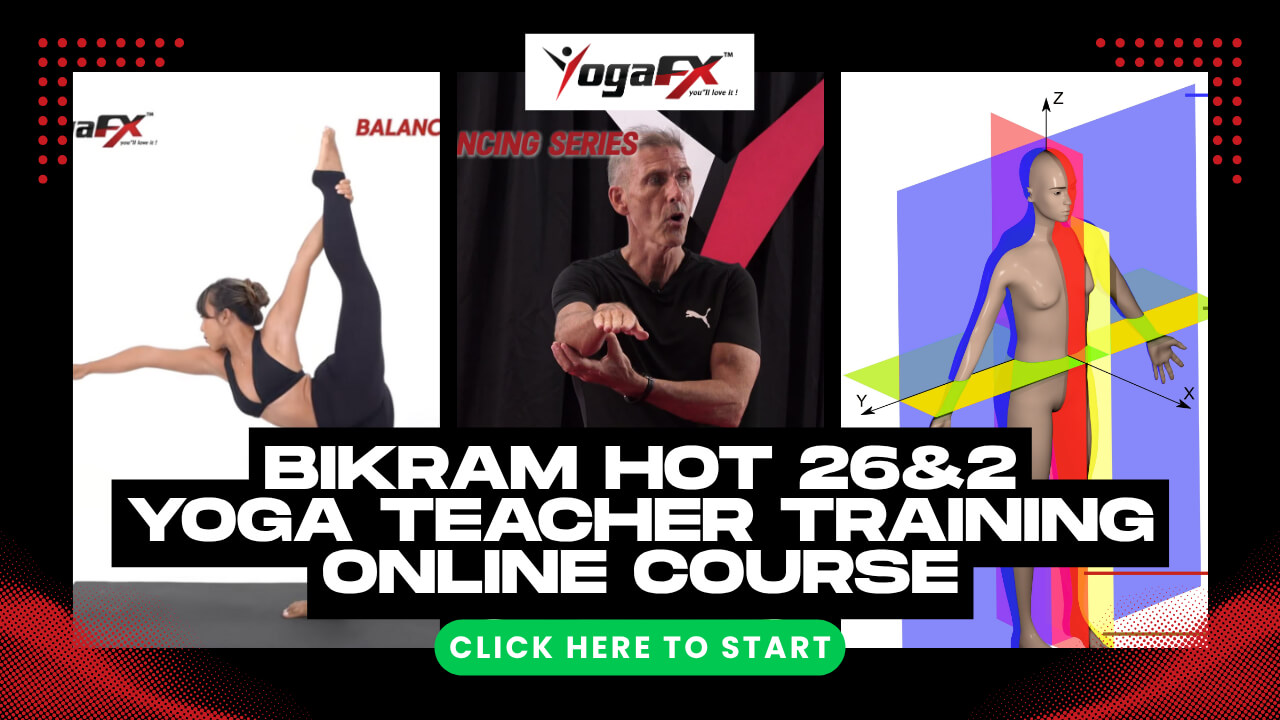
Layer one, the method. The complete Standing and Floor Series dialogue as a downloadable workbook, the same dialogue as MP3 audio files for practice away from a screen, and full posture demonstrations for both series on video. In the demonstration modules you control everything: stop, rewind, mute the audio, or cover the script and teach the demonstrator using your own developing dialogue.
Layer two, the academic requirement. Fifteen short-format premium lectures with accompanying workbooks, covering anatomical planes of movement, the muscular system, the skeletal system, the eight limbs of yoga and more. Assessment is multiple-choice per module rather than written essays.
There are no scheduled video calls, no live chat rooms, and no deadlines. Access is for life, including a 250-page reference manual. Full pricing and enrollment detail is on the Bikram Hot 26&2 online course page, and you can sample the course free before paying.
Who Teaches It, and Why That Is the Real Differentiator
Course platforms are commodities now. Method-specific expertise is not.
The curriculum was built by Mr. Ian Terry, E-RYT 500 and founder of YogaFX, who trained for five years, from 2014 to 2019, directly with Bikram Choudhury, the founder of the Bikram Hot 26&2 method, and has accumulated more than 12,000 hours of practical teacher training in this specific method. He has certified over 1,500 graduates from more than 80 countries since 2017, and in June 2026 was appointed Master Trainer of the Republic of Indonesia Yogasana Sports Federation.
The posture demonstrations are filmed with Miss Ivara Candra Kartika, who completed this training in 2023 and took Gold and Bronze at the World Yogasana Sports Federation Championships in Ahmedabad in June 2026, alongside Silver at the Asian Yogasana Championships in the UAE in August 2025. Three years separated her training from her world medals. When you are studying a posture breakdown, you are watching someone who learned it on this same curriculum.
That combination, a specialist E-RYT 500 in the original method plus a world medallist demonstrating it, is the part a generic multi-style online programme structurally cannot match. More detail on the team is on the YogaFX teacher page.
The Evidence Base You Will Be Teaching From
Students ask what the practice does. Knowing the actual research, rather than repeating studio marketing, is part of teaching credibly.
A randomised trial conducted through Harvard-affiliated Massachusetts General Hospital (Nyer et al., 2023) found that 59 percent of participants cut their depression symptoms by half or more after eight weeks of heated yoga, versus 6 percent on the waitlist. A 2025 systematic review across 43 studies and 942 participants reported consistent improvements in flexibility, bone density, and general well-being. Work by Tracy and Hart (2013) measured an approximate 20 percent increase in posterior chain strength across an eight-week Bikram programme, and research from the University of Wisconsin (Porcari, 2014) recorded an average energy expenditure of 333 kcal for women and 460 kcal for men across a 90-minute class.
These are averages from controlled research, not promises about any individual. Anyone with an existing medical condition should consult a healthcare professional before beginning a heated practice, and how to handle that conversation with a prospective student is covered in the lecture series.
How to Judge Any 26 and 2 Online Course
If you are comparing options, these six questions separate a real method-specific training from a repackaged general course:
- Does it include the full dialogue, in text and audio? Without the script you are learning postures, not teaching.
- Are all 26 postures and both breathing exercises demonstrated in full? Partial coverage means partial preparation.
- Who built the curriculum, and how many hours have they taught this method specifically? General yoga credentials are not the same thing.
- Is access permanent or time-limited? Dialogue work continues for years after certification.
- Can you preview real course material before paying? If not, ask why.
- Is there a credited path to in-person training? Online alone cannot teach the live heated room, so a provider with no in-person route is selling you an incomplete pathway.
On the last point specifically, the YogaFX online course fee is credited in full against the live Bikram Hot 26&2 MasterClass in Bali, and also satisfies its pre-course preparation requirement. Starting online costs you nothing if you later travel.
FAQ
Can you really learn 26 and 2 yoga teaching online?
Yes, for the knowledge and script components, which is most of the curriculum. Because the sequence is fixed and the instruction is a set written dialogue, mastery is a rehearsal skill that self-paced repetition suits well. Teaching a live heated room is the part that still benefits from in-person practice.
How is this different from an online Vinyasa or Hatha teacher training?
Vinyasa and Hatha training teach you to design sequences and adapt in real time, which needs live feedback. 26 and 2 teaches one fixed sequence and one fixed script, so the skill is precision rather than improvisation. That difference is why this method transfers to online study far better.
Are there live Zoom sessions in the YogaFX online course?
No. There are no scheduled video calls, no live chat rooms, no essays, and no deadlines. Every module is self-paced with lifetime access. That design is deliberate, because most students enrolling are working full-time or in a timezone where fixed live sessions are impractical.
Is 26 and 2 the same thing as Bikram yoga?
It is the same 26 postures and 2 breathing exercises in the same fixed order. Many studios and training academies now use the method name rather than the founder’s name. The sequence and the dialogue structure are unchanged, which is why the terms are used interchangeably in practice.
Do I need to be able to do all 26 postures before enrolling?
No. There is no audition, no flexibility requirement, and no minimum practice history. The curriculum is designed to bring a committed beginner to teaching-level understanding. Several graduates who went on to medal internationally began with a limited practice.