















Hot yoga heart rate usually sits in a moderate band. In one 2015 study of a 90-minute heated class, the average was about 80% of predicted maximum for men and 72% for women, with peaks near 92% and 85%. Trainees should expect that range, then learn to track how fast it settles.
Mr. Ian Terry is our founder and an E-RYT 500 with more than 12,000 teaching hours. This guide lines up the published numbers with the way we coach trainees in Bali. It isn’t medical advice. Please consult a healthcare professional before you start hot yoga, especially with a heart condition, high blood pressure or regular medication.
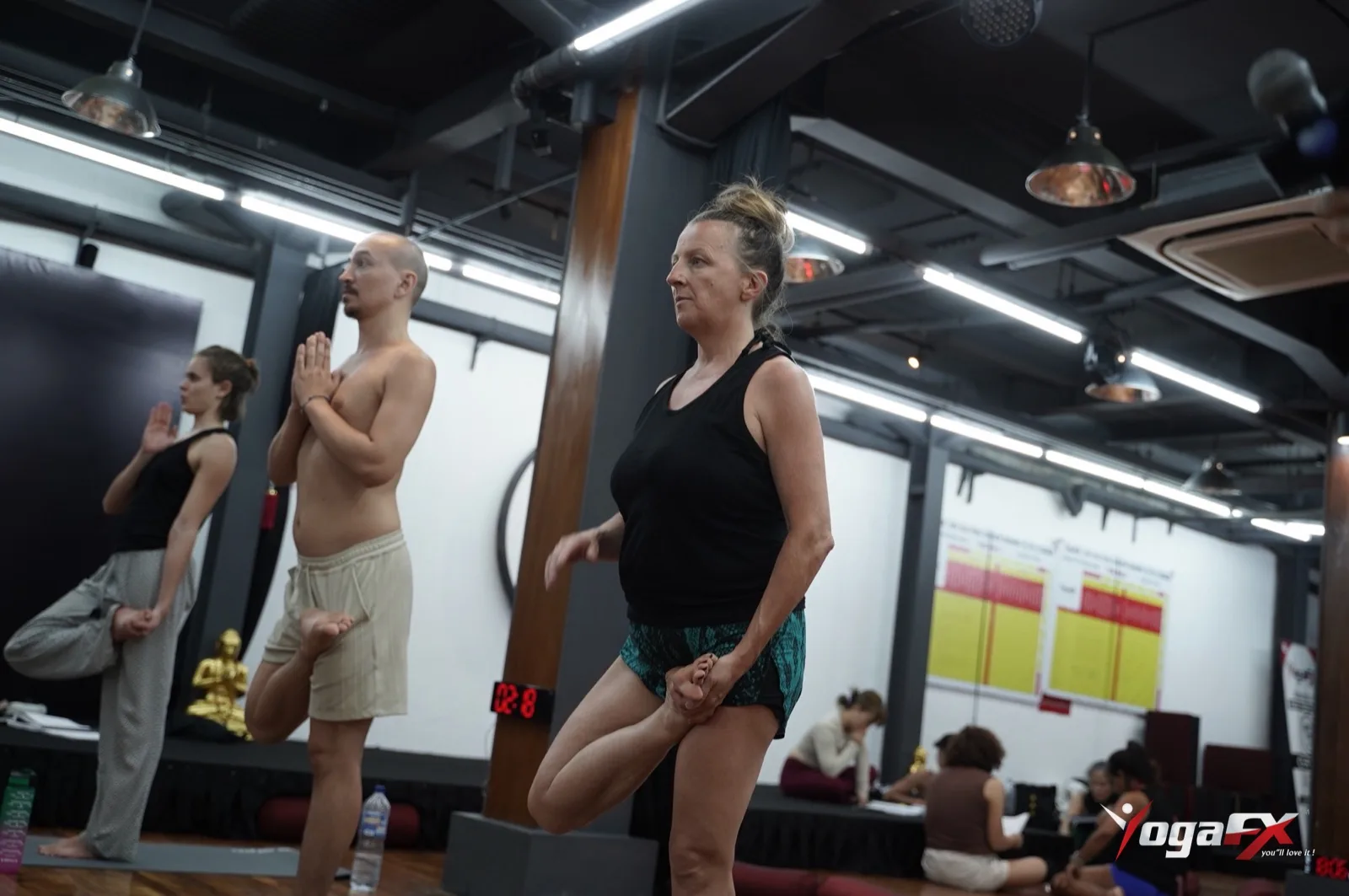
Hot Yoga Heart Rate in a 90-Minute Class: What Researchers Measured
Most trainees ask the same thing in week one: how hard is my hot yoga heart rate working in there? Two small studies give the best answer we could open and check. They differ in length and in who took part, so we’ll take them one at a time.
The 2015 Study: Hot Yoga Heart Rate Over 90 Minutes
A team led by Emily Quandt reported the results through ACE ProSource in 2015. Twenty healthy volunteers took part: seven men and 13 women, aged 28 to 67, all regular Bikram practitioners. They did a 90-minute class in a room at 105°F and 40% humidity.
The average heart rate was about 80% of predicted maximum for men and 72% for women. The highest readings reached 92% for the men and 85% for the women. The page says the men’s percentages were significantly higher.
Core temperature rose too. The average highest reading was 103.2°F for men and 102.0°F for women, and one man reached 104.1°F. Seven of the 20 volunteers went above 103°F, yet none showed signs of heat intolerance. The authors still called the rise in heart rate and core temperature “alarming”, given how little the body moves in a yoga class.
The 2020 One-Hour Study
A 2020 crossover study in the International Journal of Exercise Science looked at a shorter class. Sixteen experienced practitioners (14 women and 2 men, average age 40) did a one-hour Bikram sequence twice, once at 105°F and once at 74°F.
Average heart rate was 113 beats per minute in the heat and 109 at room temperature, and the authors found no significant difference. Before the class started, the group’s average was about 85 in both rooms. So the heat nudged the pulse up a little, but the class itself did most of the work.
Earlier work from the University of Wisconsin-La Crosse (Porcari and colleagues, 2014) also put a 90-minute class near 80% of maximum heart rate. We name that study without a link, because the page blocked our automated check, and we take no other figures from it.
What These Hot Yoga Heart Rate Numbers Don’t Tell You
Both studies are small. Most volunteers were experienced, and women made up the majority, so a first-week trainee may not match the averages. Neither study tested people with heart conditions. That’s why we treat the figures as a map, not a promise.
- Expect a moderate average. The 2015 class averaged 72% to 80% of predicted maximum.
- Expect short peaks. The highest readings reached 85% to 92% in the same class.
- Expect a gap between feel and load. In the 2020 study, heat added only a few beats to the average.
- Expect wide individual spread. Age, fitness, heat adaptation and medication all move your hot yoga heart rate.
Hot Yoga Heart Rate Zones: What the Percentages Mean in Beats
A heart rate zone is a band of your maximum heart rate. Most fitness watches use five zones. In the common scheme, Zone 1 is light recovery at about 50 to 60% of maximum, and Zone 5 is a near-maximal effort at about 90 to 100%.
Nobody knows their true maximum without a lab test. A common rule of thumb says maximum is 220 minus your age, but it can be off by 10 beats or more. So treat the table below as a rough guide, not a result.
| Age | Estimated max (220 minus age) | Typical class average (72% to 80%) | Typical peak (85% to 92%) |
|---|---|---|---|
| 30 | 190 bpm | 137 to 152 bpm | 162 to 175 bpm |
| 40 | 180 bpm | 130 to 144 bpm | 153 to 166 bpm |
| 50 | 170 bpm | 122 to 136 bpm | 145 to 156 bpm |
Take the 40-year-old row. An average of 130 to 144 beats lands in the middle zones, and a peak near 160 touches the upper end of Zone 4. That fits what trainees tell us about hot yoga heart rate: a long, steady effort with a few hard moments.
Your own hot yoga heart rate will differ. A trainee on a beta blocker, for example, may see a lower pulse for the same effort. Ask your doctor how your medicine affects heart rate in the heat.
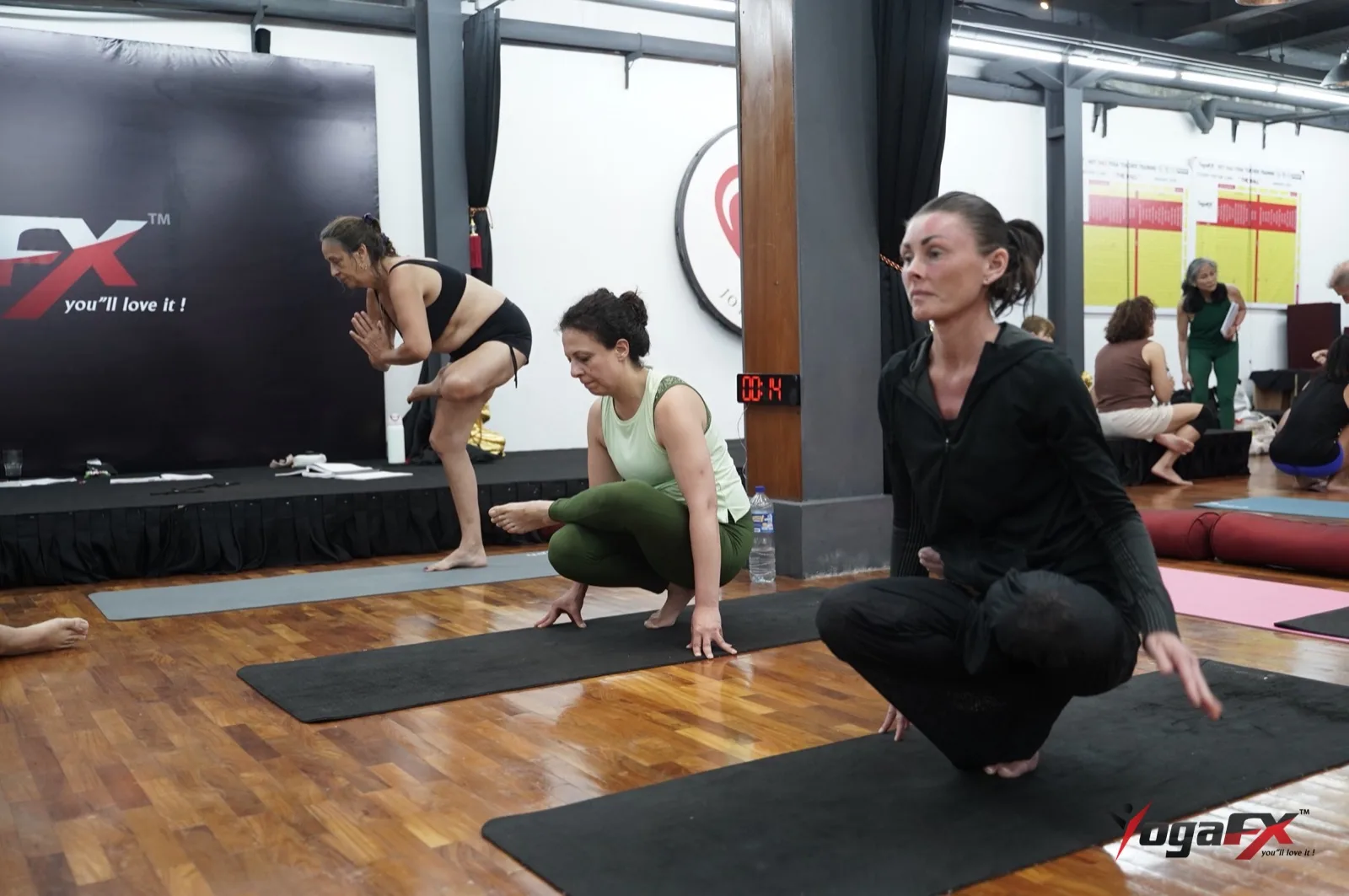
Where Hot Yoga Heart Rate Rises and Falls in the Sequence
The 26&2 sequence never changes, so a teacher learns where the room tires. That’s a real advantage for tracking. Our Definitive Guide to Hot 26&2 Yoga maps the hot yoga heart rate in a class this way. It is a teaching map, not a measured result, and the zone you reach depends on age, fitness, heat adaptation and medication.
| Stage of class | What the heart tends to do | What to track | What a trainee does |
|---|---|---|---|
| Standing series | Highest demand of the class. Long holds, balance and heat push the pulse up. Short peaks may come in Balancing Stick, Standing Bow Pulling Pose, Triangle and Standing Head-to-Knee. | Breath rhythm and balance, more than the clock | Keep breathing through the nose. Ease off a little if speech or balance breaks. |
| Savasana between postures | The pulse settles. Short rests are the first chance to drop toward a recovery zone. | How quickly breathing slows | Lie still, relax the face and let the breath lengthen. |
| Floor series | Lower demand overall. Backbends such as Cobra, Locust, Bow and Camel lift the pulse again. | Dizziness when you come up | Move slowly between postures and sip water in the breaks. |
| Final Savasana | The clearest recovery window. Heart rate and breathing settle toward rest. | Pulse after a few quiet minutes | Stay down. Sit up slowly, and keep sipping. |
Effort, Rest and Renewed Effort
The Guide describes some standing postures as short bursts of about 20 to 30 seconds, followed by controlled recovery. That is the idea behind effort, rest and renewed effort. It is a coaching description, and no study we opened measured it posture by posture.
Because the order is fixed, a trainee can predict the hot yoga heart rate wave. You know the hardest stretch is early. So pace the first half, and don’t spend everything before the floor series begins. For more on the whole sequence, read our Definitive Guide to Hot 26&2 Yoga.
How to Track Your Heart Rate in a Hot Room
Tracking a hot yoga heart rate sounds simple, but a hot, wet room makes it tricky. Here’s the routine we teach trainees. It starts before you walk in and ends after you leave.
Before Class
- Note your resting pulse. Sit for two minutes and count it. In the 2020 study, the group’s pre-class average was about 85.
- Drink early. Start the day before, so you walk in well hydrated. Our hot yoga hydration guide explains how.
- Eat lightly. A heavy meal in a hot room sits badly.
During Class
- Use the talk test first. If you can say a short sentence between breaths, you are fine. If you can manage only a word or two, ease off.
- Watch the trend, not one reading. A single spike in a standing posture means little. A pulse that stays high through Savasana means more.
- Treat a wrist watch as rough. We haven’t opened a study on watch accuracy in heat, so use readings as a hint and trust your breath and balance.
After Class
- Check the settle. Sit for a few minutes and notice whether your hot yoga heart rate and breathing slow.
- Compare across weeks. If the same class feels easier and your pulse settles sooner, your fitness and heat tolerance are improving.
- Rehydrate and rest. Replace fluid and give your body time to cool.
None of this needs special equipment. The point of tracking hot yoga heart rate is attention. A teacher who can read their own pulse and breath finds it much easier to read a room of 30 students. If you also wonder whether a class counts as cardio, our guide to whether hot yoga is a cardio workout covers it.
When a High Heart Rate Means Stop
A raised hot yoga heart rate is normal in the heat. A raised pulse with other symptoms isn’t. The Mayo Clinic lists the signs of heat exhaustion: a weak, rapid pulse, heavy sweating, faintness, dizziness, fatigue, nausea, muscle cramps and headache.
Its advice is plain. Stop all activity and rest, move to a cooler place, and drink cool water or sports drinks. It also says heatstroke is life-threatening and happens at a core body temperature of 104°F (40°C) or higher. Anyone who becomes confused, loses consciousness or can’t drink needs immediate help.
That figure matters here. In the 2015 study, one man’s core temperature reached 104.1°F, and the ACE page notes that heat illness risk rises at 104°F. So the middle of a class isn’t a place to push through warning signs.
- Chest pain or pressure. Stop at once and get urgent medical help.
- A racing or irregular heartbeat that doesn’t settle after a few minutes of rest.
- Dizziness, confusion or faintness. Sit or lie down, and tell the teacher.
- Nausea, cramps or a pounding headache. Leave the room, cool down and sip water.
Please speak to your doctor before heated classes if you have a heart condition, high blood pressure or take medicine that affects heat tolerance. Our guide to whether hot yoga is good for your heart goes deeper on heat safety.
What Trainees Say After Learning to Read the Room
Reviews don’t measure a hot yoga heart rate. They do show what changes when people learn to pay attention in a hot room. Rachel spoke at her graduation ceremony in January 2024:
“I came for healing. I found family, community, inspiration. I found new dreams for myself.” (lightly trimmed, punctuation added)
Rachel, YouTube review, 2024
Jenya described her own three weeks of training in a graduation video. Her words about the heart are literal here, because opening the heart is what she says changed:
“You helped me to open my heart, and I really feel that my heart was opened, and it’s absolutely different feeling now.”
Jenya, YouTube review, 2023
Neither review is a clinical result. They are first-hand accounts. They point to the same skill we train, which is noticing what your body is doing before it shouts.
How YogaFX Trains Teachers to Watch Heart Rate in Bali
YogaFX teaches this in the Bikram Hot 26&2 Yoga Teacher Training MasterClass, led by Mr. Ian Terry. Classes run about 90 minutes at 40°C and 40% humidity, using natural tropical heat in Bali, not electric heaters. You study online first, then complete a 6-day intensive.
Mr. Ian Terry trained for five years, from 2014 to 2019, with the founder of the method. He also holds the title of Master Trainer from the Republic of Indonesia Yogasana Sports Federation. Since 2017, YogaFX has trained more than 1,500 graduates from 80+ countries.
- Certification: Yoga Alliance RYT 200-Hour plus the Bikram Hot 26&2 200-Hour International Yoga Certification.
- Next batch: check-in Sunday 24 January 2027 and check-out Friday 29 January 2027 at Soham Wellness Center in Seminyak.
- Price: Early Bird US$1,899 (normally US$1,999), with payments from US$250 a month and no interest.
- Try a class first: your first class at our Seminyak studio is free with the Free 1-Day Guest Pass.
- What you practise: pacing your hot yoga heart rate, reading breath and balance, and cueing a full room safely.
See how the days are laid out in our guide to the 6-day hybrid yoga teacher training in Bali.
FAQ
What is a normal heart rate during hot yoga?
There is no single normal number. In a 2015 study of 20 regular practitioners, the average over a 90-minute class was about 80% of predicted maximum for men and 72% for women. Age, fitness, heat adaptation and medication all shift the figure, so track your own trend instead.
Does hot yoga increase heart rate?
Yes, mildly to moderately. A 2020 study of 16 experienced practitioners found an average of 113 beats per minute in a heated one-hour class and 109 at room temperature, which was not a significant difference. The heat mostly changes how effort feels, so watch your breath as well as your pulse.
Why is my heart rate so high after hot yoga?
Your body is still cooling itself, so the pulse stays raised for a while after class. Sit down, sip water and breathe slowly. If it keeps racing, or comes with dizziness, chest pain or confusion, stop all activity, cool down and seek medical help. Tell your doctor if it happens often.
Is a high heart rate in hot yoga dangerous?
A raised pulse is expected in a heated room. The warning sign is a high pulse together with dizziness, nausea, cramps, faintness or confusion, which Mayo Clinic lists among heat exhaustion symptoms. Stop, move somewhere cooler and drink cool fluids. Seek urgent help for confusion, fainting or chest pain.
Can you do hot yoga with a heart condition?
Heat adds load to the heart, and some medicines change how you handle it, so the safe answer depends on you. Please consult a healthcare professional before booking any heated class. Then tell your teacher about the condition before the room warms up, so they can watch you with care.
Still have questions? Message Mr. Ian and the YogaFX team on WhatsApp, and we will answer them personally. Ask about the Bali training, your first hot class or how we teach safe pacing. Chat with us on WhatsApp any time.