







Awkward pose (Utkatasana) is a squat held for 60 seconds in total, split into three foot positions and six 10-second holds. In the Hot 26&2 class it is the first long test for your thighs. A good teacher paces students through it by watching knees, heels and breath, not by changing the timing.
Awkward Pose: What the Legs Do for 60 Seconds
Mr. Ian Terry, E-RYT 500 and Founder and Lead Instructor of YogaFX, has taught this posture across more than 12,000 hours. He treats it as the place where a student learns what sustained really means. The knees bend, the arms reach forward, and then nothing moves for ten long seconds.
That stillness is the point. Awkward pose is an isometric hold, so the muscles tighten while the joints barely move. Mayo Clinic describes isometric exercises as tightening a muscle or group of muscles without a noticeable change in length. For trainees, that explains why the pose feels harder than its shape suggests.
Here is the posture at a glance, as we teach it at YogaFX:
Where Awkward Pose Sits in the Hot 26&2 Class
Awkward pose arrives early in the standing series, after the opening warm-up and before Eagle pose. By then the body is warm, so the legs are ready to work. That timing matters, because the strength you spend here is the strength you need for the balance postures that follow.
Our own guide to the Hot 26&2 class explains why the standing series usually creates the greatest cardiovascular demand. It names awkward pose first among the postures with sustained lower-body muscular engagement. You can read the full breakdown in our guide to the 26 postures.
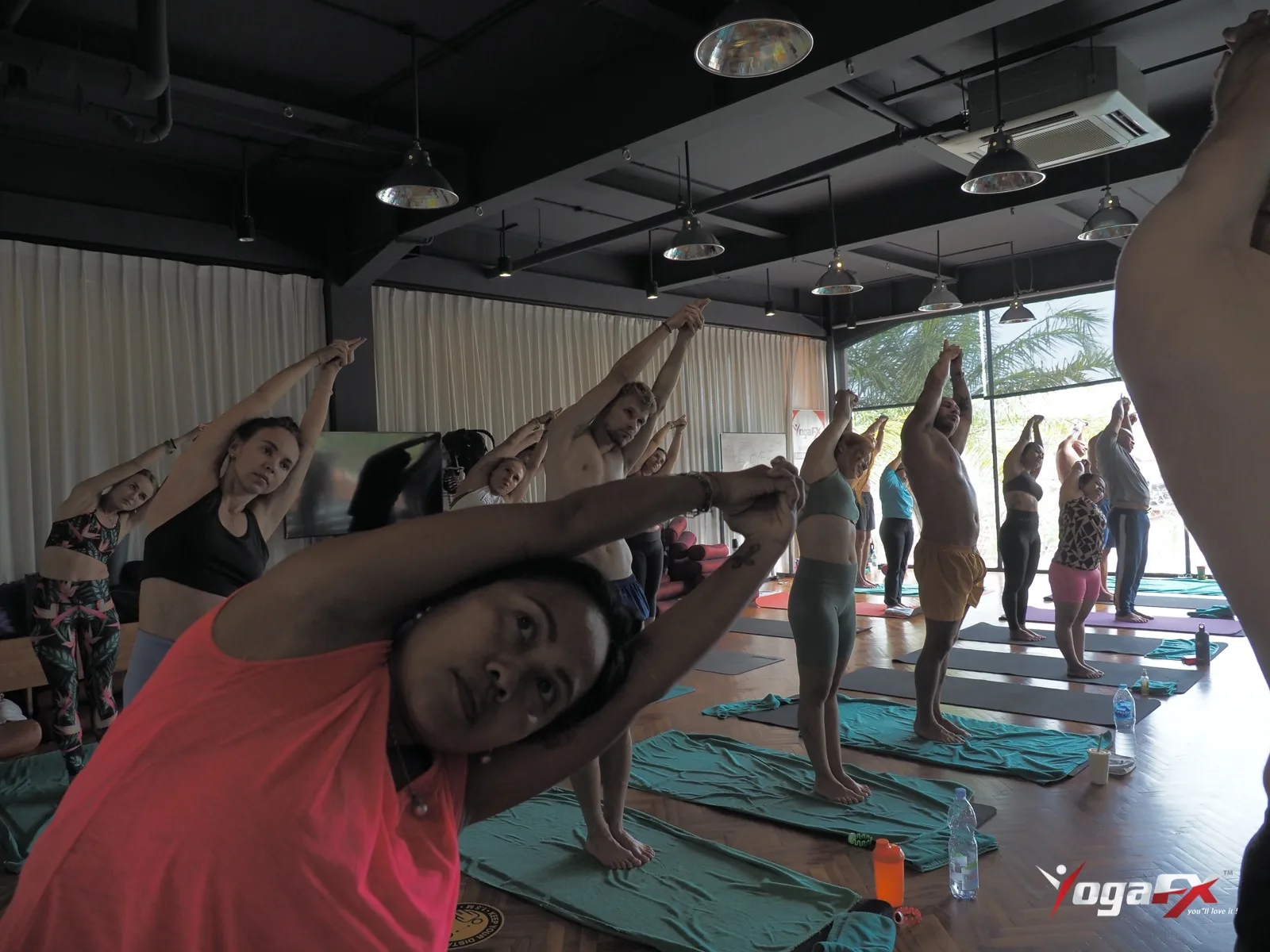
The room adds to the load. YogaFX classes run 90 minutes in natural tropical heat of about 40 °C and 40% humidity, with a scripted dialogue, no demonstration and no music. Because nobody shows you the shape, you’ll feel every second of it.
One study gives a sense of scale. A 2014 University of Wisconsin study (Porcari et al.) reported about 333 kcal for women and 460 kcal for men across a 90-minute class, with heart rates near 80% of maximum. That figure covers the whole class, not one posture. Still, it shows that a heated standing series asks a lot of the heart as well as the legs.
Sustained Leg Work: What Each Part Loads
Each part of awkward pose loads the same muscles in a different way. Students rarely notice the shift. Teachers can’t miss it, because the shift tells them where to look next.
| Part | Foot position | Where trainees feel it | What breaks down first | Teacher pacing response |
|---|---|---|---|---|
| 1 | Hip-width, heels down | Front of the thighs and glutes | The chest drops as the quads tire | Lift the chest first, then ask for depth |
| 2 | Up on the toes, sit halfway | Calves, ankles and thighs | The heels sink toward the floor | Cue “lift the heels” and accept a shallower sit |
| 3 | Feet together, balls of the feet | Thighs, inner thighs and feet | Knees drift apart and the breath tightens | Praise knees together at any depth, then breathe |
Notice that the first fault in each row is different. That is why a teacher cannot repeat one correction all the way through. Instead, you read the part, predict the fault and speak to it before it spreads across the room.
How a Teacher Paces Students Through Awkward Pose
The script fixes the timing, so pacing is not about speeding up or slowing down. It is about your voice, your order of corrections and where you stand. Trainees practise all three in the MasterClass.
Three jobs for your voice
- Name the next part early. A student who knows what is coming can brace for it instead of guessing.
- Give one correction per student. Two cues at once, in a hot room, usually land as noise.
- Return to the breath. Steady breathing is the quickest way to calm shaking legs.
What to scan from the front of the room
A mirror and a clear view make your job easier. Scan the same way each time so nothing gets missed:
- Knees first. Knees collapsing inward are the safety fault, so they come before any depth or style point.
- Heels in Part 2. Dropped heels turn the second part back into the first.
- Breath. A held breath shows in the shoulders and jaw. Cue the exhale.
- Colour and focus. A student who looks faint or weak needs to stop and cool down.
Pacing different students
- First-week beginners. Stay shallow and keep the chest tall. Depth can come in later classes.
- Tired legs late in the week. Remind them that the hold is short and the next posture is different.
- Students with sore knees. Keep the depth small and the knees tracking over the toes. Ask them to check with a healthcare professional if the pain is new or sharp.
Mr. Ian Terry trains this skill by having trainees teach each other, then adjusting how they speak, not just what they say. If you want the foot, knee and arm positions for each part in detail, a part-by-part alignment guide on our sister site covers them.
Balance work builds on the same leg strength. Our article on proprioception exercises shows how the postures after awkward pose train the ankles, knees and hips to share the load.
Common Awkward Pose Faults a Teacher Should Spot
Faults are easier to fix when you can name them in two seconds. Trainees keep a short mental list, and they use it in every class they teach. The table below shows what each fault looks like from the front of the room.
| Fault | What you see | Likely cause | Short fix |
|---|---|---|---|
| Forward lean | Chest folds toward the thighs, back rounds | Tired quads or tight ankles | Chest up, weight back, sit a little higher |
| Knees falling in | Knees angle toward each other | Weak hips or too much depth | Press the knees out over the toes |
| Sinking heels | Heels touch down in Part 2 | Calves tire, depth chasing | Lift the heels and accept less depth |
| Dropping arms | Arms sag below shoulder height | Shoulder fatigue | Reach long, fingers level with the eyes |
Most students show two faults at once. Pick the safer one first, because a second correction can wait until the next hold. That small habit keeps the room calm and keeps your instructions short.
Drills Trainees Use to Learn Teaching This Posture
In the MasterClass, nobody learns to teach by reading a script silently. Trainees practise out loud, in pairs and in small groups, and they get feedback straight away. Three drills help most with awkward pose:
- The two-second scan. One trainee holds the pose while the other names the single most important fault. It trains your eye to prioritise.
- The one-line cue. The teacher gives a correction in five words or fewer. If it takes longer, it is too long for a hot room.
- The breath check. The teacher watches only the shoulders and jaw for ten seconds, then cues the exhale. It sounds simple, but it changes how the whole class holds.
As a result, graduates leave with a habit rather than a memorised list. They look, choose, speak and move on. That rhythm matters more than any single cue, because a full room won’t wait for you to think.
It also protects you. When you are teaching, you stand while others squat. Therefore your legs can stay fresh enough to notice what the room needs, instead of drifting into your own comfort. Trainees often tell us that this was the biggest surprise of the week.
Why the heat changes how you teach it
Heat makes everything slower, including your own thinking. For example, a cue that feels clear in a cool classroom can sound muddled at 40 °C. So trainees practise in the real room, with real sweat, until the words come out cleanly.
Students also tire faster in heat, which is why the pacing of your corrections matters. Give the early fixes to the students who struggle first, and save fine-tuning for the stronger ones. By the second set, the room should feel steady, not rushed.
How Awkward Pose Fits Into a Six-Day Training Week
A six-day intensive leaves little room for guessing, so the week is built to repeat the standing series until it feels familiar. Awkward pose shows up in every practice class, which means trainees feel it, then teach it, then feel it again the next morning.
- Early in the week. Trainees learn the three parts and where the legs complain first. Most are surprised by how short ten seconds can feel.
- Midweek. Practice moves from feeling to speaking. Trainees describe the parts aloud and receive feedback on tone and order.
- Late in the week. Trainees teach the posture to the group, with the pacing habits above, while Mr. Ian Terry watches the room and the teacher together.
That repetition is deliberate. Posture clinics and group teaching turn a sore pair of thighs into a clear, calm voice. If you can hold your breath steady while your legs burn, you can talk a room through it. As a result, awkward pose becomes one of the most useful postures to practise teaching, even though it looks plain on paper.
What the Research Says About Sustained Squat Holds
No study has tested awkward pose on its own, so we use nearby evidence and say plainly where it stops.
- Blood pressure. Mayo Clinic notes that isometric exercises may help lower and control blood pressure. It also warns that people with high blood pressure should work at a lower intensity, and that holding the breath and straining can cause a dangerous rise in blood pressure.
- Strength. The same page says isometric work builds strength mainly in the position you hold, so awkward pose is not a full strength programme. A 2013 study by Tracy and Hart reported about a 20% rise in posterior chain strength after Bikram practice, along with changes in flexibility and body composition. That result belongs to the whole class.
- Heat. The CDC advises people who exercise in heat to drink more water than usual without waiting until they are thirsty, to pace activity, and to stop and cool down if they feel faint or weak.
In short, the research supports steady breathing, careful pacing and good hydration. It does not prove that this one posture changes your health. If you have heart problems, high blood pressure or knee trouble, please consult a healthcare professional before practising. Our guide to hot yoga hydration covers what trainees drink across the training week.
Sources: Mayo Clinic on isometric exercises and CDC on heat and athletes. The 2014 Porcari and 2013 Tracy and Hart studies are named from the published record and are not linked here.
What Trainees Say About Learning the Standing Series
We cannot offer a review about awkward pose alone. These graduates describe the room, and every word is theirs.
“I’m beginner for yoga. First day I feel my body broken, but today easy for me.”
Febri, YouTube graduation video, 2024
Another graduate, Novi, thanked the teachers for their lessons and wished everyone health and spirit, in her graduation video (translated from Indonesian, 2024).
Learn to Teach Awkward Pose With Mr. Ian Terry in Bali
Reading about a posture only takes you so far. At YogaFX, Mr. Ian Terry teaches awkward pose and its dialogue in the 6-day hybrid MasterClass, which pairs an online pre-course with an intensive in Bali. Graduates earn a Yoga Alliance RYT 200 certificate plus the Bikram Hot 26&2 200-hour certification.
- Next intensive: check-in Sunday 24 January 2027, check-out Friday 29 January 2027, at Soham Wellness Center in Seminyak.
- Payment: instalments start from USD 250 per month with no interest.
- Community: 1,500+ graduates from 80+ countries have trained with YogaFX.
See the full format on our Hot Yoga Teacher Training in Bali page, then message Mr. Ian Terry to ask your own questions.
FAQ
What muscles does awkward pose work?
Awkward pose mainly works the front of the thighs and the glutes. Part 2 adds the calves and ankles, and Part 3 brings in the inner thighs and feet. The lower back also works to keep the torso upright. It is a sustained squat, so effort builds over all six holds.
How long do you hold awkward pose in hot yoga?
In the Hot 26&2 class you hold each of the three parts for 10 seconds, then repeat the set. That makes six holds and about 60 seconds of work in total. The timing stays the same every class, so students can measure their own progress.
Why do my legs shake in awkward pose?
Shaking usually means the thigh muscles are tiring under a steady load. It is common, especially for beginners, and often eases as you practise. Keep breathing, lift the chest and reduce your depth if needed. If you feel faint, pain or dizziness, stop and rest.
Is awkward pose safe if I have sore knees?
It depends on the knee and the cause, so please consult a healthcare professional first. In class, you can stay shallow and keep your knees tracking over your toes. Depth matters less than alignment. If pain is new or sharp, ease out of the pose and tell your teacher.
How do teachers cue awkward pose without demonstrating it?
In the Hot 26&2 class the teacher follows a scripted dialogue and does not demonstrate. Trainees learn to describe each part in words, keep a steady tempo and correct from the front of the room. Mr. Ian Terry trains this delivery in the six-day MasterClass in Bali.
Still have questions? Message Mr. Ian Terry and the YogaFX team on WhatsApp and we will answer them personally.