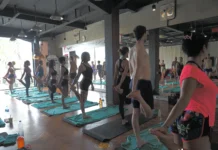




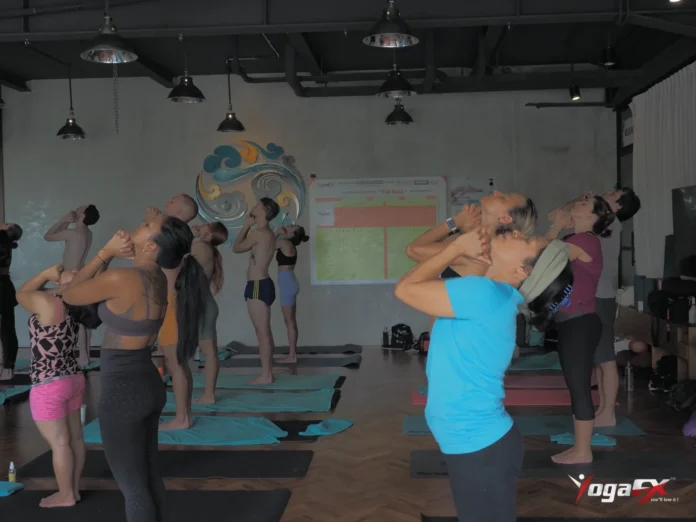
Standing head to knee pose is a one-leg balance in which you hold one foot, kick that leg straight in front of you and fold your forehead toward the knee. At YogaFX in Bali, trainees do not only learn to do it. They learn five short spoken cues that help another student find it.
Most students meet standing head to knee pose and feel three things at once: a wobble, a pull behind the kicking knee and a strong urge to look at the floor. That’s normal. One leg holds your whole body still in a room near 40°C, while the other leg stretches away from it.
This guide is written for the future teacher. It shows the five cues in the order we teach them, the fixes for a tight body, what independent health sources say about balance and hamstring stretching, and how trainees practise cueing. If you want the plain step-by-step version first, read the posture guide on 26and2yoga.com.
Standing Head to Knee Pose in the Hot 26&2: The Five Cues
A cue is one short sentence a teacher says while a student is holding the posture. In the Hot 26&2 class, the spoken dialogue tells the student what to do. Trainees learn something extra: which cue to add when the pose starts to go wrong. Here are the five cues we teach for the Dandayamana Janushirasana, in the order they work.
- Lock the standing leg. Press the whole foot into the floor and straighten the knee with a firm thigh.
- Take the foot. Bring the knee up and hold the foot with both hands, fingers interlocked under the ball of the foot.
- Kick it straight. Push the heel forward until the leg is as straight as your back allows.
- Square the hips. Keep both hip bones facing the mirror and the chest tall.
- Fold with control. Bend the elbows, bring the forehead toward the knee, then come up the same way you went down.
Because the order never changes, a tired trainee can still remember it, and a student can learn to trust it. Most falls start at the first cue, not the last. The standing leg is the foundation, so a soft knee or a rolling ankle shows up as a wobble two steps later.
Why every cue starts at the foot
Why start at the foot? Because every other part of standing head to knee pose depends on it. When the standing leg is firm, the hips can stay level, the chest can lift and the kicking leg has something to push against. When the standing leg is soft, the whole body spends its effort just staying upright. Trainees learn to check the foot before they say anything else.
You can see where this posture sits among the others in our guide to the 26 and 2 yoga poses, and our full guide to Hot 26&2 yoga explains how the whole class fits together.
What the Standing Head to Knee Pose Trains: Balance, Length and Focus
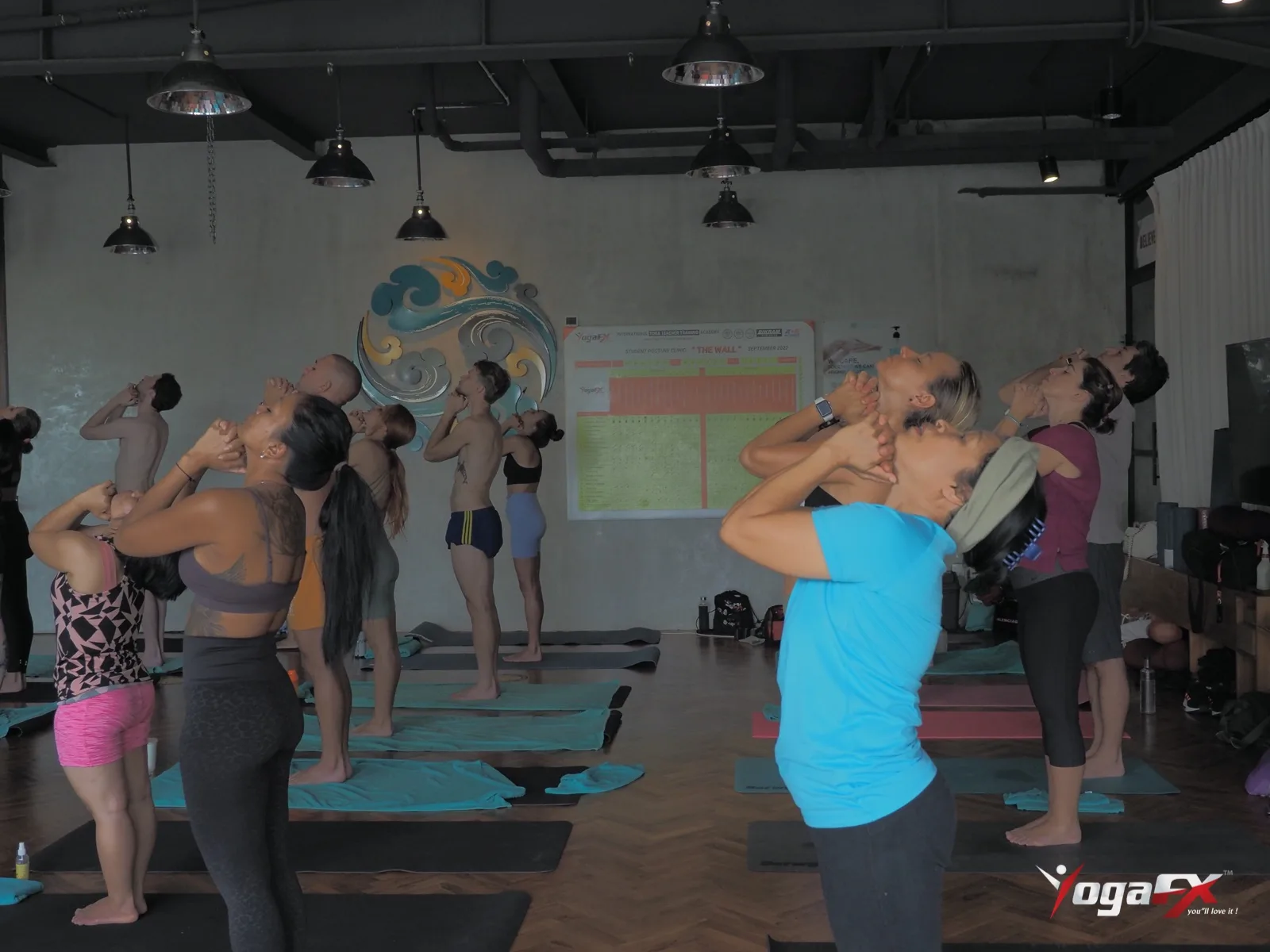
Standing head to knee pose looks like one move, but it trains three things at the same time. Balance keeps you upright. Length lets the kicking leg straighten. Focus stops the first two from falling apart. Independent health sources back up the ideas behind each one.
Balance you can feel and balance you can teach
Mayo Clinic lists a single-leg stand among its basic balance exercises. Its page says to hold the position as long as you can keep good form, up to 30 seconds, then repeat on the other side. It also says that if the exercise is too hard at first, you can hold onto something for support (Mayo Clinic balance exercises).
The same page says older adults especially need balance exercises to help prevent falls. That is a good reason to learn how to teach balance well, because the students you teach later won’t all be young.
Standing head to knee pose is a harder cousin of that exercise. You add a held foot, a forward fold and a hot room. So the same rule applies: good form first, more difficulty later. A teacher who says “hold longer” without saying “hold well” misses the point.
Hamstring length without forcing it
The back of the kicking leg takes the stretch. UMass Memorial Health describes a hamstring stretch in which you keep the knee, neck and back straight, do not bounce, and hold for 30 to 60 seconds (UMass Memorial hamstring stretch). Mayo Clinic Sports Medicine says much the same: keep it gentle, breathe freely, and do not bounce or hold a painful stretch (Mayo Clinic Sports Medicine).
Both pages describe a seated stretch, so they are not about this posture directly. The principle still carries over. We hold the shape with control, stop where the back stays long, and never pulse in and out.
Strength and the whole class
A 2013 randomized trial by Tracy and Hart, published in the Journal of Strength and Conditioning Research, put healthy young adults through 24 hot yoga sessions in 8 weeks. The abstract reports increased deadlift strength, higher lower back and hamstring flexibility, and modestly lower body fat than the control group (PubMed abstract).
That study looked at the whole class, not this posture alone, and its authors call it exploratory. So treat it as a hint about what regular practice can build, not as a promise. Results vary from person to person.
Fixes for a Tight Body: What Trainees Learn to See and Say
Tight hamstrings, stiff hips and short breath are the most common limits we see in standing head to knee pose. A teacher cannot stretch a student, so the job is to spot the one thing that is off and say one short sentence about it. The table pairs the six things trainees spot most often with a cue that helps.
| What you see | Where it comes from | Cue to try |
|---|---|---|
| Kicking leg stays bent, foot droops | Tight back of the leg | “Push the heel forward, only as far as your chest stays tall.” |
| Back rounds, shoulders hunch toward the leg | Reaching for the knee instead of folding | “Lift the chest first, then fold.” |
| Standing hip slides to the side | The kick pulls the pelvis out of line | “Both hips face the mirror.” |
| Standing foot rolls, toes grip | Weight has moved to the edge of the foot | “Spread the toes and press the whole foot down.” |
| Grip slips, elbows flare | Sweat and a loose hold | “Lock the fingers under the ball of the foot.” |
| Eyes wander, breath stops | Effort has taken over the face | “One point in the mirror. Breathe through the nose.” |
Notice that most cues are about the base, the hips and the eyes, not about the kick. A teacher who only says “kick higher” fixes almost nothing. A teacher who names the one thing that is wrong, in plain words, fixes it quickly.
Three softer versions to offer
- Bent knee, tall chest. Hold the foot with the kicking knee bent and keep the torso upright. This suits new students and tight hamstrings.
- Fingertips on a wall. Mayo Clinic suggests holding onto something for support when balance is hard, and a wall does the job.
- Shorter hold. A steady few breaths with good form beats a long, shaky one.
A lower, softer version isn’t a failed pose. It teaches the same lesson, and most students build the full shape over weeks. Over weeks of practice the balance sense improves, and the same fold feels calmer.
How Trainees Practise Cueing the Standing Head to Knee Pose in Bali
Knowing a posture and teaching it are different skills. A teacher has to see the problem, choose one cue and say it clearly while the student is still holding the shape. Cueing standing head to knee pose takes repetition, so we practise it every day.
In our 6-day hybrid format, trainees work through the same 26 postures and 2 breathing exercises daily. In the posture clinics they coach each other out loud and get live feedback from Mr. Ian Terry, our Founder and Lead Instructor (E-RYT 500, with more than 12,000 teaching hours).
Mr. Ian trained for five years, from 2014 to 2019, with the founder of the Bikram Hot 26&2 method. Since 2017, more than 1,500 graduates from over 80 countries have trained with YogaFX.
A simple cueing drill
- Watch first. One trainee holds the pose while the observer watches quietly for a few breaths.
- Name one problem. The observer picks the biggest issue from the table, not all six.
- Give one cue. One short sentence, in the same order as the five cues.
- Check the change. Wait to see whether the cue worked before saying anything else.
Here is how it sounds in a clinic. A trainee watches a classmate whose hip is sliding sideways while the leg kicks. Instead of a long explanation, the trainee says, “Both hips face the mirror.” The classmate squares up, the standing knee steadies and the fold gets deeper without any force. One cue, one change.
Short cues work best in a hot room, because attention is already stretched. “Press the whole foot into the floor” can be acted on at once. “Try to feel more grounded” cannot.
Why slow work beats fast work
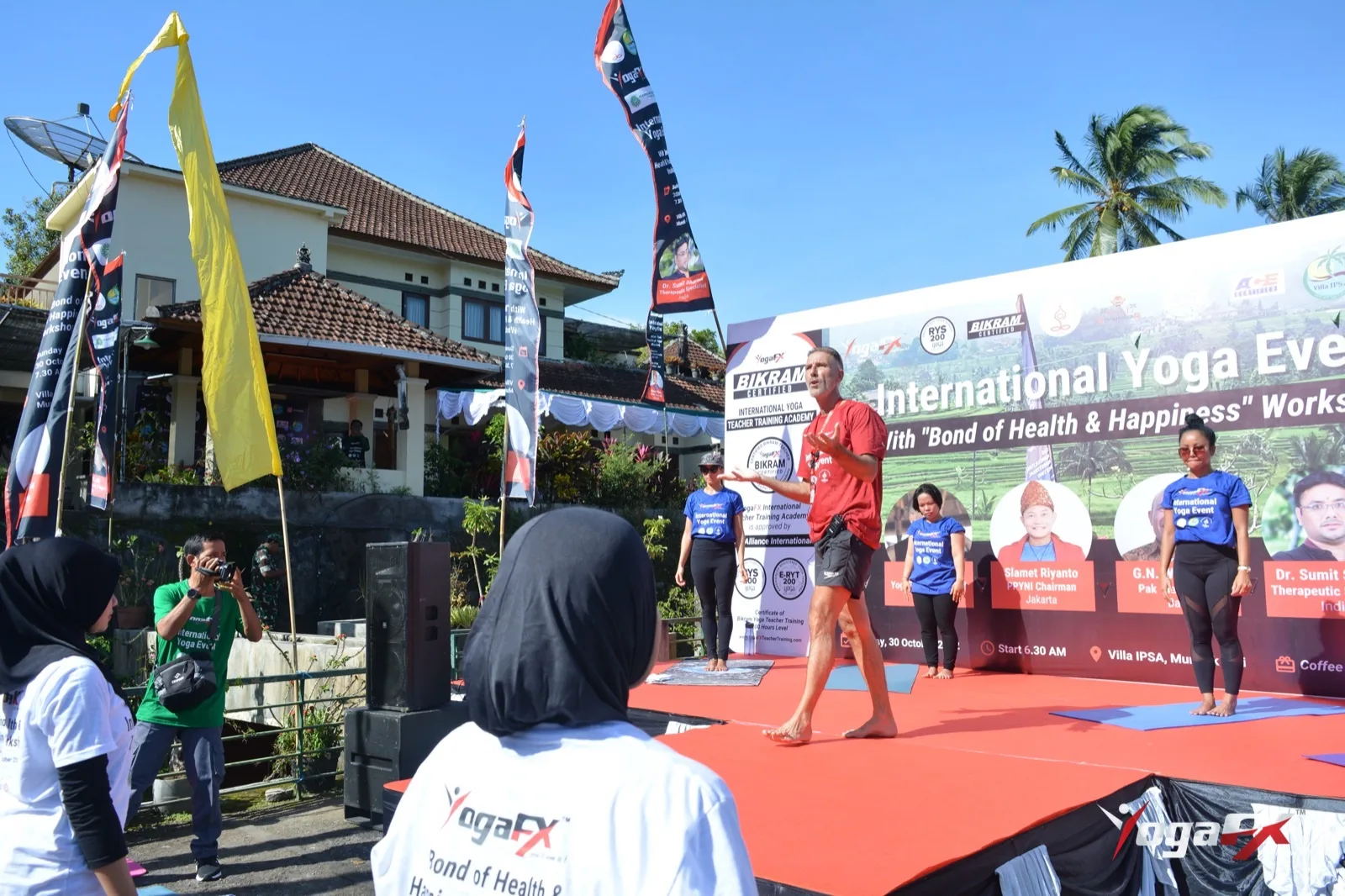
Mr. Ian Terry puts the belief behind his teaching this way: “There can be no greater investment than the one that you make in your health, because without it, nothing else matters.” For cueing, that means patience. A trainee who learns to hold one posture well this week finds the next balance posture easier next week.
What Trainees Say About Learning to Teach in Bali
Students rarely describe a single posture when they look back. They describe the effort and the way the training pushed them. Here are three reviews from YogaFX trainees, with first names only.
Agnieszka said in a YouTube review: “I was afraid that I didn’t manage. I did it. I am very happy.” (Agnieszka, YouTube review, 2023, watch the video).
Michele wrote: “Out of the ordinary organization and professionalism.” (Michele, Google review, 2022). Villin wrote: “Truly life changing experience, blessed to have had this opportunity.” (Villin, Google review, 2022).
Agnieszka’s short video review is below. It takes under a minute to watch.
Where Standing Head to Knee Pose Sits in the Class
Standing head to knee pose comes early in the standing series, after Eagle and before Standing Bow Pulling. By then your legs are warm and your attention has already worked hard. That placement helps, because a warm leg is easier to lock and a trained mind is easier to fix on one point.
If you want a calmer single-leg balance first, our eagle pose guide shows how trainees cue the posture just before this one. The next posture in the series, covered in our standing bow pulling pose guide, asks for the same locked standing leg with a kick in the opposite direction.
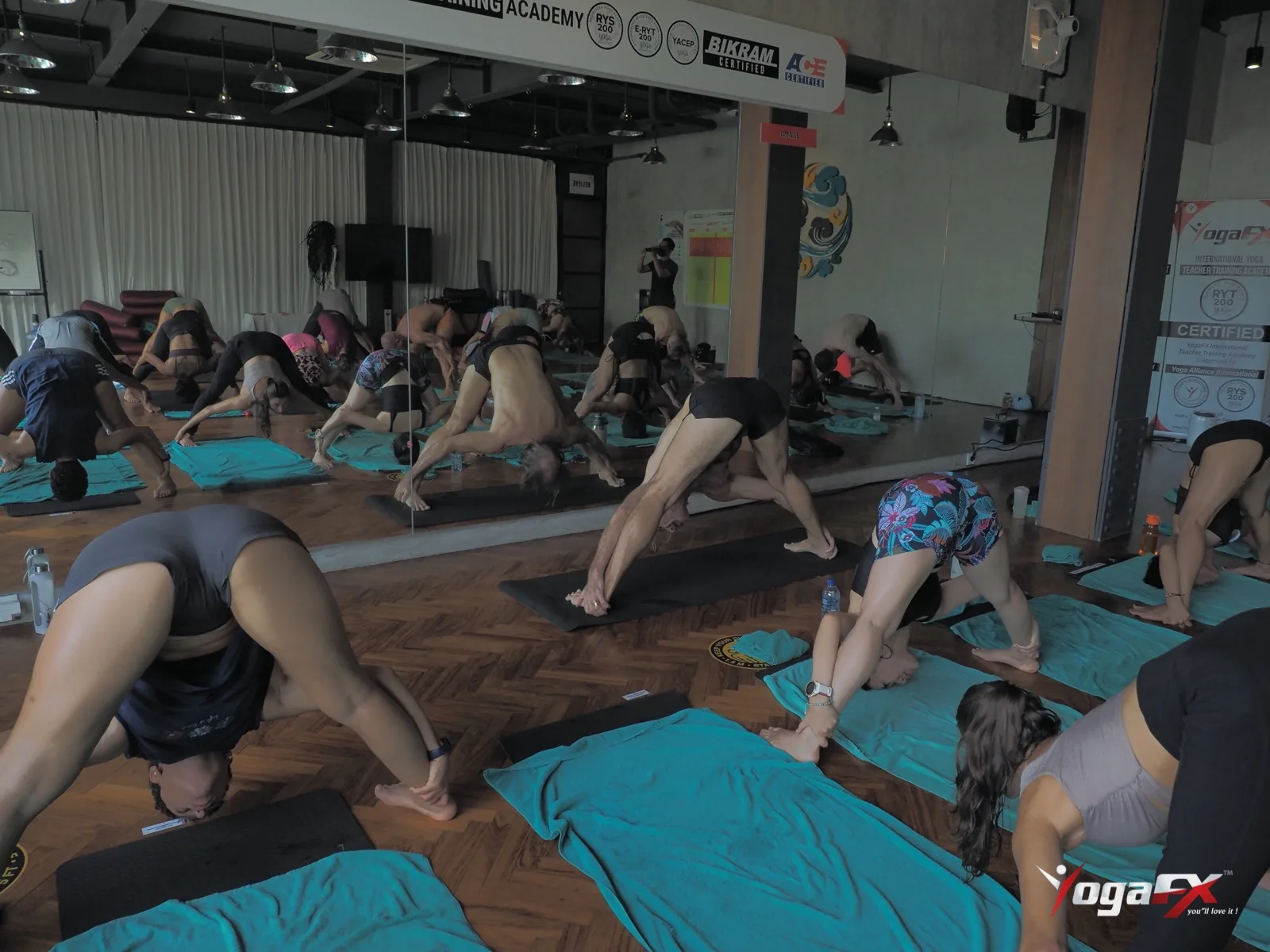
Like every posture in the method, you do it twice. You work both sides in the first set, then repeat both sides in the second set. The repeat shows you what you changed, and it gives a trainee a second chance to try a better cue.
Staying Safe: When to Ease Out
Good teaching offers choices, and it also knows when to stop. Mayo Clinic advises people with serious balance problems, or a condition that affects the bones, joints or muscles, to get a healthcare professional’s OK before balance exercises. We repeat that advice. This article is education, not medical advice, so please consult a healthcare professional before you practise standing head to knee pose.
Come down if you feel sharp pain, dizziness, or a pinch in the knee, hip or lower back. Heat adds load, so drink water before class and rest between sides when you need to. Tell your teacher about any injury before class starts.
Learn to Teach the Standing Head to Knee Pose at YogaFX in Bali
If you want to cue postures like this with confidence, the YogaFX Bali MasterClass is built for that. It is a 6-day hybrid course: online pre-course study, then an in-person intensive in Seminyak, Bali. The next intensive runs from check-in on Sunday 24 January 2027 to check-out on Friday 29 January 2027.
Graduates earn the Yoga Alliance RYT 200-Hour credential and the Bikram Hot 26&2 200-Hour International Yoga Certification. See the full 26 and 2 yoga teacher training programme for the curriculum. Want to feel the pose before you decide? Ask about the free 1-Day Guest Pass at our Seminyak studio.
Ready to ask a question? Message Mr. Ian and the YogaFX team on WhatsApp and we will reply personally.
FAQ
How do you cue standing head to knee pose?
Give one short cue at a time, in a fixed order: lock the standing leg, take the foot, kick it straight, square the hips, then fold. Watch the pose first and fix the biggest problem only. Wait to see whether the cue worked before you add another.
Should the standing knee be locked in standing head to knee pose?
In the Hot 26&2 the standing leg is cued firm, with the thigh tight and the whole foot pressed down. Firm does not mean pushed backwards. If the knee feels sore or the leg shakes, soften the cue and ask the student to ease out. Check with a healthcare professional about knee pain.
What is a good standing head to knee pose modification for tight hamstrings?
Hold the foot with a bent knee and keep the chest tall. Straighten the leg only as far as the back stays long. You can also rest fingertips on a wall for support. A softer version teaches the same lesson, and most students lengthen the leg a little over weeks.
Why does my standing leg shake in standing head to knee pose?
Shaking is the foot and ankle making tiny corrections, so it is not failure. Check that your weight sits across the whole foot, fix your eyes on one point in the mirror and breathe out slowly. If the shaking turns to pain or dizziness, come down and rest.
How is standing head to knee different from standing separate leg head to knee?
In standing head to knee you balance on one leg and fold toward the lifted leg. In standing separate leg head to knee you stand with feet wide apart and fold the forehead toward one knee. They are different postures at different points in the sequence, and each has its own cues.
Still have questions? Message Mr. Ian and the YogaFX team on WhatsApp to enrol or ask and we will answer them personally.