













Seasonal affective disorder yoga is a sensible addition to a winter routine, not a treatment. The National Institute of Mental Health (NIMH) lists light therapy, psychotherapy, antidepressants and vitamin D as the treatments for SAD, and yoga is not among them. A class can add a fixed time, regular movement and company.
That’s the honest answer, and it shapes the rest of this page. We read the guidance from the NIMH and Mayo Clinic, then asked one practical question: where does seasonal affective disorder yoga, and a heated class in particular, fit into a winter routine that those sources already describe?
Medical note: this page is general information, not medical advice. Seasonal affective disorder is a form of depression. If your mood stays low for days at a time, please consult a healthcare professional, such as a doctor or a mental health specialist, before you change any treatment.
What Seasonal Affective Disorder Yoga Can and Cannot Do
Start with what a class cannot do. It cannot replace a light box, therapy or medication. The NIMH says light therapy and vitamin D are treatments for winter-pattern SAD, while psychotherapy and antidepressants treat depression in general. Yoga appears on neither list.
What seasonal affective disorder yoga can do is smaller, and it is still useful. Think of it as a way to carry habits that doctors already recommend. For example, a class can give you:
- A fixed time. Mayo Clinic advises scheduling reliable times to wake up and go to bed each day.
- Regular movement. Mayo Clinic says exercise and other physical activity help relieve stress and anxiety, and both can make SAD symptoms worse.
- Company. The NIMH lists social withdrawal, the feeling of “hibernating”, among winter-pattern symptoms. A class puts you in a room with other people.
None of this is a treatment claim. If a website promises that seasonal affective disorder yoga works as a treatment, it is ahead of the evidence.
What Seasonal Affective Disorder Is, in Plain Words
The NIMH describes SAD as a type of depression with a recurrent seasonal pattern. In most cases, symptoms start in late fall or early winter and go away during spring and summer. Many people feel a little “down” when the days get shorter, but SAD isn’t just the winter blues.
The depression symptoms are the familiar ones, such as a sad, anxious or “empty” mood most of the day, nearly every day, for at least 2 weeks. Winter-pattern SAD adds a few of its own:
- Oversleeping, which doctors call hypersomnia.
- Overeating, particularly a craving for carbohydrates, which can lead to weight gain.
- Social withdrawal, the feeling of hibernating.
Who Gets It, and Why
Who gets it? The NIMH says SAD usually begins in young adulthood, occurs much more often in women than in men, and is more common in people living farther north, where winter daylight is shorter. It gives Alaska and New England as examples, against Texas and Florida.
Bali sits just south of the equator, so daylight there changes far less across the year than it does in northern countries. That is context, not a promise. Moving to the tropics is not a treatment plan, and nobody should book a flight to treat a medical condition.
Why does it happen? Researchers are still working that out. Mayo Clinic says the specific cause remains unknown, and it lists three suspects: reduced sunlight that may disrupt your body clock, a drop in serotonin, and a shift in melatonin. The NIMH reports that people with winter-pattern SAD may make too much melatonin, which can increase sleepiness.
Light and Rhythm: Where Seasonal Affective Disorder Yoga Fits
Light is the centre of the medical advice. Mayo Clinic calls light therapy one of the first-line treatments for fall-onset SAD. The NIMH describes sitting in front of a very bright light box every day, usually first thing in the morning. Because of that, the sensible rule for any seasonal affective disorder yoga plan is simple: never crowd out a light session your doctor recommends.
A studio is not a light box, and a class is not light therapy. Still, the timing logic carries over. If you already wake at the same hour for a morning session, a class can sit right after it. As a result, the day starts the same way every time, which is the point of a routine.
Mayo Clinic adds a safety note worth repeating. Tell your provider if you have bipolar disorder before you start light therapy or an antidepressant, because both can trigger a manic episode. So ask first, then build the routine.
Heat and Seasonal Affective Disorder Yoga: What the Research Says
The best-known heated yoga trial came from a team at Massachusetts General Hospital (Nyer et al., 2023, Journal of Clinical Psychiatry, PubMed 37883245). People with depression took heated classes for 8 weeks, and 59% saw their symptoms drop by half or more, against 6.3% of the waitlist group.
That result is promising, but read it carefully. The trial studied depression, not seasonal depression, and it ran for 8 weeks rather than a whole winter. As a result, it cannot tell us whether seasonal affective disorder yoga with heat works. Anyone who says seasonal affective disorder yoga is proven is stretching the data.
What the Heat Actually Feels Like
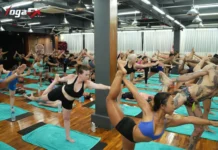
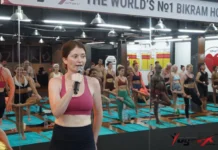
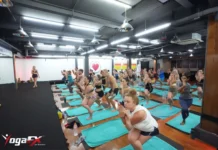
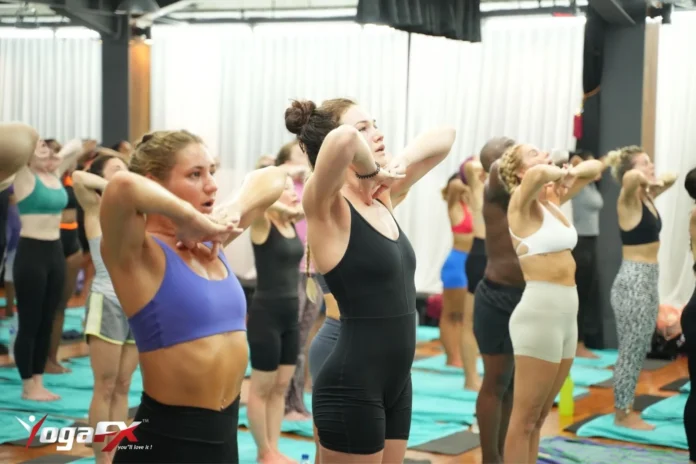
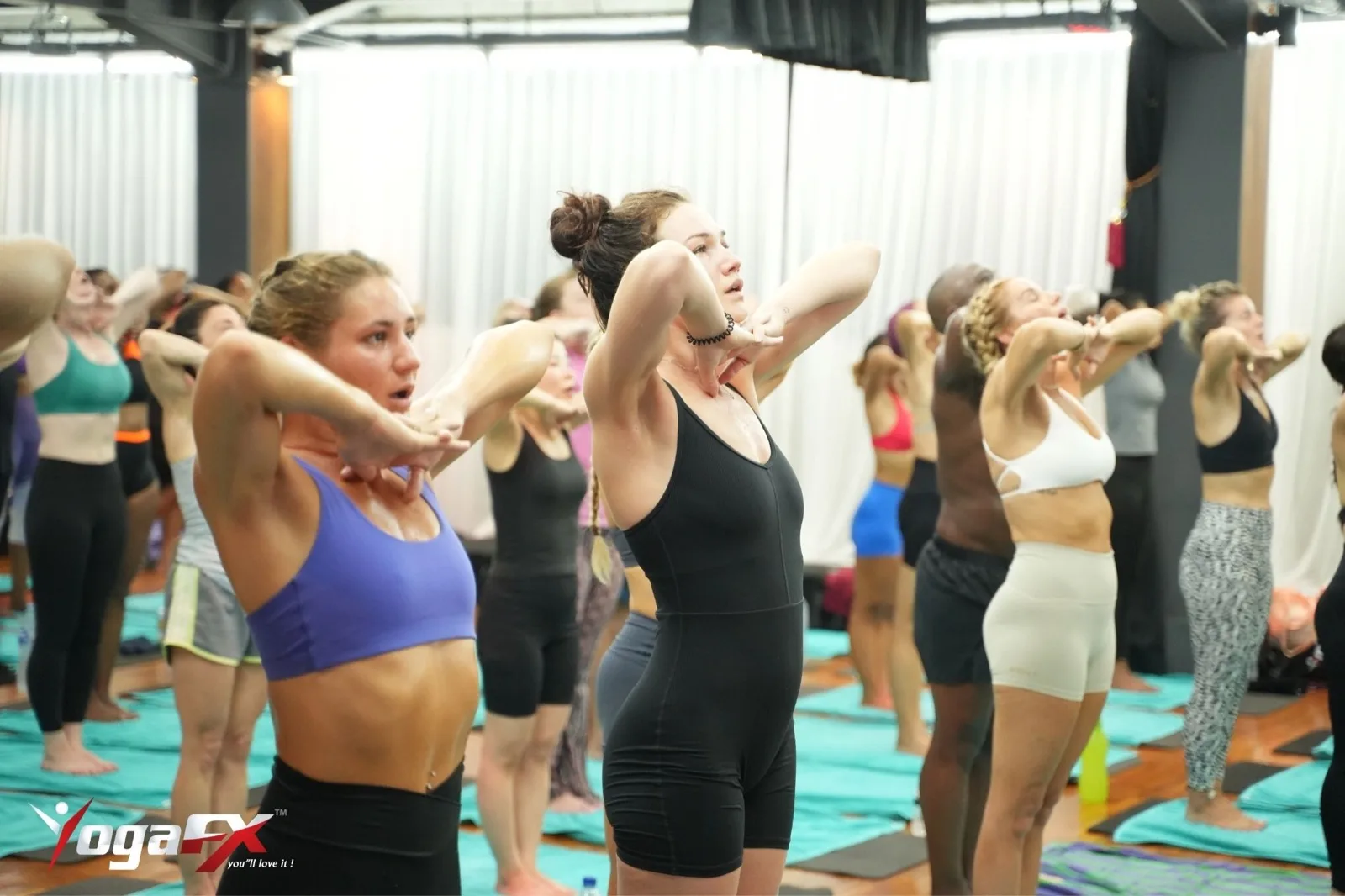
So what does the heat actually feel like? A YogaFX class runs 90 minutes at about 40 degrees C and 40% humidity. In Bali the warmth is natural tropical heat, not an electric heater. The teacher speaks a scripted dialogue, with no demonstration and no music, so you follow the words rather than a performance.
Heat isn’t for everyone. Some people find it uncomfortable, and a good teacher says so plainly. If you take medication or live with a medical condition, ask your doctor before you try a heated class. If the room feels wrong, you can sit out and rest.
Routine: The Part With the Strongest Support
If one idea from this page sticks, make it this one: for seasonal affective disorder yoga, rhythm beats intensity. The advice that appears again and again is about rhythm: wake up at the same time, move your body, get light early, and stay in touch with people. A class can carry several of those at once.
| Routine anchor | What Mayo Clinic or the NIMH says | How a class day can carry it | What it does not replace |
|---|---|---|---|
| Wake and bed times | Schedule reliable times to wake up and go to bed each day (Mayo Clinic). | A booked morning class gives you a reason to get up at the same hour. | A sleep plan from your doctor if sleep is a problem. |
| Physical activity | Regular exercise helps relieve stress and anxiety (Mayo Clinic). | 90 minutes of guided movement, several times a week. | Therapy or medication for depression. |
| Morning light | Light therapy is a first-line treatment, usually in the morning (Mayo Clinic, NIMH). | Walk to the studio in daylight, or practise outdoors. | A light box that your doctor recommends. |
| Company | Social withdrawal is a winter-pattern symptom (NIMH). | A room of trainees and students who expect to see you. | Talking to a counsellor or a trusted person. |
A Gentle First Week
If you and your doctor agree that a class is fine, keep the first week small. The goal is repetition, not effort. Here is a plan that many new students find easy to keep:
- Pick one slot. Choose a time you can repeat, such as the same morning hour on three days.
- Start gently. Stay near the back or the door, drink water, and rest whenever you need to.
- Add daylight. Walk or ride to the studio so your day starts outside.
- Check in with yourself. After a week, note your sleep, your energy and your mood, and share the notes with your doctor if you wish.
Because the plan is small, it is easy to repeat. Repetition matters more than a perfect class, and it fits the rhythm that Mayo Clinic describes.
A YogaFX class day in four numbers
Notice what the numbers do not say, because that is where honest writing about heat matters most. They describe a class, not a treatment. They are useful because a predictable class is easy to repeat, and repeating things is what routine is made of. That is why seasonal affective disorder yoga works best when it is predictable.
How We Teach This at YogaFX in Seminyak
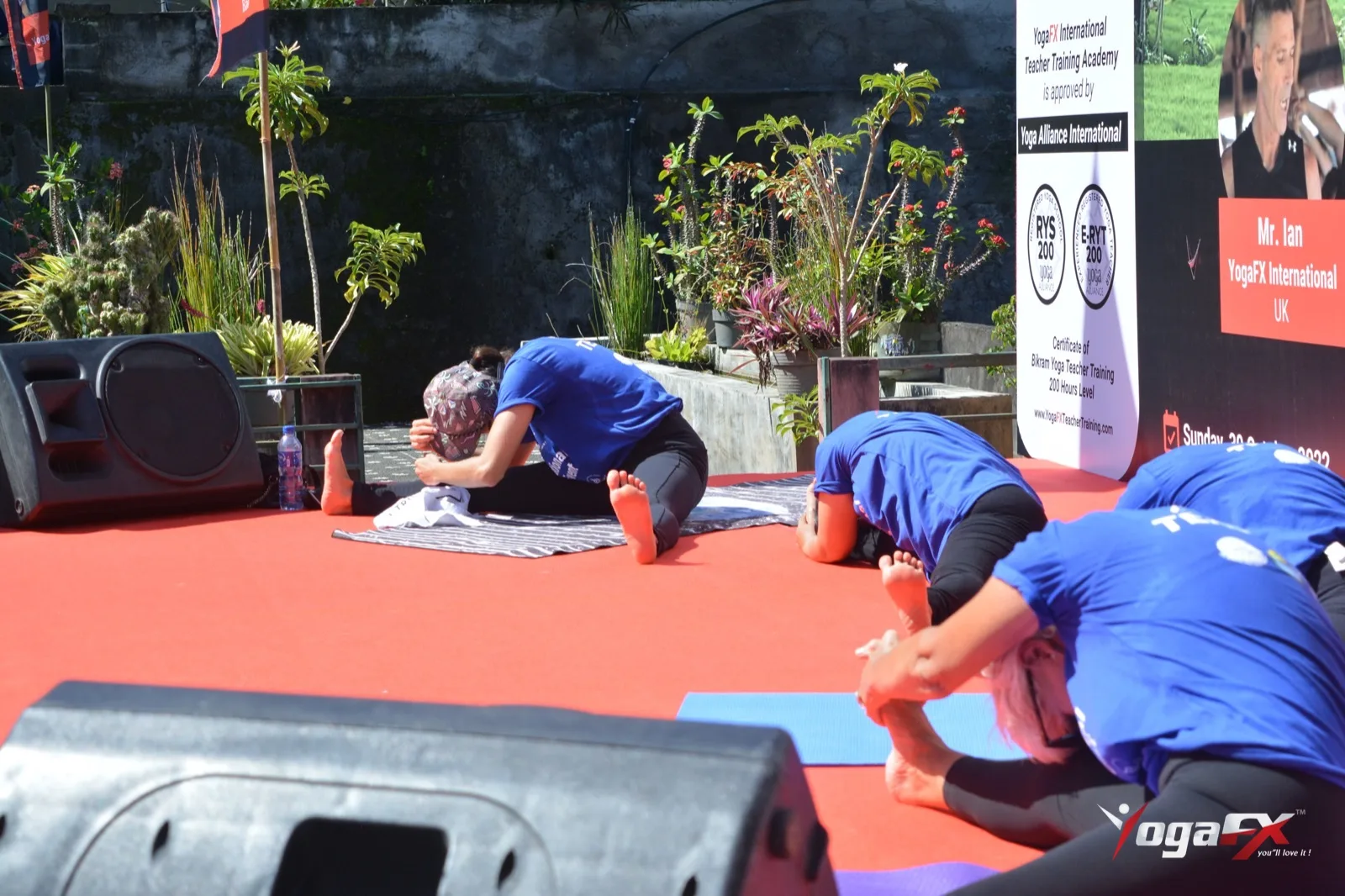
Mr. Ian Terry, E-RYT 500, is the Founder and Lead Instructor of YogaFX, with more than 12,000 teaching hours behind him. Our approach to seasonal affective disorder yoga follows one house rule of the teacher training: a health claim needs a source. Trainees learn to describe what seasonal affective disorder yoga may offer without promising what it cannot.
That matters for anyone who teaches in the dark months. A student may tell you that winter is hard. A good teacher listens, keeps the class welcoming, and points the student toward a doctor when the low mood is heavy. It is not the teacher’s job to diagnose or treat anything. Our guides to hot yoga for depression and hot yoga and anxiety show how we frame those conversations.
YogaFX graduates come from more than 80 countries, and over 1,500 people have trained with us since 2017. The only studio that is open today is Seminyak, and the Canggu studio is coming soon. The studio is open 06:00-22:00 daily, and your first class there is free with the Free 1-Day Guest Pass.
What Graduates Say About the Group
These clips come from graduation ceremonies, so they talk about support and the people in the room, not about mood or winter. We include them so you can hear how trainees describe the group. Our YouTube channel holds 357 student testimonial videos.
“It takes me a while for me to open up and I feel like I did that yesterday.”
Clara, YouTube graduation video, 2024
“Your team is fantastic, I’m thankful to all of you for the support.”
Ajay, YouTube graduation video, 2024
“Thank you to everyone who always supports me.” (translated)
Kartika, YouTube graduation video, 2024
When to Get Professional Help
Seasonal affective disorder yoga is the wrong place to stop if you are struggling. Mayo Clinic says it is normal to have some days when you feel down. It advises seeing your health care provider if you feel down for days at a time and cannot get motivated for things you normally enjoy. Please do not wait if any of these sound familiar:
- Your sleep or appetite has changed.
- You are using alcohol to feel better or to relax.
- You feel hopeless.
- You have thoughts of not wanting to live, in which case contact your local emergency number or crisis line straight away. In the US you can call or text 988.
The NIMH also asks people to talk to a health care provider before starting or stopping any medication. Mayo Clinic puts it bluntly: for depression, alternative treatments are not a substitute for medical care. We agree, and that includes yoga.
Want the research angle for practising at home? Read this research summary for home practice, written by our online team for people studying remotely.
Next Step: Try a Class or Train to Teach
If you want to try seasonal affective disorder yoga in or near Seminyak, the simplest next step is a class. Claim the Free 1-Day Guest Pass, pick a time you can repeat, and see how the room feels. Tell the teacher if you are new or unsure about the heat.
If teaching is the goal, our Bikram yoga teacher training overview explains the 6-day hybrid MasterClass: online study first, then an intensive in Bali. It leads to a dual credential, Yoga Alliance RYT 200 plus a Bikram Hot 26&2 certification.
The next MasterClass runs from Sunday 24 January 2027 to Friday 29 January 2027, with instalments from USD 250 per month. For the full picture, see our 200-hour yoga teacher training in Bali guide.
FAQ
Does yoga help seasonal affective disorder?
Yoga is not a listed treatment for seasonal affective disorder. The NIMH names light therapy, psychotherapy, antidepressants and vitamin D. Yoga can still support a winter routine, because it adds regular movement, a fixed time and company. Treat it as an addition to medical care, never a replacement for it.
What is the best yoga for seasonal depression?
No pose or style has proof behind it for seasonal depression. What matters more is that you can repeat it. Pick a class or home sequence you will do at the same time most days, ideally in the morning, and check with your doctor first if you take medication or have a health condition.
Is seasonal affective disorder the same as seasonal depression?
People use the two terms for the same thing. Seasonal affective disorder, or SAD, is a type of depression with a recurring seasonal pattern. The NIMH says that in most cases symptoms start in late fall or early winter and fade in spring and summer. A doctor makes the diagnosis.
Does exercise help seasonal affective disorder?
Mayo Clinic lists regular exercise as a self-care step, because physical activity helps relieve stress and anxiety, which can make SAD symptoms worse. It does not replace treatment. Light therapy, talking therapy and medication are the main medical options, so please discuss a plan with your health care provider.
Can a hot yoga class replace a light box?
No. A light box is a medical device used daily, usually first thing in the morning, and a studio is not a substitute. A class can sit alongside it as a movement and routine anchor. If your doctor suggests light therapy, keep that session in your schedule and add the class around it.
Still have questions? Message Mr. Ian Terry and the YogaFX team on WhatsApp to enrol or ask and we will answer them personally. Tell us where you live, how you sleep and what you want from a class. We will say plainly whether a heated room suits you or whether a doctor’s visit should come first.