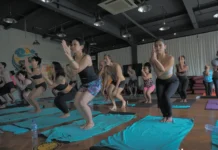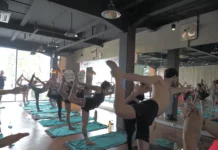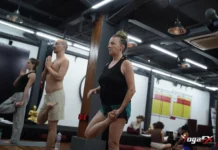










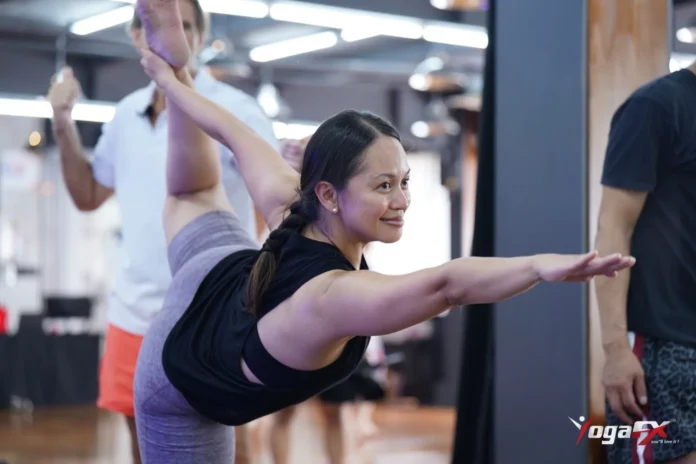
Tree pose balance comes from your eyes and your mind first, and your legs second. In the Hot 26&2 class, you lock one leg, place the other foot high on the thigh, and rest your eyes on one fixed point. Trainees at YogaFX learn to cue that exact order, so a nervous student can hold it.
Tree pose looks calm from the outside. Inside, it is a small test of attention. You stand on one leg in a room held near 40°C, with sweat on your skin and a mirror in front of you. Balance in that setting is mostly a focus skill. The leg only has to follow where the eyes and mind go.
This guide shows how tree pose balance works, how our trainees practise cueing it, and what the research on balance and attention says. It is written for two readers: the student who wants to stop wobbling, and the future teacher who needs to explain it clearly to a full room.
Tree Pose Balance in the 26&2: The Short Answer
Here is the order we teach. It never changes, because a fixed order is easy to remember when you are tired and hot.
- Eyes first. Pick one still point at eye level and keep your gaze on it.
- Standing leg second. Lock the knee and press the whole foot into the floor.
- Foot placement third. Bring the other foot high on the thigh and press foot and thigh together.
- Breath fourth. Breathe evenly through the nose, so the chest stays quiet.
- Return every time. When focus slips, come back to the point without frustration.
Because of that, most falls start at step one, not step two. Students look down, look at the person next to them, or look at their own wobbling foot. The moment the eyes move, the body follows. That is why we treat tree pose as a lesson in concentration before we treat it as a lesson in leg strength.
Our own full guide to the 26 postures makes the same point. Standing Head-to-Knee, Standing Bow Pulling Pose, Balancing Stick and tree pose all need sustained attention, because even a small loss of focus changes balance, stability and control.
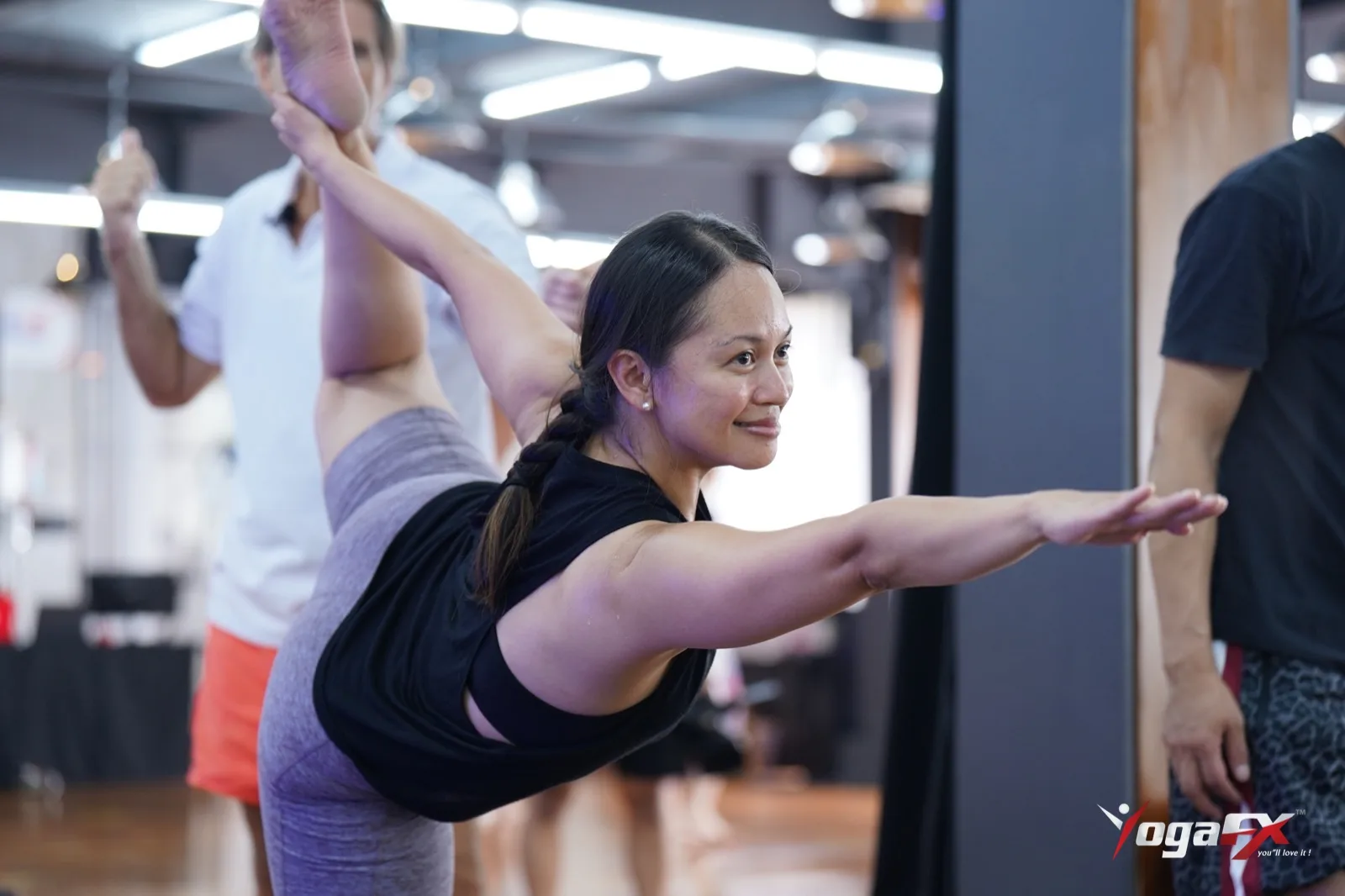
What Tree Pose Asks of the Body and the Mind
Balance feels like one thing, but it is several systems working together. Your ankle, hip and trunk make tiny corrections many times a second. Your brain reads that information and decides what to adjust next. You do not feel most of it happening.
Your body sense does the quiet work
Cleveland Clinic describes proprioception as your body’s ability to sense its own position and movement. Its page says proprioception is crucial to maintaining balance, and that you can have effective proprioception without vision. The receptors sit in your skin, muscles, ligaments, tendons and joints. Read more on the Cleveland Clinic proprioception page.
That matters for tree pose. In a mirror room, the eyes give one useful reference. The standing foot gives another. A trainee who learns to feel the whole foot on the floor has a second source of balance information, and it does not depend on looking at anything.
Attention costs balance
A 2016 PLoS ONE study by Beurskens and colleagues tested 20 healthy young adults standing on one leg. Their sway and sway speed increased when they also had to count backwards by threes, and again when they were fatigued (PLoS ONE, 2016). In plain words, a busy mind and a tired body each make balance worse.
The study did not test yoga, and the group was small and young. We use it for one narrow point: attention and balance are linked. That fits what we see on the mat. A trainee who is thinking about her next line, her sweaty hands or the clock wobbles more than one who is watching her focus point.
Mr. Ian Terry, our Founder and Lead Instructor (E-RYT 500, with more than 12,000 teaching hours), builds the training around this link. His dialogue framework teaches trainees to turn a spoken command into a precise muscle action without looking around the room.
The Focus Ladder: 5 Steps to a Steady Tree Pose
We call the order below the focus ladder. It is a simple way to remember and to cue the posture. Each rung depends on the one before it.
Step 1: Fix the eyes
In the standing series, students use the mirror as a fixed visual reference. For tree pose, pick one point on your own reflection, such as the eyes or a spot on the shoulder. Keep it still. Soft eyes that stay put beat hard eyes that dart.
If you lose the point, do not chase it. Blink, breathe, and find it again. The return is the skill. Teachers should say this out loud, because many students think losing the point means they failed.
Step 2: Lock the standing leg
A locked knee turns the standing leg into a stable post. A soft, bent knee asks the small muscles around the ankle to do far more work. Press the big toe, little toe and heel evenly into the floor, so the foot spreads and grips.
This is also where sweat shows up. So a wet floor and wet skin make small slips more likely. Wide, active toes give the foot more surface to work with.
Step 3: Place the foot with care
Bring the other foot up the standing leg and press foot and thigh firmly together. Firm pressure holds the foot in place far better than a gentle rest, especially when both surfaces are slippery. Keep the hips level and facing forward.
Never rest the foot against the side of the knee. The knee joint should stay free of sideways pressure. If the thigh is out of reach today, the foot goes lower, on the calf or ankle. That is because a lower, steady foot teaches more than a high, shaky one.
Steps 4 and 5: Breathe, then return
Many students hold their breath without noticing. The jaw tightens, the shoulders rise, and the balance gets worse. Cue a slow breath through the nose and a soft face. The breath gives the mind a second job that is calm and repeatable.
Then repeat the return, for example every time your eyes drift. Focus will slip, and that is normal. A student who comes back four times in one hold has practised concentration four times. That is the real training effect.
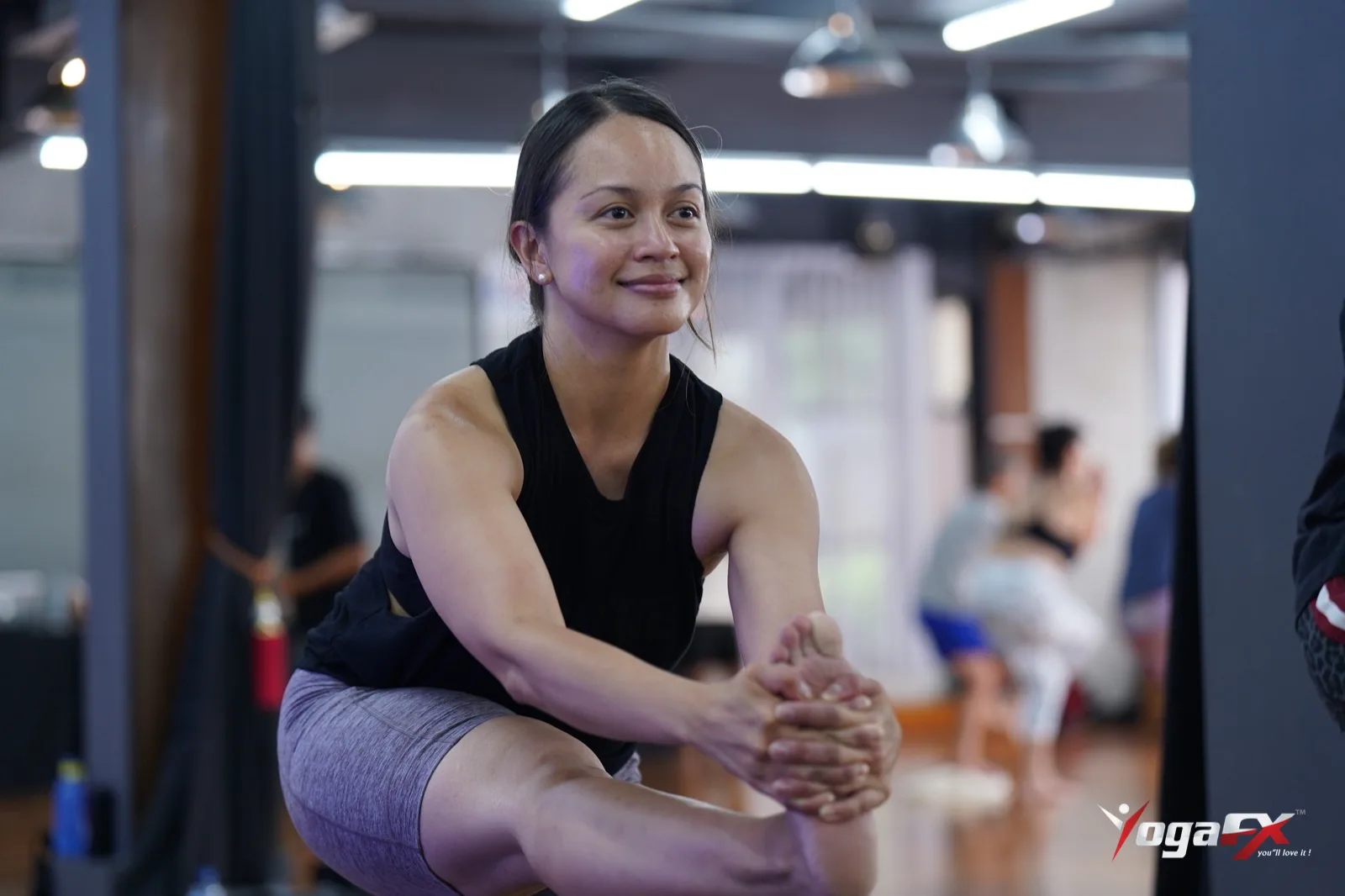
Common Tree Pose Problems and the Cue That Fixes Each
Every teacher sees the same handful of problems. The table below pairs each one with its usual cause and a short cue you can say in one breath. Use it as a quick reference when you practise cueing.
| What you see | Likely cause | Cue to try |
|---|---|---|
| Wobbling at the ankle | Standing knee is soft, foot is not gripping | “Lock the knee, spread the toes.” |
| Eyes dart around the room | No fixed focus point | “Find one still point and stay there.” |
| Raised foot slides down | Sweat and light pressure | “Press foot and thigh together, firmly.” |
| Hip pushes out sideways | Weight shifts onto the standing hip | “Level the hips, face the mirror.” |
| Held breath, tight jaw | Effort has taken over the face | “Soft face, slow breath through the nose.” |
| Foot pressing into the knee | Thigh feels out of reach | “Lower the foot, keep it off the joint.” |
Notice that most of these cues are about attention, breath and foot placement, not strength. A teacher who only says “stand taller” misses most of what is going wrong. A teacher who points the eyes, the breath and the foot solves it faster.
How Trainees Practise Cueing Tree Pose
Knowing tree pose and teaching it are different skills. A teacher has to see the problem, choose one cue, and say it clearly while the student is still holding the posture. That takes repetition, and in our course it is practised every day.
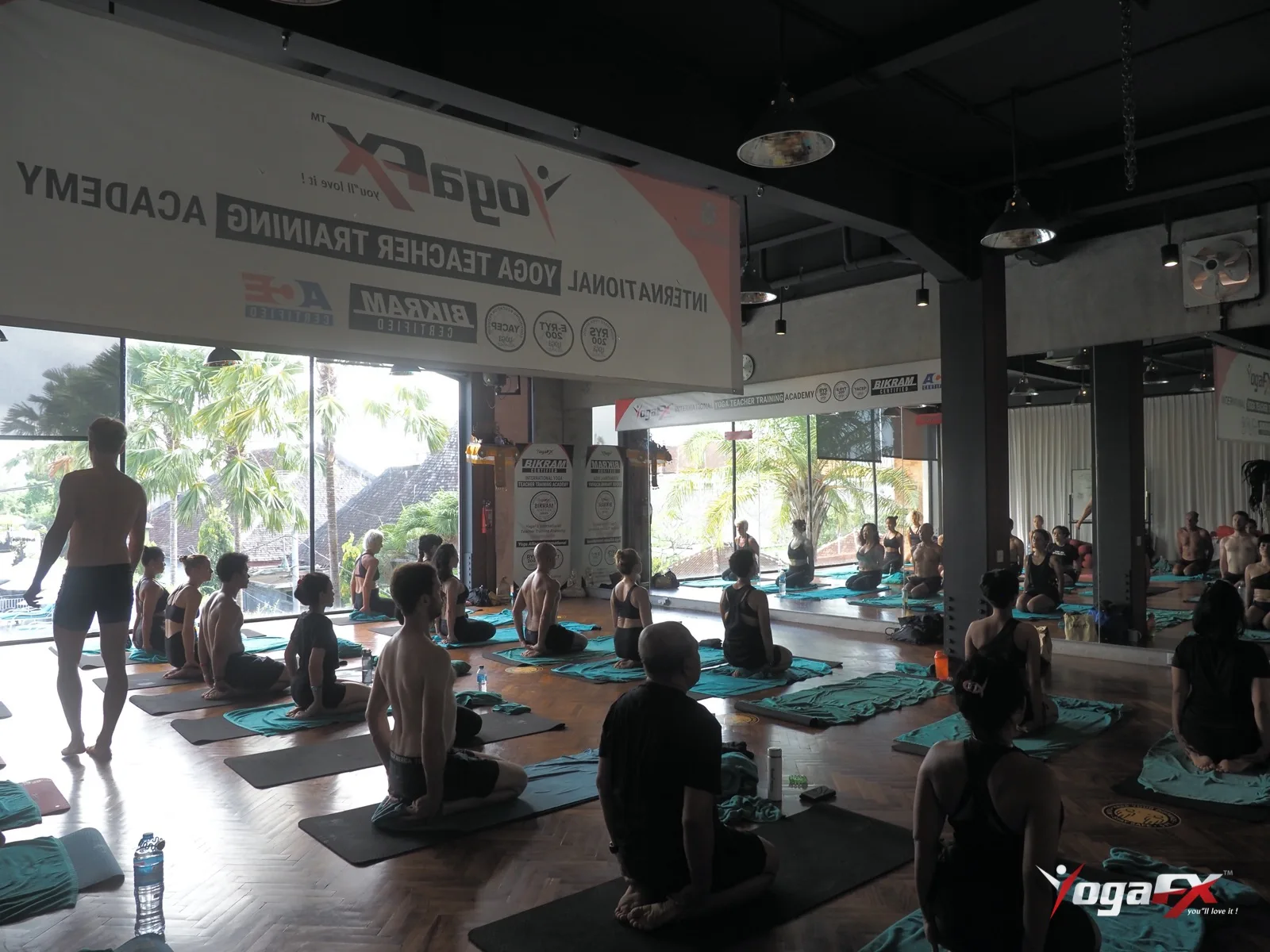
In our 6-day hybrid format, trainees practise the same 26 postures and 2 breathing exercises every day. In the posture clinics, trainees coach each other out loud and receive live feedback from Mr. Ian Terry. That turns body awareness into spoken cues.
A simple cueing drill to try
- Watch first. One person holds the posture while the observer watches quietly for a few breaths.
- Name one problem. The observer picks the biggest issue from the table above, not all of them.
- Give one cue. The cue is one short sentence, in the same order as the focus ladder.
- Check the change. The observer watches whether the cue worked before saying anything else.
The aim is a short, physical cue. A cue like “try to feel more grounded” is vague, while “press the whole foot into the floor” can be acted on at once. Short cues also work better in a hot room, because attention is already stretched.
What trainees say
We keep the room supportive on purpose, because speaking in front of a group is its own balance test. Here is how a trainee described it in a YouTube review: “it’s been a very safe place with everyone. Everybody’s been so supportive.” (a trainee in our YouTube review, 2026).
Another trainee said: “Thank you so much to push and to create like a beautiful classes every day” (a trainee in our YouTube review, 2026). A third said: “I can’t wait to go back to wherever and teach Bikram” (a trainee in our YouTube review, 2026).
Making Tree Pose Safe: Variations and When to Stop
Good teaching offers choices. A student on day one should not feel that a lower foot is a failure. It is the safe version of the same lesson, and it trains the same focus.
- Foot on the calf or ankle. Keeps the knee clear and lowers the balance demand.
- Fingertips on a wall. Offers support for students with fear of falling or poor balance.
- Shorter hold. Ten steady seconds beat thirty shaky ones.
- Rest between sides. Fatigue makes balance worse, so recover before the second leg.
Mayo Clinic describes standing on one leg as another common balance exercise. It suggests holding the position as long as you can keep good form, up to 30 seconds, then switching sides. It also advises using a stable object like a table or counter for support if you need it. Details are on its balance exercises page.
The same page says to get your healthcare professional’s OK before balance exercises if you have serious balance problems or a condition that affects your bones, joints or muscles. We repeat that advice here. This article is education, not medical advice, and anyone with a health concern should consult a healthcare professional before practising.
Stop and come down if you feel sharp pain, dizziness or a pinch in the knee or hip. Heat adds load, so drink water before class and take a break when you need one.
Where Tree Pose Sits in the Standing Series
Tree pose comes late in the standing series, after the postures that already ask for strong single-leg balance. That placement helps. By the time you reach it, your legs are warm and your attention has been working for a long stretch.
As a result, tree pose is a good test of what you have built. If your focus has stayed intact through the earlier postures, tree pose feels steadier. If it has frayed, tree pose shows you where. For a posture-by-posture view, read our guide to the Hot 26&2 postures, including Standing Bow Pulling Pose and the other single-leg balances.
The same single-leg skills carry beyond the studio. Athletes who run or kick rely on one-leg stability on every stride. We cover that teaching niche in our articles on yoga for footballers and hot yoga for runners, where single-leg balance cues like these appear.
Learn to Teach Tree Pose at YogaFX in Bali
If you want to cue postures like tree pose with confidence, the YogaFX Bali MasterClass is built for that. It is a 6-day hybrid course: online pre-course study, then an in-person intensive in Seminyak, Bali. The next intensive runs from check-in on Sunday 24 January 2027 to check-out on Friday 29 January 2027.
Graduates earn the Yoga Alliance RYT 200-Hour credential and the Bikram Hot 26&2 200-Hour International Yoga Certification. More than 1,500 graduates from over 80 countries have trained with us since 2017. See the full 26 and 2 yoga teacher training programme for the curriculum.
Trainees leave knowing the 26 postures and 2 breathing exercises, but also how to say one clear cue at the right time. Tree pose is a small posture that teaches that skill well.
Ready to ask a question? Message Mr. Ian and the YogaFX team on WhatsApp and we will reply personally.
FAQ
How long should you hold tree pose?
Mayo Clinic suggests holding a one-leg balance for up to 30 seconds, as long as your form stays good, then switching sides. In a Hot 26&2 class, follow your teacher’s timing instead. If you wobble early, shorten the hold and keep your eyes steady rather than forcing the full time.
Why is tree pose so hard in a hot room?
Tree pose asks you to balance on one leg while sweat makes the foot slippery and the heat raises effort. A wandering mind makes it worse, because research shows attention affects balance. Most trainees improve by fixing their eyes on one point, locking the standing leg and pressing foot and thigh firmly together.
Can you put your foot on your knee in tree pose?
No. Place the foot on the thigh or lower on the calf, never on the knee joint. Pressing sideways into the knee can strain it. If the foot will not stay high on the thigh, lower it until it holds firmly, keep the standing knee locked, and build height slowly over weeks.
Is tree pose good for balance?
Standing on one leg is a common balance exercise, according to Mayo Clinic, and tree pose is a form of it. Regular practice trains your ankle, hip and core to adjust in small steps. If you have a serious balance problem or a bone or joint condition, ask your healthcare professional first.
How do you cue tree pose for a student who keeps falling out?
Start with the eyes. Ask the student to pick one still point at eye level and keep looking at it. Then cue the standing leg, then the foot, then the breath. Offer a lower foot as a choice, and praise the return to the focus point, not only the hold.
Still have questions? Message Mr. Ian and the YogaFX team on WhatsApp to enrol or ask and we will answer them personally.