












Hot yoga blood pressure research is small, but it points in an interesting direction. In one 12-week pilot study, adults who took hot yoga three times a week saw modest drops in resting readings. Heat can also lower pressure and cause fainting, so check with your doctor first if you take blood pressure medicine.
This article is general information, not medical advice. Please consult a healthcare professional before starting hot yoga, especially if you have high or low blood pressure, take blood pressure medicine, or have a heart condition.
Hot Yoga Blood Pressure: The Short Answer
Most people ask one of two questions. Does hot yoga lower blood pressure, or can it push it too high? The honest answer is that the evidence is thin, so what happens depends on who you are.
- Adults who take no medicine: one small hot yoga blood pressure study saw average readings fall by a few points over 12 weeks.
- People who take blood pressure medicine: the CDC says several common medicines raise heat risk, so your doctor should decide.
- Anyone who feels dizzy in the room: low pressure and dehydration are a real risk in heat, so rest early.
Hot yoga blood pressure questions come up more often than you might expect, because many adults check their numbers and worry about heat.
That’s why we wrote this guide for teachers as much as for students. If you lead a hot class, someone in your room will ask about hot yoga blood pressure. You need a calm, accurate answer that stays inside your scope. We’re yoga teachers, not doctors, and a good teacher knows where that line sits.
Mr. Ian Terry, E-RYT 500, has more than 12,000 teaching hours. He teaches YogaFX trainees that a teacher’s first job in a hot room is to keep people safe. Everything below follows that rule.
What Heat Does to Your Blood Vessels and Blood Volume
When you stand in a hot room, your body works to cool itself. It sweats, and sweating costs fluid. The Mayo Clinic Health System explains that heat and sweating can lower the amount of fluid in the body, which can reduce blood volume and lead to dehydration.
That is one reason teachers watch for dizziness. A student who has lost fluid may feel light-headed when they stand up quickly or move between postures.
There is also a possible upside. A 2018 review in Mayo Clinic Proceedings (Laukkanen and colleagues) looked at sauna bathing. The authors list a possibly lower risk of high blood pressure among the benefits, and they suggest improved endothelial function and reduced arterial stiffness as mechanisms.
Please read that carefully. It is a narrative review of sauna, not yoga. It’s a clue, not proof that a hot yoga class does the same. Because the mechanism matters to teachers, we explain the theory of nitric oxide and heat in a separate guide.
What the Hot Yoga Blood Pressure Study Actually Found
The best-known hot yoga blood pressure trial comes from Texas State University. Stacy Hunter, who leads a cardiovascular physiology lab there, presented it at the American Heart Association’s Hypertension 2019 Scientific Sessions. AHA News covered it as preliminary research.
The design was simple. Ten men and women aged 20 to 65 took part. Five were randomly assigned to hourlong hot yoga classes three times a week for 12 weeks, in a room of about 105 degrees Fahrenheit. The other five had no classes.
None of the volunteers took blood pressure medicine, and none had followed a regular fitness routine for at least six months. After 12 weeks, the yoga group’s average systolic pressure fell from 126 to 121. Diastolic pressure fell from 82 to 79. The control group saw no change, and the yoga group also reported lower perceived stress.
| Measure | Hot yoga group (5 people) | No-class group (5 people) |
|---|---|---|
| Classes | Hourlong hot yoga, 3 times a week | No yoga classes |
| Average systolic pressure, start to week 12 | 126 to 121 | No change |
| Average diastolic pressure, start to week 12 | 82 to 79 | No change |
| Perceived stress | Lower | Not reported as lower |
10
Volunteers
Five hot yoga, five no classes. Ages 20 to 65.
12 weeks
Study length
Hourlong hot yoga, three times a week.
-5 mmHg
Average systolic
126 at the start, 121 at week 12.
-3 mmHg
Average diastolic
82 at the start, 79 at week 12.
0
Change in control group
Readings stayed the same without classes.
Why the Result Is Only a Hint
Those are interesting numbers for hot yoga blood pressure research, but they come with big limits. For example, ten people is very small. The article does not say the volunteers had high blood pressure, and none took medicine, so the study cannot tell us what happens in people being treated for hypertension.
Hunter herself says that larger studies need to be done before researchers can say anything with confidence. We agree, so we describe this result as a hint, never a promise.
Why Hot Yoga Blood Pressure Can Drop Too Far in a Hot Room
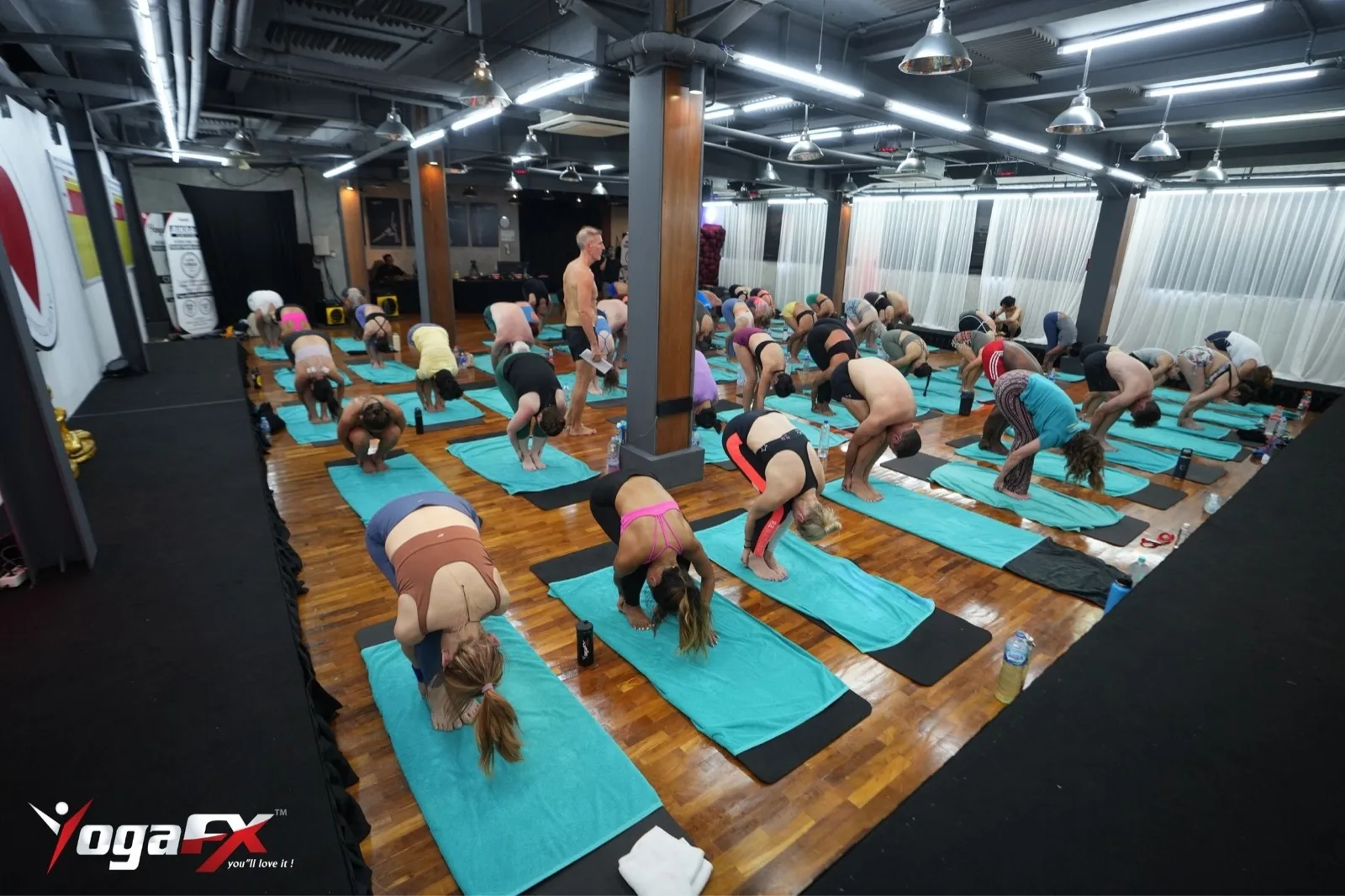
Many students worry that hot yoga will push blood pressure up. In the room, the more common worry for teachers is the opposite: a student who feels faint. Heat, fluid loss and quick changes of position can combine, which means a student can feel fine one minute and faint the next.
The CDC describes this clearly for clinicians. Several blood pressure medicines can lower pressure further in the heat and raise the risk of fainting and falls. We cover that list in the next section.
Postures That Need Extra Care
Any posture that changes your head position quickly deserves respect. In the Hot 26&2 sequence, that includes the transitions out of forward bends and the move from the floor back to standing.
- Slow transitions. Come up in stages, and let the room stop moving before you start the next posture.
- Standing balance postures. Dizziness here can mean a fall, so step out of the posture early.
- Backbends. Breathe evenly and come up slowly, because holding your breath makes light-headedness worse.
Savasana is the recovery bridge. Our guide to savasana benefits explains why resting after heat matters, so teachers shouldn’t rush it.
Hot Yoga Blood Pressure and Medicine: What the CDC Lists
If you take medicine for blood pressure, this section matters most. The CDC publishes clinical guidance on heat and medications. It says the guidance reflects expert opinion, so treat it as a careful summary, not a rulebook. Never change your medicine without your doctor.
| Medicine type | What the CDC lists | What it can mean in a hot class |
|---|---|---|
| Diuretics | Electrolyte imbalance, volume depletion and dehydration, reduced thirst | You may lose fluid faster and feel thirsty later than usual. |
| Beta blockers | Reduced superficial vasodilation, decreased sweating, lower pressure, higher risk of fainting and falls | Cooling may work less well, and dizziness can arrive quickly. |
| Calcium channel blockers | Decreased blood pressure, increased risk of fainting and falls, electrolyte imbalance | Standing up fast may feel worse than it does at home. |
| ACE inhibitors and ARBs | Decreased blood pressure, increased risk of fainting and falls, reduced thirst sensation | You may not notice that you need water. |
| ACE inhibitor or ARB plus a diuretic | May significantly increase risk of harm from heat exposure | Talk to your doctor before any hot class. |
Hot yoga blood pressure advice for medicated students starts with their doctor. This isn’t a list of medicines to fear. Millions of people take them safely. The point is that heat changes the picture, so your doctor should know you plan to practise in a hot room.
How to Prepare for the Doctor Conversation
Bring a short list to your appointment. Include your medicines, how hot the room gets (we run near 40°C), the class length (90 minutes), and how often you plan to practise. Ask what warning signs to watch for, and what you should do if you feel unwell.
Who Should See a Doctor First About Hot Yoga Blood Pressure
Our guide on whether hot yoga is safe covers the wider list of groups. For hot yoga blood pressure specifically, we suggest a conversation with your doctor before your first hot class if any of these apply.
- You have been told you have high blood pressure, or you check readings at home and they are often high.
- You take a diuretic, beta blocker, calcium channel blocker, ACE inhibitor or ARB.
- You often feel faint when you stand up, or you have fainted before.
- You have a heart condition, or you are pregnant.
- You have had heat exhaustion or heat stroke in the past.
The Mayo Clinic Health System also suggests that people with high blood pressure monitor their blood pressure during hot weather and drink plenty of fluids. Checking at home, at the same time each day, gives your doctor a useful picture.
If you want the heart side of the story, read our guide to hot yoga and heart health. It looks at heart rate, effort and what the research does and does not show.

How Hard Does the Class Work Your Cardiovascular System?
For hot yoga blood pressure questions, effort matters as much as heat, because both load the cardiovascular system. A 2014 University of Wisconsin-La Crosse study (Porcari and colleagues) measured a 90-minute Bikram class. Average effort reached about 80% of maximum heart rate. That’s real exercise, so a doctor may want to hear about your plans.
Our standing series usually asks the most of the heart, while the floor series gives more time to recover. You can read how this plays out in our guide to hot yoga heart rate. If you are new, build up slowly, drink steadily and give your body a few weeks to adapt.

A Simple Home Routine Before Your First Class
A little preparation makes the hot yoga blood pressure conversation with your doctor much more useful. Here is a simple routine you can start a week before your first class.
- Measure your pressure at the same time each day, seated and rested, and write the numbers down.
- Note your medicines and the times you take them.
- Show the readings to your doctor and say that you plan to try a hot class.
- Ask what warning signs to watch for, and what to do if you feel unwell.
Take the notes to class too. If you do feel dizzy, you’ll be able to tell your teacher exactly what happened, and that helps them look after you.
What Teachers Should Do and Never Do
If you teach, or plan to, students will tell you about their health in the lobby, in the hot room, or by message. Here is how our trainees learn to respond to hot yoga blood pressure questions.
What a Good Teacher Does
- Ask new students whether they have a medical condition or take regular medicine, and listen without judging.
- Remind everyone that rest is always allowed, in child’s pose or lying on the back.
- Watch faces, not just postures. Pale, glassy or confused looks need attention at once.
- Keep water and a cool, calm space ready, and know your local emergency number.
- Suggest that anyone with a blood pressure question speaks to their doctor.
What a Good Teacher Never Does
- Never tell a student to stop, skip or change a medicine.
- Never promise that hot yoga will lower blood pressure or replace treatment.
- Never say that sweating cleanses the body. It does not, and we do not teach that.
- Never push a student through dizziness to finish a posture.
Chest pain, confusion or fainting is an emergency. Call for medical help straight away. Do not wait to see whether it passes.
For the mechanics of the sequence itself, see our guide to Hot 26&2 Yoga.
What YogaFX Trainees Say About Being Looked After
Safety is also about culture. In a good training room, people feel seen and free to rest. These short quotes come from video reviews recorded at the end of YogaFX trainings. They are not medical evidence. They describe the room.
He’s always about us and not necessarily him.
Justin, YouTube review, 2025 (watch the video)
I believe I can do four classes a day.
Paula, YouTube review, 2025 (watch the video)
You can watch Paula’s full review below.
Hot Yoga Blood Pressure and YogaFX Teacher Training
Many readers who ask about hot yoga blood pressure are weighing a teacher training. The programme is the 6-day Bikram Hot 26&2 Yoga Teacher Training MasterClass in Bali, a hybrid format with pre-course online study and a six-day intensive. Graduates earn a Yoga Alliance RYT 200 and a Bikram Hot 26&2 200-hour certificate.
The next batch checks in on Sunday 24 January 2027 and checks out on Friday 29 January 2027 at Soham Wellness Center in Seminyak.
The Early Bird price is US$1,799 (normally US$1,999), with payment plans from US$250 a month. The training is physically demanding, so we ask future trainees to talk to their doctor first. Our 200-hour yoga teacher training in Bali guide explains what the six days involve.
If you live near Seminyak and want to try a class first, the studio offers a Free 1-Day Guest Pass. Your first class is free, and it is a calm way to meet the teacher and mention any health question before you commit.
FAQ: Hot Yoga and Blood Pressure
Does hot yoga lower blood pressure?
It might, but the evidence is small. In a 12-week study of 10 adults not taking medicine, average systolic pressure fell from 126 to 121 in the hot yoga group, while the control group did not change. The researchers say larger studies are needed. Ask your doctor before relying on it.
Does hot yoga increase blood pressure?
We found no evidence that hot yoga raises resting blood pressure, and the small study above saw slight drops in adults taking no medicine. Effort does raise heart rate, though. A 2014 University of Wisconsin-La Crosse study measured about 80% of maximum heart rate in a Bikram class. Ask a doctor if you are unsure.
Can you do hot yoga with high blood pressure?
Ask your doctor first. The CDC lists diuretics, beta blockers, calcium channel blockers, ACE inhibitors and ARBs as medicines that can raise heat risk through dehydration, lower pressure or fainting. Your doctor knows your readings and medicine, and can say whether a hot class suits you and how to prepare.
Can hot yoga cause low blood pressure or dizziness?
Heat can contribute. Mayo Clinic Health System says heat and sweating can lower body fluid, reduce blood volume and lead to dehydration, and the CDC links several blood pressure medicines to lower pressure and fainting in heat. If you feel dizzy, lie down on your back, rest and sip water.
Is Bikram yoga good for high blood pressure?
There is no strong proof that it treats high blood pressure. The small hot yoga study found modest drops in adults taking no medicine, and a sauna review suggests heat may help blood vessel function. Neither shows that hot yoga treats hypertension. Keep taking prescribed medicine and follow your doctor’s plan.
Still have questions? Message Mr. Ian and the YogaFX team on WhatsApp and we will answer them personally.