











Hot yoga dizzy spells are common, and the first move is simple: lower your centre of gravity. Turn toward the mirror, lie down on your back in Savasana, breathe through your nose and stay in the room. Don’t stand up fast. If confusion, chest pain or fainting appears, get medical help.
This article is general information, not medical advice. Please consult a healthcare professional about dizziness, especially if you are pregnant, take medicine, or have a heart, blood pressure or kidney condition. In an emergency, call your local emergency number.
Hot Yoga Dizzy: What to Do in the First 60 Seconds
Most people who feel hot yoga dizzy for the first time do the wrong thing, and it isn’t their fault. They bolt for the door, or they push on to prove a point. Both choices raise the risk. A calm, low position is safer, and our trainees learn it before they learn any fancy posture.
The Six Steps, in Order
Here is the order we teach in the room. It comes from the dizziness steps in our own Hot 26&2 guide, and it fits the first-aid advice from medical sources you can check yourself.
- Stop moving and get low. Do not try to finish the posture. Come out of it slowly and lower your centre of gravity right away.
- Turn and lie down. Turn around so your head faces the mirror and your feet point to the wall. Then lie on your back in Savasana, the Dead Body Pose.
- Breathe through your nose. Keep your mouth closed and make each breath slow and even. Calm nasal breathing helps settle a racing heart.
- Sip, do not gulp. Take small sips of water once the spinning eases. A big gulp on a sloshing stomach can bring on nausea.
- Tell your teacher. Raise a hand or catch their eye. A teacher cannot feel what you feel, so a quiet signal helps them help you.
- Stand up slowly. When you feel steady, roll to your side, sit for a moment, then rise. Standing fast is a classic way to get dizzy all over again.
That sequence covers a mild hot yoga dizzy spell. It doesn’t cover warning signs such as confusion or chest pain. We deal with those in the section on when to get medical help, so please read it before your first class.
Why Hot Yoga Makes You Dizzy
A hot yoga dizzy spell rarely has one cause. Heat, fluid, food, posture and breath all play a part. When two or three line up, the head starts to swim.
Medical sources describe the main triggers well. The Mayo Clinic page on heat exhaustion lists faintness and dizziness among its symptoms. It says heat exhaustion follows hard effort in hot, humid conditions, when the body cannot cool itself well through sweating.
Heat and heavy sweating
Your skin cools you by sweating, and sweat only cools when it evaporates. In humid air it evaporates slowly, so you keep sweating and keep losing water. The same Mayo Clinic page names heavy sweating, nausea, headache and a weak, rapid pulse as signs of heat exhaustion, when the body is struggling with heat.
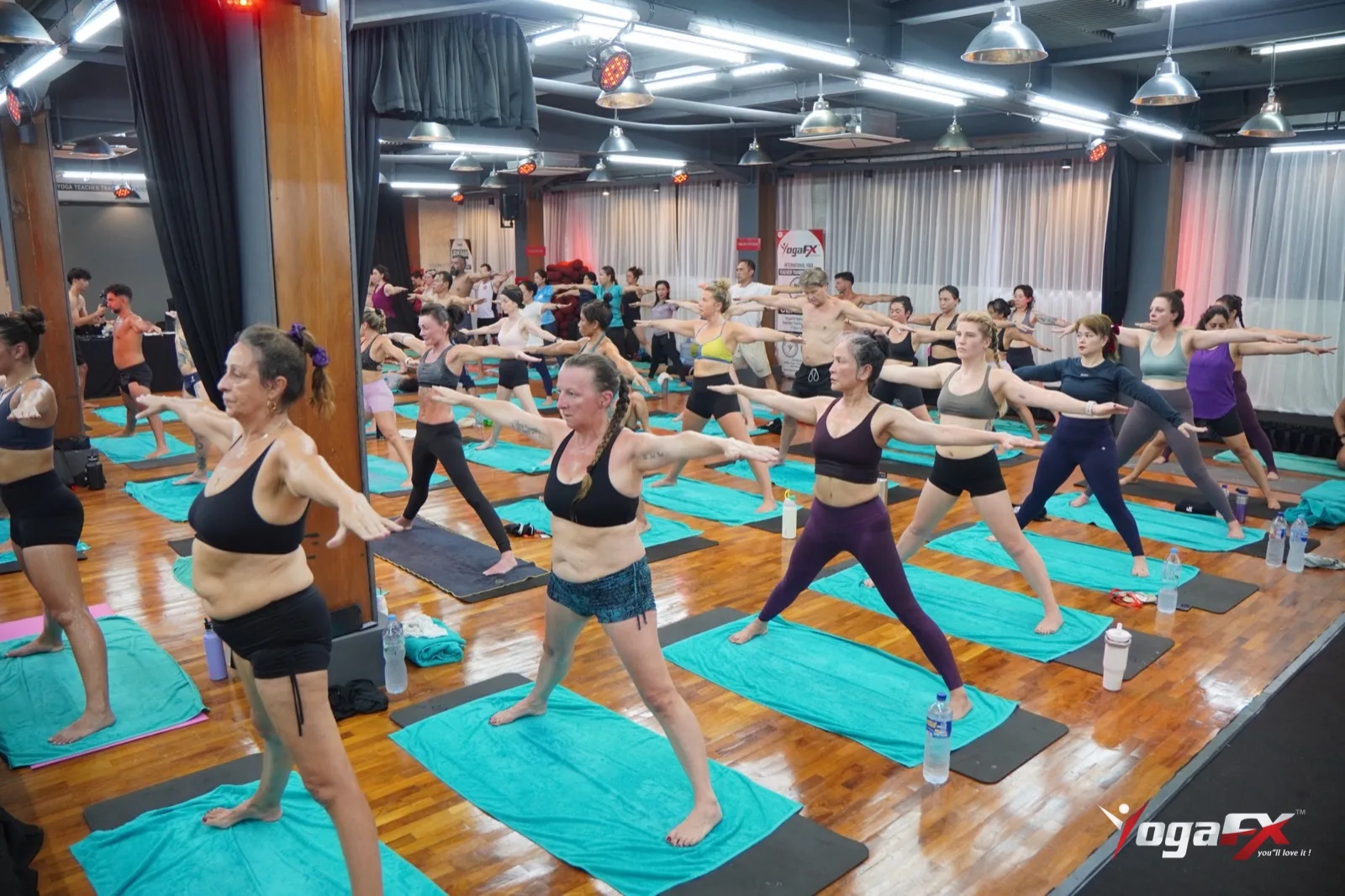
A class at YogaFX runs 90 minutes in natural tropical heat near 40°C with about 40% humidity. That isn’t a gentle room. A 2014 University of Wisconsin study (Porcari and colleagues) found that a 90-minute Bikram class took people to about 80% of their maximum heart rate. So the first few classes ask a lot of your body.
Standing still and standing up fast
Standing for a long time and rising quickly are both known fainting triggers. Harvard Health lists prolonged standing, standing up too quickly and dehydration among the common triggers of vasovagal syncope, a common kind of fainting. The Cleveland Clinic adds that a hot environment and too little salt and fluid can set it off too.
Hot 26&2 has long standing sections and quick changes from standing to the floor. That is why the way you move between postures matters as much as the postures themselves.
Low fluid, low salt and the wrong food timing
Many trainees walk in having sipped little all day, then try to catch up in the last half hour. That rarely works. A stomach full of water or a heavy lunch competes with your skin and muscles for blood. Our guide to hot yoga hydration across a six-day training shows how trainees spread their drinking through the day instead.
Alcohol the night before, caffeine on an empty stomach and tight clothing can add to the problem. Mayo Clinic lists dehydration, alcohol and clothing that traps sweat as causes of heat exhaustion.
Holding your breath or mouth breathing
Many new students hold their breath in hard postures, or breathe hard through the mouth. Fast mouth breathing can push the heart rate up and add to a swimmy feeling. Slow breathing through the nose is the habit we ask trainees to build, and it is also the first thing to return to when dizziness hits.
Dizzy, Lightheaded or Faint: What Each Sign Means
Not every hot yoga dizzy moment means the same thing. The table below sorts common signs into four levels, with a suggested response for each. It is a guide for students and trainee teachers, not a diagnosis.
| What you feel | What it may mean | What to do |
|---|---|---|
| Mild lightheadedness after a posture or after standing up | A short drop in blood pressure from changing position fast, often with low fluid (Harvard Health, Cleveland Clinic). | Get low, breathe through the nose, sip water and rise slowly once steady. |
| Dizziness with sweating, nausea, spots or tunnel vision, cold clammy skin | Warning signs that fainting may be coming (Cleveland Clinic, Harvard Health). | Lie down at once. Resting your feet a little higher helps. Tell your teacher and do not stand up until the feeling passes. |
| Dizziness with headache, nausea, weak fast pulse, heavy sweating or cramps | Possible heat exhaustion (Mayo Clinic). | Stop practising. Move to a cooler place, lie down, sip cool water and have someone stay with you. |
| Confusion, fainting, a seizure, being unable to drink, or chest pain | Possible heat stroke or a heart or brain problem. These are emergencies. | Call your local emergency number. Do not wait to see if it passes. |
What First-Aid Guidance Adds
The Mayo Clinic first-aid page for heat exhaustion gives the same ladder. It says to move the person out of the heat, lay them down and raise the legs and feet slightly, loosen tight clothing and offer chilled water or a sports drink. It tells people to call emergency services if the person faints, becomes confused or agitated, has a seizure or cannot drink.
The Four-Step Dizzy Drill Trainees Learn
Trainee teachers practise this drill until it feels automatic. Then they can calmly guide a student through a hot yoga dizzy spell when the room is hot and the student is scared.
Step 1
Get low
Lower your centre of gravity and come out of the posture slowly.
Step 2
Lie down
Head to the mirror, feet to the wall, flat on your back in Savasana.
Step 3
Breathe and sip
Slow nasal breaths, then small sips of water once the spinning eases.
Step 4
Watch and rise
Tell your teacher, rest as long as you need and stand up slowly.
Notice what the drill leaves out. There is no pushing through, no gulping water and no sprint to the door. Each step lowers the load on your heart and head. That is why the drill works for a beginner with a first hot yoga dizzy spell, and for an experienced student on a hard day.
Why Trainees Stay in the Room, and When They Leave
In a Hot 26&2 class, the rule you hear most is to stay in the room. New students sometimes hear that as “never stop.” That isn’t what it means when you have a hot yoga dizzy spell.
Staying in the room means you stay in the class space and keep resting, breathing and sipping. You lie down on your towel in Savasana instead of walking out while your head is spinning. A wobbly walk to a door can carry a bigger fall risk than a calm rest on the floor.
There is a second reason. Rising quickly is a known trigger, and the Cleveland Clinic lists changing position fast among the causes of fainting. A hot yoga dizzy student who lies down is already in the safest position if the feeling gets worse. And a teacher who can see you can act sooner.
A trainee’s view of staying in the room
Deny took the YogaFX training in 2025. He told the camera that the first day was very hard and that he wanted to go home. Then he remembered what the room had taught him:
I just remember that we have to stay in the room. Just stay in the room until everything ends, no quits.
Deny, YouTube review, 2025
His story is about staying with a hard day, not about ignoring a warning sign. Those are different things. You stay in the room by resting well, not by forcing a posture while dizzy.
When staying in the room is not enough
Staying in the room is for the mild case. If dizziness doesn’t ease after a few minutes of lying still, or if any red-flag sign appears, a good teacher helps you to a cooler place and asks for help.
Mayo Clinic says to move to a cooler place and to contact a healthcare professional if symptoms get worse or don’t improve within one hour. Resting in the room and getting help are two steps on the same ladder.
Our teachers say it plainly to trainees: you are never weak for stopping. A student who rests early is usually still practising a year later.
When Hot Yoga Dizzy Spells Need a Doctor
Most hot yoga dizzy spells are mild. Some are not. These signs mean the problem may be bigger than a quick head rush, so treat them seriously:
- Confusion, agitation or slurred speech. Mayo Clinic lists confusion among the reasons to get immediate medical help with heat illness.
- Fainting or a seizure. Mayo Clinic says to call emergency services if the person faints or has a seizure.
- Being unable to drink. If you cannot keep sips down, the body is not coping with the heat.
- Chest pain, heart palpitations or shortness of breath. Harvard Health says to call emergency services right away for chest pain or shortness of breath, and Cleveland Clinic names these among the reasons to see a provider after fainting.
- Dizziness that keeps coming back. Harvard Health suggests seeing a doctor for repeated episodes.
Mayo Clinic also says a body temperature of 40°C (104°F) or higher needs help right away. You will not be taking your own temperature in class, so judge by how the person looks and acts. If they seem confused or very unwell, call for help first and cool them while you wait.
If you have a known heart condition or take blood pressure medicine, speak to your doctor before you practise in heat. Our guide to hot yoga and heart safety explains what teachers need to know about heat and the heart. It also helps to read about what trainees learn about resting in Savasana, because rest is the main tool in this whole article.
How to Stop Hot Yoga Dizzy Spells Before They Start
You cannot prevent every hot yoga dizzy moment, but you can lower the odds a lot. These habits come from what we see across six-day trainings in Bali, and each one lines up with the medical advice above.
- Drink through the whole day. Begin hours before class. Keep class itself for small sips only.
- Time your food. Eat a real meal about three hours out, and keep the last hour light. A heavy stomach and a hot room do not mix.
- Add salt if you sweat a lot. Mayo Clinic first aid suggests a sports drink with electrolytes for heat exhaustion, and Cleveland Clinic lists too little salt as a fainting trigger.
- Skip alcohol the night before. Alcohol is on the Mayo Clinic list of causes of heat exhaustion.
- Wear light clothing. Mayo Clinic says clothing that does not let sweat evaporate adds to the problem.
- Move slowly between postures. Take a breath before you rise, especially going from the floor to standing.
- Breathe through your nose. It slows the heart and keeps the mind steady.
- Build up over several classes. Your body adapts to repeated heat, so the third or fifth class usually feels calmer than the first.
Our guide on pacing your first weeks in Bali’s heat explains that adaptation in more detail. In our experience, most students notice they sweat sooner and settle faster after a handful of classes. Everyone adapts at their own speed, so please treat that as a guide, not a promise.
Medicines and Conditions That Change Your Hot Yoga Dizzy Risk
Some medicines make dizziness in heat more likely. Mayo Clinic names beta blockers, diuretics, antihistamines and some other drugs as raising the risk of heat exhaustion, and Cleveland Clinic names decongestants and certain blood pressure medicines as fainting triggers. If you take any of these, ask your doctor before you try a hot class. Do not stop a prescribed medicine on your own.
What teachers should watch for
If you plan to teach, learn to scan the room for faces, not only postures. Look for grey or flushed skin, a glassy stare, a student who stops sweating, or one who sways. Walk to them, speak quietly and guide them down. That habit is part of how we train teachers at YogaFX, and it matters as much as memorising the dialogue.
What YogaFX Trainees Say About Staying in the Room
Safety is also about culture, and culture decides how a hot yoga dizzy student is treated. In a good room, people look after each other and feel free to rest. These short comments come from video reviews recorded at the end of YogaFX trainings.
The people that you meet here change your life and your heart forever.
Amanda, YouTube review, 2023
Katy, in her 2019 video review, said she never felt alone in the room because the people around her were so supportive. That support is what makes a student willing to lie down and signal a teacher instead of hiding a dizzy spell.
Deny’s review, which we quoted above, shows the same thing from another angle. A hard day is easier when the room is on your side. Mr. Ian even says “good job” to him on camera at the end of that video.
How YogaFX Teaches Dizziness Safety in Bali
Mr. Ian Terry, Founder and Lead Instructor at YogaFX, is an E-RYT 500 with more than 12,000 teaching hours. He spent five years, from 2014 to 2019, training with the founder of the Bikram Hot 26&2 method. In every room he runs, the teacher’s first job is to keep people safe.
Our classes follow the Hot 26&2 format: 26 postures and 2 breathing exercises over 90 minutes, in natural tropical heat. Trainees practise teaching in that same heat, so they learn to read a hot room from the inside. They also learn the dizzy drill above, and how to say it in a calm voice when a student needs it.
If you are new to hot yoga and live near Seminyak, the studio offers a Free 1-Day Guest Pass. Your first class is free. It is a low-pressure way to feel the room, meet a teacher and mention any health worry before you commit. The studio sits at Jl. Pangkungsari Gg Jepun No.888, Kuta Utara, Seminyak, Badung, Bali 80361, and opens 06:00 to 22:00 every day.
If you are thinking about teacher training
The program is the 6-day Bikram Hot 26&2 Yoga Teacher Training MasterClass, a hybrid format with online pre-course study and a six-day intensive in Bali. Graduates earn a Yoga Alliance RYT 200 and a Bikram Hot 26&2 200-hour certificate.
The next batch checks in on Sunday 24 January 2027 and checks out on Friday 29 January 2027. Our 200-hour yoga teacher training in Bali guide explains what the six days involve.
This is physically demanding work in real heat. We encourage future trainees to talk to their doctor first and to ask us anything about heat and health before enrolling.
FAQ: Hot Yoga Dizzy Questions
Why does hot yoga make me dizzy?
A hot yoga dizzy spell has a few usual causes. Heat makes you sweat, and sweat drains water and salt. Add long standing, quick position changes, little food or shallow breathing, and blood pressure can dip. Medical sources list heat, dehydration and rising too fast as common causes. Rest, slow breaths and small sips usually help a mild spell.
What should I do if I feel dizzy in hot yoga?
For a hot yoga dizzy spell, come out of the posture, lower your centre of gravity and lie on your back with your head toward the mirror. Breathe slowly through your nose and sip water once the spinning eases. Tell your teacher. Rise slowly. If you feel confused, faint or have chest pain, get medical help at once.
Should I leave the room if I feel dizzy?
For a mild hot yoga dizzy spell, lying down in the room is usually safer than walking out while unsteady. If you do not improve after a few minutes, or you feel very unwell, ask your teacher to help you to a cooler place. Confusion, fainting or inability to drink need emergency help straight away.
Can hot yoga make you faint?
It can for some people, and a hot yoga dizzy spell can be an early warning. Cleveland Clinic lists hot environments, too little salt and fluid, long standing and getting up fast as fainting triggers. Warning signs include lightheadedness, sweating, nausea and tunnel vision. Lie down when you notice them. Fainting with chest pain or confusion needs a doctor.
How do I stop getting dizzy in hot yoga?
To prevent a hot yoga dizzy spell, drink steadily through the day, eat a real meal about three hours before class, skip alcohol, wear light clothes and breathe through your nose. Move slowly between postures and build up over several classes. If you take blood pressure medicine or have a heart condition, ask your doctor first.
Still have questions? Message Mr. Ian and the YogaFX team on WhatsApp and we will answer them personally. We can also talk through your own health questions about heat before you book a class or a training place with us in Bali.