


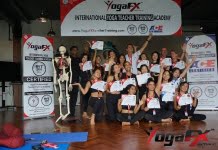




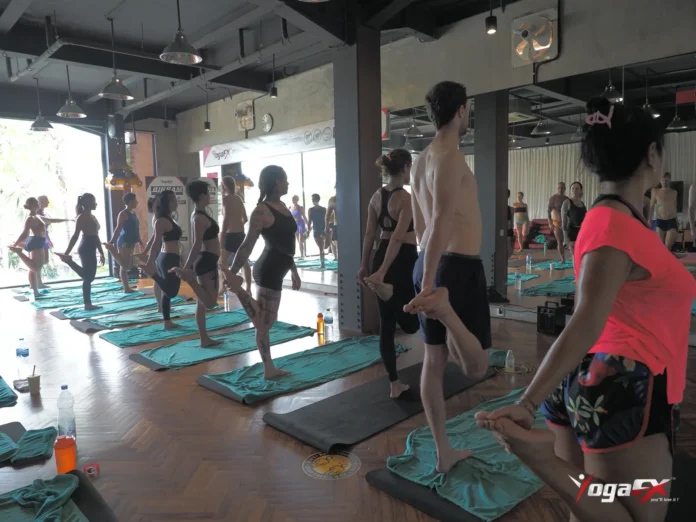
Triangle pose is the posture where trainees learn that a calm-looking shape takes real work. In the 26&2 standing series, a trainee memorises the cues for Trikanasana, holds a deep front knee bend in a 40°C room, and then teaches it back in two sets on each side.
This guide follows that path as it happens at YogaFX in Bali. It covers where the posture sits in the class, how trainees learn the words and the shape together, the mistakes trainers fix every week, and why the effort lands in Zone 3 to 4 of your heart rate.
Triangle Pose in the 26&2: What a Trainee Actually Has to Learn
A student in a 26&2 class has one job: follow the teacher and do the posture. A trainee has three jobs at once. You need to do the posture, know the words that build it, and notice what the person on the next mat is doing wrong.
That is why triangle pose is such a good teaching posture. Its shape is simple enough to describe in one sentence, yet every part of it can go wrong.
The stance can be too narrow. The front knee can cave in. The chest can collapse toward the floor. Each error has a cue that fixes it, and learning which cue goes with which error is the real lesson.
Mr. Ian Terry, Founder and Lead Instructor at YogaFX (E-RYT 500, 12,000+ teaching hours), trained for five years, from 2014 to 2019, with the founder of the method. The fixed dialogue he teaches is the same one every trainee at YogaFX learns, so the lesson in triangle pose is also a lesson in how the whole class is built.
What a trainee carries out of the room
- The order of the cues. Stance first, then the knee, then the hips, then the arm, then the gaze. Swap two of them and the shape stops working.
- The purpose of each cue. A cue is not decoration. Each one prevents a specific error that you can see from across the room.
- The pace of delivery. The words have to land while the student is still in the posture, not after they have come out.
- The honest limits. Some bodies cannot get a deep bend on day one, and a good trainer knows how to say so without lowering the standard.
Where Triangle Pose Sits in the Standing Series
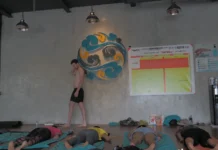
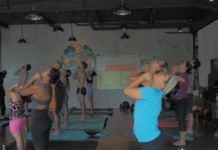
Every 26&2 class has the same shape: 26 postures and 2 breathing exercises, 90 minutes, about 40°C and 40% humidity. Triangle pose belongs to the standing series. Standing Separate Leg Stretching comes right before it, and Standing Separate Leg Head to Knee comes right after.
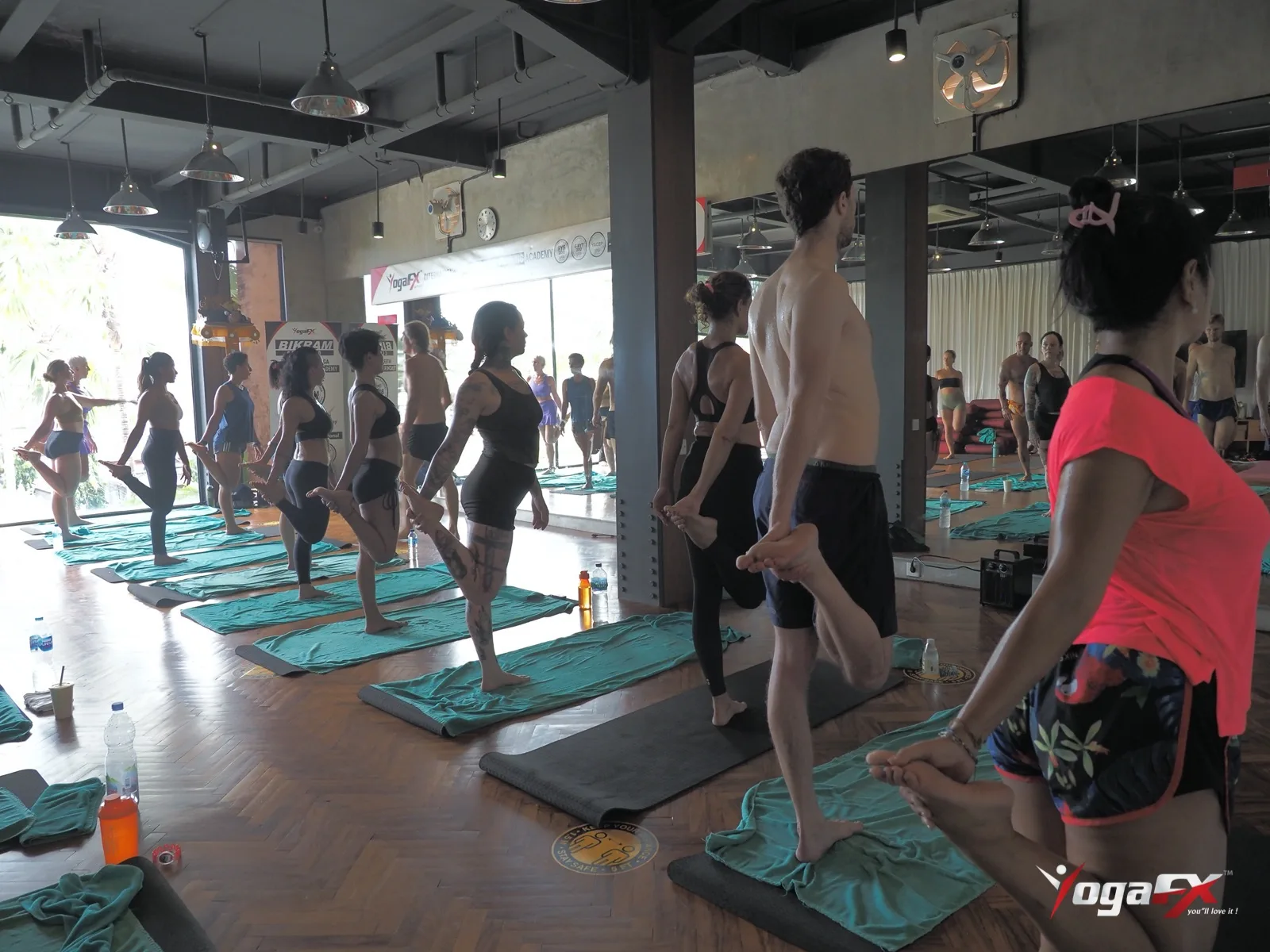
By the time you reach it, you have already done a long stretch of full-body work, so the legs are warm and the breathing is steady. That position matters for trainees. They meet triangle pose with some fatigue in the body, which is exactly when sloppy cueing and sloppy form start to show.
Each posture is repeated, so you get two sets per side. You hear the cues, hold the shape, release and go again. For a trainee, the second set is a built-in review. Did the correction you just heard actually change your body? If you want the student’s side of the same posture, there is a student-side walkthrough of the triangle pose cues on our sister site 26and2yoga.com.
What comes before and after triangle pose
Because triangle pose follows Standing Separate Leg Stretching, the wide stance is already familiar by the time the cues begin. The feet are far apart, the legs are warm, and the trainee has just practised keeping the spine long over a wide base. That makes this a good place to study how one posture hands off to the next.
The posture that comes after it, Standing Separate Leg Head to Knee, uses a similar base. Trainees who set up triangle pose well tend to find that next setup easier to describe, because they already know what a stable wide stance feels like and what it looks like when it goes wrong.
To see how this posture fits among the others, our guide to the 26 and 2 yoga poses lists the full sequence. Two neighbouring standing postures also get their own teaching write-ups, Standing Head to Knee and Balancing Stick.
How Trainees Learn Triangle Pose and Its Dialogue
We do not publish the dialogue itself, and we will not reproduce it here. It is taught live, because the pacing and the voice matter as much as the words. What we can describe is the way trainees build the skill.
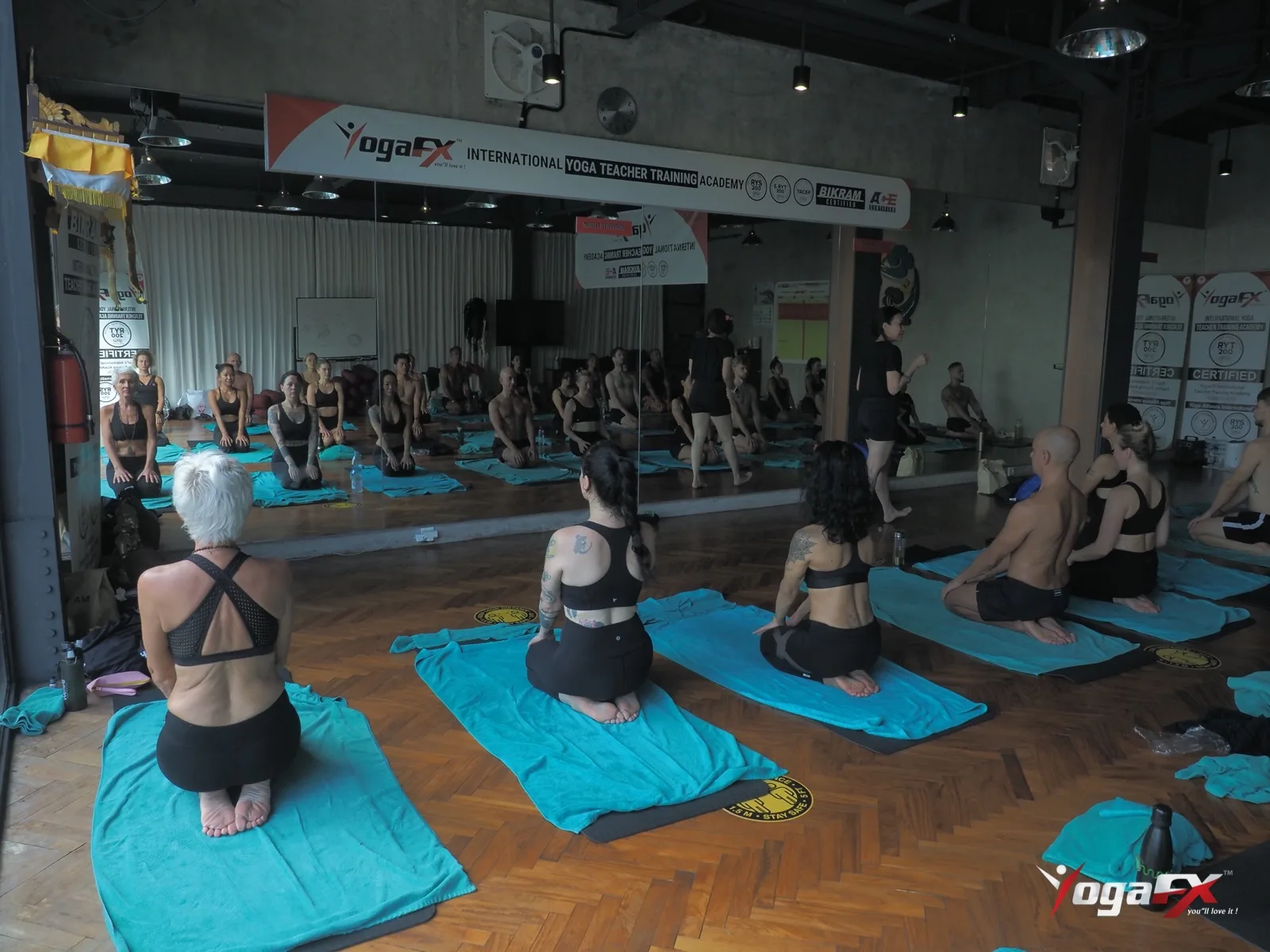
Trainees build that skill in four steps.
- Feel it first. You practise triangle pose as a student, in the heat, until the shape is in your body. You cannot cue what you have not felt.
- Hear it in the room. You listen to the cues as a student, and you start to notice what each one is asking your body to do.
- Learn the words. You memorise the order of the cues, one cue at a time, and practise saying them out loud.
- Say it back. You deliver the cues to a classmate who is in the posture, and watch whether their shape changes.
The table below shows what each stage asks of a trainee and what a trainer is looking for. It is a map of the process, not a script.
| Learning stage | What the trainee does | What the trainer checks | Typical slip |
|---|---|---|---|
| Feel it | Holds the full posture in two sets on each side | Stance width, front knee over ankle, straight back leg | Standing too narrow, so the knee drifts forward |
| Hear it | Listens to the cues as a student | Does the trainee match the body to each cue in time? | Moving ahead of the cue instead of following it |
| Learn the words | Memorises the cue order, one cue at a time | Correct order, no missing steps | Dropping the hips cue and losing the open chest |
| Say it back | Delivers the cues to a classmate in the posture | Pace, volume and whether the classmate changes shape | Talking too fast, so the classmate never lands the shape |
Notice that the last stage is where most trainees discover they do not know the posture as well as they thought. Saying a cue out loud is a test of understanding. If you cannot explain why the hips go back, you probably have not felt why the hips go back.
Triangle Pose Mistakes Trainees Make, and How Trainers Fix Them
Trainers see the same handful of errors again and again. The fix is almost never to shout a correction. It is to pick the one cue that addresses the cause and say it once, clearly.
- The front knee collapses inward. Trainers usually trace this to a stance that’s too short. Widen the base first, then ask the knee to track over the little-toe side of the foot.
- The chest sinks toward the floor. The hips have crept forward. One cue to send them back gives the chest room to open again.
- The back knee locks. The student is hanging on the joint. A straight leg that still works in the thigh is the goal.
- The neck cranks upward. The student is chasing the ceiling with the head. Let the eyes find a point and keep the neck long.
- The breath stops. Tension has taken over the whole body. A slower exhale and softer shoulders usually bring it back.
Look at how each fix points back to a cue earlier in the sequence. That chain is why the dialogue is built in a fixed order. A trainer who knows the chain can diagnose a problem from one visible symptom, because the symptom always traces to the step before it.
A good trainer also knows when not to correct. If a student has a sore knee, the better call is to let them shorten the bend and keep the other cues. Teaching is mostly about deciding what to leave alone.
Why Triangle Pose Lands in Zone 3 to 4 in a Hot Room
Zones are slices of your maximum heart rate, which most people estimate as 220 minus their age. In our working map of the class, triangle pose falls in Zone 3 to 4, about 70 to 90% of that maximum. Treat it as an estimate built from published study ranges. Nobody measured this one posture on its own.
Three things stack up to push the effort that high:
- A deep bend in the front knee keeps the biggest muscles in the leg working for the whole hold.
- The hold is long enough for the effort to build rather than spike and fade.
- The room is 40°C, so your heart beats faster to move heat away from the body.
The best-known measurement of a full class is a 2014 University of Wisconsin study (Porcari et al.). A 90-minute hot class burned about 333 kcal for women and 460 kcal for men, with participants near 80% of maximum heart rate. That covers the entire class, so it says nothing about triangle pose alone.
Heat, stretching and staying safe
According to the Mayo Clinic, the best time to stretch is when your muscles are warm. Keep the movement smooth, with no bouncing, and expect tension rather than pain. Mayo also says stretching isn’t a warm-up, so light movement comes first. In a 26&2 class, triangle pose arrives after a long run of standing work, which suits that advice.
Harvard Health describes stretching as what keeps muscles flexible and preserves range of motion in the joints. It recommends doing it daily if you can, or at least three or four times a week. Regular practice may help the hamstrings and hips that this posture asks for, although results vary.
Heat can make a stretch feel easier than it really is, so let tension guide your depth, not the mirror. This article is general information, not medical advice. Consult a healthcare professional before practising if you have a joint or spine problem, blood pressure concerns, or dizziness in the heat. Tell your teacher before class as well.
What Trainees Say About Learning in the Hot Room
Reviews are the best evidence of how this kind of learning feels from the inside. These come from trainee video reviews on the YogaFX YouTube channel, and both reviewers are unnamed in the video, so we credit them by source.
“I’ve learned so much. Thank you, thank you for Mr. Ian, thank you for Mr. Rich Nash, thank you for all.”
A trainee in our YouTube review, 2023
“Every single time I do it. I learn something new and for me this experience in particular has mostly been about learning about what’s going on in here.”
A trainee in our YouTube review, 2026
The 2026 reviewer talks about practising Bikram on and off for a while, and still finding something new. That is the same thing trainers say about triangle pose. You can watch the 2026 trainee in the full YouTube review, or the 2023 one below.
Across our reviews, the social proof sits at 150 Google reviews, 50 Yoga Alliance reviews and 357 YouTube testimonials, and more than 1,500 graduates from 80+ countries have trained with us since 2017.
Learn Triangle Pose as a Teacher at YogaFX in Bali
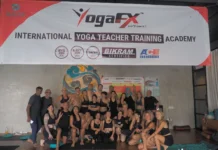
At YogaFX, triangle pose is one posture inside a bigger programme, the 26 and 2 yoga teacher training. The Bali teacher training leads to a dual certification: Yoga Alliance RYT 200-Hour plus the Bikram Hot 26&2 200-Hour International Yoga Certification.
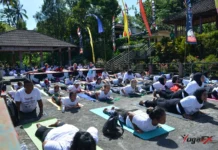
The format is a hybrid. You do the online pre-course work first, then join the intensive in Bali, where the practice, the dialogue and the delivery all happen in the heat. The next batch checks in on Sunday 24 January 2027 and checks out on Friday 29 January 2027.
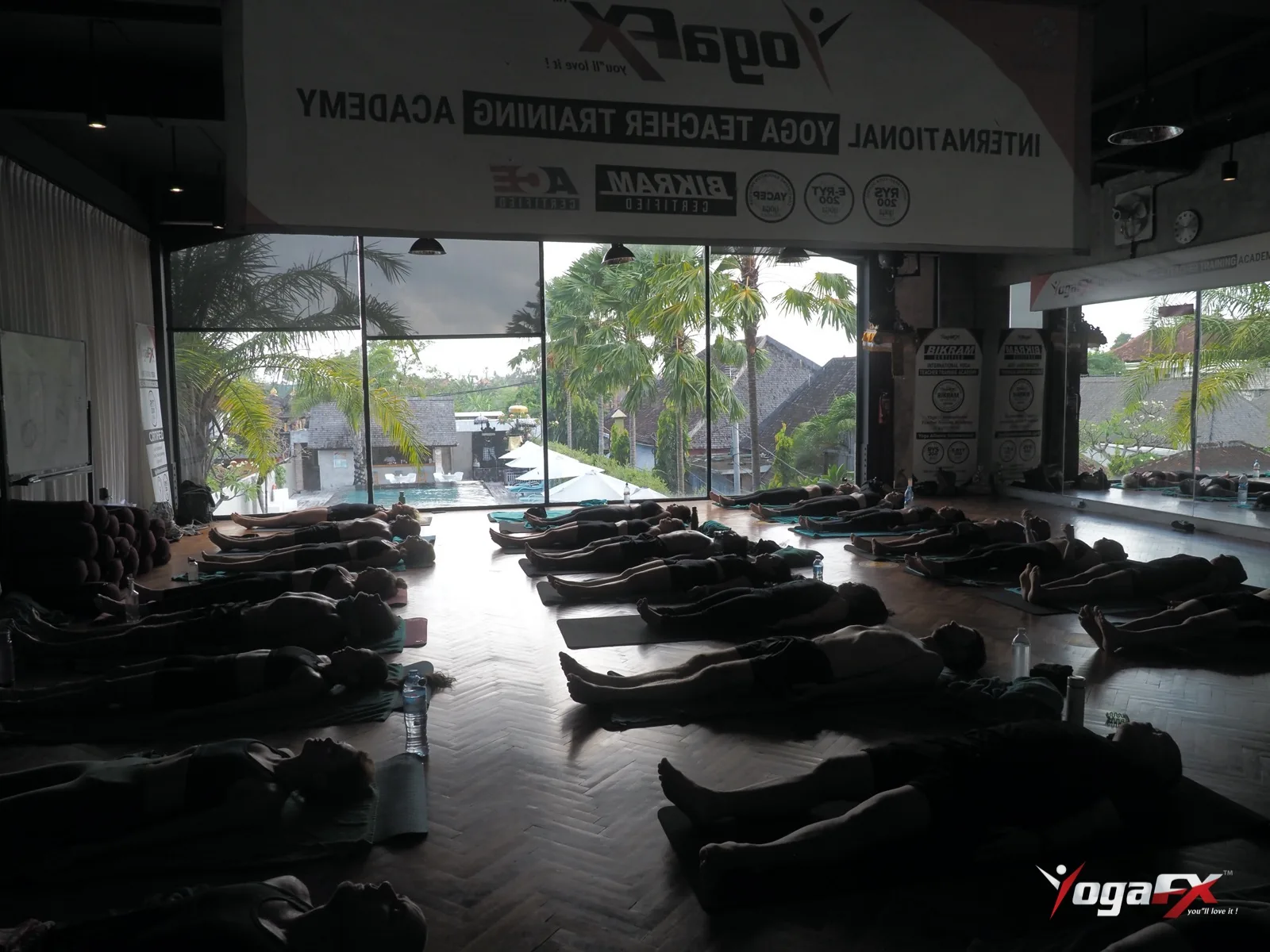
If you only want to feel the posture first, the Seminyak studio offers a free 1-day Guest Pass, so your first class is free. You can also read how the method is taught in our original hot yoga guide before you decide.
If you are comparing teacher trainings, ask how much of the course goes into delivering postures like this one, not only doing them. Holding a shape well and guiding someone else into it are different skills, and the second one is what a certificate is supposed to prove.
Ready to talk it through? Message Mr. Ian and the YogaFX team on WhatsApp and we will answer your questions about the training personally.
FAQ
What is triangle pose called in Sanskrit?
Trikonasana is the usual Sanskrit spelling of triangle pose, and it means roughly three angles. The 26 and 2 sequence writes it as Trikanasana. Either way, the name describes the shape your legs, torso and arms build together, with the front knee bent deeply and the back leg strong.
What muscles does triangle pose work?
Mostly the big muscles of the legs. The front thigh and glute hold the knee bend, the back leg stays strong, and the inner thighs and hamstrings lengthen. The side body also stretches along the top arm. In a hot class, that adds up to high effort, around Zone 3 to 4.
How do you teach triangle pose?
Start with the base and finish with the gaze. Give the stance cue, then the foot, the knee, the hips and the arm. Say one cue at a time, keep a steady pace, and watch the room. Fix the cause of an error, not only the symptom you can see.
Is triangle pose safe during pregnancy?
This is a question for your doctor or midwife, not a yoga article. A deep standing posture in a 40°C room can affect pregnant students differently. Consult a healthcare professional first, tell your teacher before class, and follow their advice about heat, depth and whether to practise at all.
Is triangle pose a hip opener?
It works the hips, since the front thigh and hip hold a deep bend and the inner thighs stretch. But it is a full standing posture, not a stretch for one area. The back leg, side body and spine all work together, so the hips are one part of the shape.
Still have questions? Message Mr. Ian and the YogaFX team on WhatsApp and we will answer them personally. We can explain how the training runs, what the next batch looks like, and whether the free guest pass at the Seminyak studio is the right first step for you.