













Most lists of hot yoga benefits for men are written without a single number in them. This one is the opposite. Below is what controlled studies actually measured in people doing the Hot 26&2 sequence, what the heat specifically contributes, and what male trainees report noticing during a six-day intensive in Bali, which is a different timescale from the eight to sixteen weeks most of the research runs over.
Two things worth saying before the numbers. The research base is small, the trials are mostly modest in size, and nothing here is a promise about your body. And the benefits that show up in a lab are not always the ones men mention first when they finish a course. Both are covered.
What the Research Actually Measured
Every row below is a measured outcome from a published study of Bikram-style hot yoga, not a general claim about wellness. Where a study reported men separately, that is noted.
| Benefit | What was measured |
|---|---|
| Strength | Deadlift strength rose 13% over eight weeks against a 4% fall in controls (Tracy and Hart, 2013). Knee-extensor strength rose 14% (Hart and Tracy, 2008). Posterior chain strength rose about 20%. |
| Balance | Balance time rose 228% after 24 classes in eight weeks (Hart and Tracy, 2008). |
| Flexibility | Gains of 16% to 33% across Bikram training studies (Willmott and colleagues, 2025). |
| Aerobic fitness | VO2max rose 7% after 12 heated classes. The same yoga at room temperature produced no gain (Bourbeau and colleagues, 2021). |
| Heart and metabolism | Better blood-vessel function and insulin sensitivity, with total cholesterol down 16 mg/dL and LDL down 18 mg/dL in middle-aged and older adults (Hunter and colleagues, 2013 and 2018). |
| Calorie cost | Men burned an average of 460 kcal in a 90-minute class, at around 80% of maximum heart rate (Porcari and colleagues, 2014). |
| Stress and energy | A 16-week trial in 63 stressed, inactive adults lowered perceived stress and raised self-efficacy and energy (Hewett and colleagues, 2018). |
| Well-being | In 290 adults, six weeks of the 26 postures at 40°C raised life satisfaction, mindfulness and peace of mind (Hui and colleagues, 2022). |
A 2025 systematic review covering 43 studies and 942 participants describes the overall picture as intriguing health and functional benefits, which is a careful phrase and the right one. For the general case across both sexes, our broader guide to the benefits of hot yoga covers the same ground without the male-specific framing.
The Heat Is Not Decoration
The single most useful study for anyone asking whether the heated room is a gimmick is Bourbeau and colleagues in 2021. They ran the same yoga at two temperatures. After 12 heated classes, VO2max rose 7 percent. The room-temperature group doing the identical practice gained nothing measurable. That is as close to a controlled answer as this field currently offers: the heat is doing work the postures alone do not.
The mechanism is visible in the heart rate data. Boyd and colleagues in 2018 found the same sequence ran at 67 percent of maximum heart rate in the heat against 61 percent at room temperature. Quandt and colleagues in 2015 recorded men averaging 80 percent of predicted maximum across a whole class, against 72 percent for women. For most men that sits in the fourth of the five heart rate zones a fitness watch recognises, which is not where anybody expects a yoga class to land.
That gap between men and women is mostly a function of body size rather than effort. It is also the reason the first week feels harder for larger men, and why pacing the first set matters more than pushing it.
Strength That Shows Up Against a Control Group
Men who lift tend to discount yoga on strength grounds, and the usual counterargument is vague. The specific version is better. In Tracy and Hart’s 2013 trial, deadlift strength rose 13 percent across eight weeks while a control group fell 4 percent over the same period. The comparison is what matters. It is not that people got stronger in isolation. It is that they got stronger relative to people who did not practise.
Balance moved further than anything else: 228 percent more time held after 24 classes in eight weeks. That number looks implausible until you consider the starting point. Most adults have never trained single-leg balance deliberately, so the room for improvement is enormous, and the 26 postures contain several standing balances held for a full minute at a time.
None of this replaces progressive loading. If your goal is size, keep lifting. What the sequence adds is strength through range, held under fatigue, in positions a barbell never puts you in.
Heart, Cholesterol and the Midlife Man
This is the section that matters most for the men who actually turn up. Our published enrolment figures show the median man applying to train with us is 44 years old, 68 percent are 40 or over, and 19 percent disclose a medical condition or medication on the form, most commonly high blood pressure. The full dataset is in the How Many Men Do Yoga report.
Hunter and colleagues studied middle-aged and older adults across 2013 and 2018 and reported improved blood-vessel function and insulin sensitivity, with total cholesterol down 16 mg/dL and LDL down 18 mg/dL. Those are modest absolute changes and they came from consistent practice rather than a single course. They are also exactly the markers a GP tends to be watching in a man in his forties.
The heat that produces those adaptations is also a genuine cardiovascular load. If you have a diagnosed heart condition, blood pressure that is not under control, or you take medication affecting hydration or sweating, speak to a doctor before your first heated class. This article is general information and not medical advice.
Mood, Stress and the Benefit Men Mention First
Ask a man what changed after a month of practice and he rarely leads with cholesterol. He leads with his head. The research supports that instinct more than you might expect. A 16-week trial by Hewett and colleagues in 2018, run in 63 stressed and inactive adults, lowered perceived stress and raised both self-efficacy and energy. A study of 290 adults by Hui and colleagues in 2022 found six weeks of the 26 postures at 40°C raised life satisfaction, mindfulness and peace of mind.
The strongest result in this area comes from the heated yoga trial run at Massachusetts General Hospital and reported by Nyer and colleagues in 2023, where 59 percent of participants recorded a drop of 50 percent or more in depression symptoms over eight weeks. That describes consistent practice over two months in a clinical trial, not one class, and it is not a substitute for professional care. If low mood is a real issue for you, speak to your doctor.
The simplest explanation teachers offer is structural rather than mystical. For 90 minutes there is one voice, one instruction at a time, no phone and no decision to make beyond whether to stay in the posture for another breath. That is a narrow kind of attention most working adults never get, and it is built into the format rather than added on.
What Six Days Changes, and What It Does Not
Here is the honest version, because the research timescales and the course timescale are not the same thing. The studies above ran for eight to sixteen weeks. Our intensive runs for six days. Cholesterol will not move in six days. VO2max will not move meaningfully either.
What does move, and what male trainees report consistently, is narrower and more immediate:
- Heat tolerance. By day three or four the room stops being the main event. Almost every man says some version of this, and it is the single clearest change inside a week.
- Range of motion in specific postures. Not general flexibility, but measurable progress in the two or three shapes that were impossible on day one, usually the forward folds.
- Knowing the sequence cold. Practising twice a day for six days embeds the order in a way that three classes a week does not.
- A different relationship with discomfort. The most commonly reported change is not physical. Men describe recalibrating what they consider hard.
The long-term benefits in the table are available to anyone who keeps practising afterwards. The six days are what make keeping practising likely, which is a different and more useful claim than pretending a week rebuilds a body.
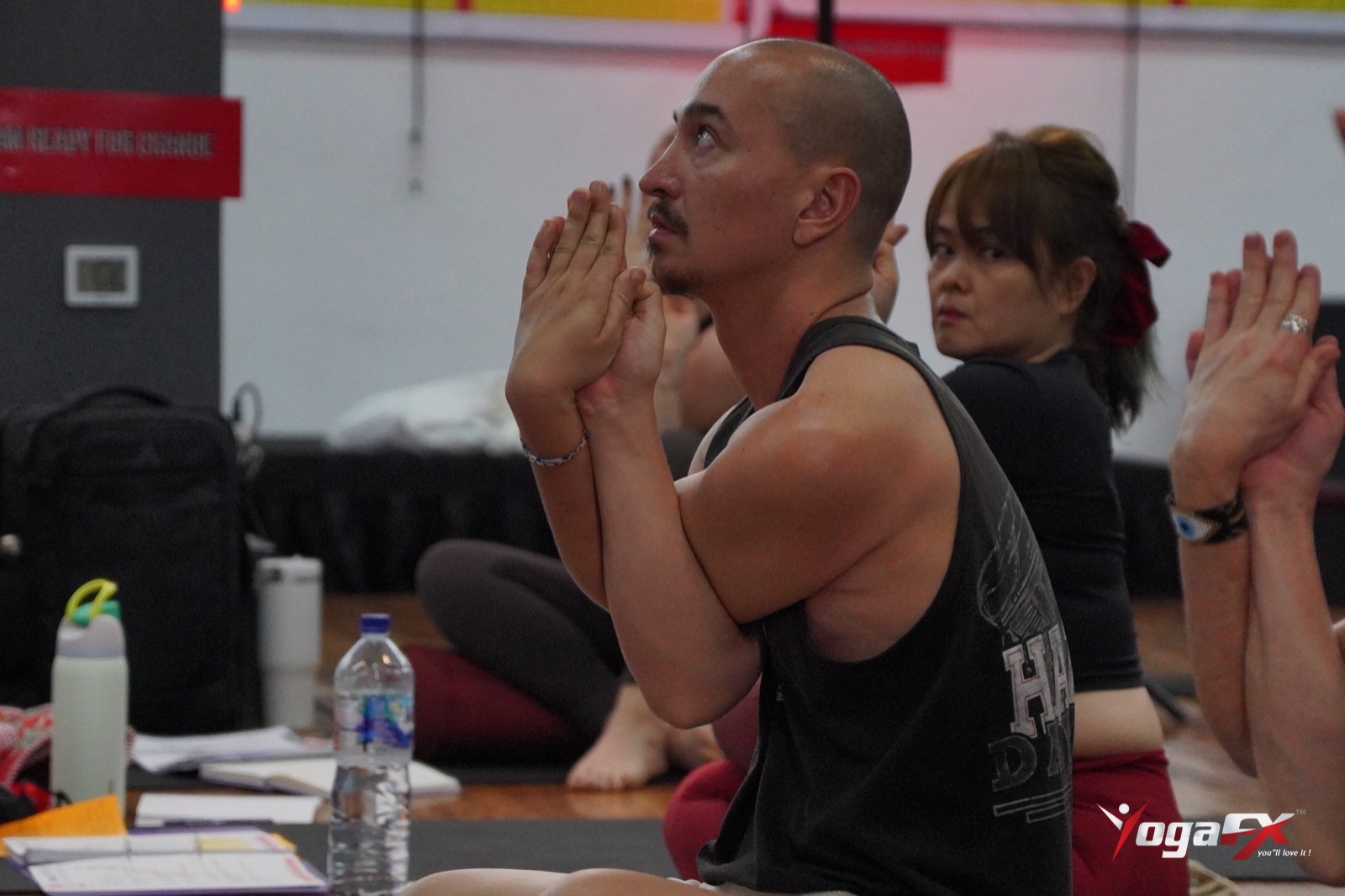
Here is one male graduate describing it in his own words at the end of his course.
Who Trains With Us, and Who Teaches It

Eighty-three percent of the men who apply already practise the sequence before they arrive, and only 41 percent rate their own fitness as good, against 55 percent of the women. That combination describes the room accurately: experienced enough to know what they are signing up for, modest enough about their condition to pace it.
Mr. Ian Terry leads the programme. He is an E-RYT 500 instructor with more than 12,000 teaching hours and over 1,500 graduates from 80 countries, and he trained directly under Bikram Choudhury across five training events between 2012 and 2019. Twenty-nine percent of male applicants name him specifically as a reason for choosing YogaFX, against 20 percent of women. His background is on the our teacher page.
The programme itself is a hybrid: online pre-course study, then a six-day intensive in Bali capped at 19 students, leading to dual certification as a Yoga Alliance RYT 200 and a certified Hot 26&2 teacher. Details are on the 26 and 2 yoga teacher training page with upcoming course dates. If you are still at the stage of wondering whether the practice is built for you at all, can men do hot yoga answers that from inside the method. To ask a direct question, send a WhatsApp message to Mr. Ian Terry on +62 811 3888 330.
How Often You Have to Practise for Any of This to Apply
Every figure in the table above came from a specific dose, and quoting the result without the dose is how benefit lists become useless. The trials generally prescribed around three classes a week. Tracy and Hart ran eight weeks. Hart and Tracy’s balance result came from 24 classes across eight weeks, which is three a week exactly. Bourbeau’s VO2max change took 12 heated classes. Hewett ran 16 weeks.
So the practical floor is three classes a week sustained for about two months. Below that, you are unlikely to reproduce any of these numbers. Our own recommendation is to build up to three to five a week once the heat has stopped being the obstacle, which for most men is somewhere after the first handful of classes.
There is one finding that argues against treating this as a box to tick. In the Harvard and Massachusetts General Hospital data on heated yoga, each additional class was associated with a further improvement in symptom scores, with no plateau observed up to 30 classes. That result concerns depression specifically and should not be stretched to fitness generally, but it points at something teachers see constantly: this is a practice where the returns keep arriving rather than flattening out after a month.
FAQ
What are the main benefits of hot yoga for men?
Measured outcomes include a 13 percent rise in deadlift strength over eight weeks against a decline in controls, 16 to 33 percent flexibility gains, a 228 percent improvement in balance time, and a 7 percent rise in VO2max that only appeared in the heated group. Men also average around 460 calories per class.
Is hot yoga good for men over 40?
The research on middle-aged and older adults is the most encouraging part of the evidence, reporting better blood-vessel function, improved insulin sensitivity and lower cholesterol. Most men who apply to train with us are over 40. Anyone with a heart condition or uncontrolled blood pressure should get medical clearance first.
Does the heat actually add anything?
Yes, and one study tested it directly. Running the same yoga at two temperatures, the heated group gained 7 percent in VO2max over 12 classes while the room-temperature group gained nothing measurable. Heart rate also runs higher in the heat, at 67 percent of maximum against 61 percent.
Can hot yoga replace weight training for men?
No. It builds strength through range and under fatigue, and it outperformed a control group on deadlift strength, but it does not provide progressive loading. Most men who lift use it alongside the gym rather than instead of it, typically replacing one session a week.
How quickly do men notice a difference?
Heat tolerance shifts within three to five classes and is the first thing almost everyone reports. Flexibility in specific postures follows over weeks. The cardiovascular and cholesterol changes in the research came from eight to sixteen weeks of consistent practice, not from a single course.