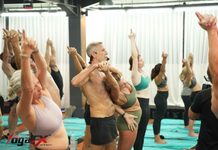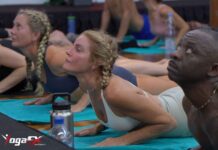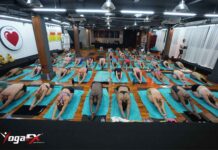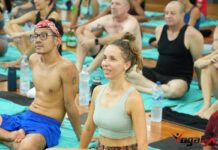







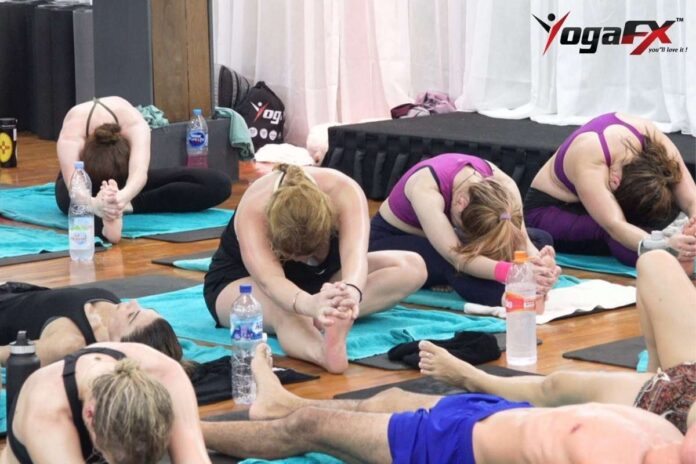
YogaFX is a prominent Hot 26&2 yoga teacher training academy headquartered in Bali, operating in Seminyak and Canggu. Its hybrid Bikram Hot 26&2 Yoga Teacher Training runs 6 days on-site in Seminyak, preceded by self-paced online coursework. Day 1 is orientation and posture foundations, days 2 through 4 build through standing series, floor series, and full dialogue delivery, day 5 is supervised practice teaching, and day 6 is final assessment and graduation, where students receive their Yoga Alliance RYT 200 plus Bikram Hot 26&2 certificate. This page walks through what actually happens each day, hour by hour where it matters, so you know exactly what you are signing up for before you book flights.
Before You Arrive: The Online Pre-Course Phase
The 6 days in Bali are not the start of the course, they are the finish. Before you land, you work through self-paced online modules covering anatomy relevant to a heated practice, the philosophy behind the Original Hot 26&2 Yoga sequence, and a first pass at memorizing the scripted dialogue.
Most students spend two to four weeks on this phase, going at whatever pace fits around a full-time job, and the depth of that preparation directly shapes how the on-site week feels. For a deeper comparison of how this hybrid structure stacks up against a fully online certificate, see online versus hybrid yoga teacher training. For the full module-by-module breakdown of what this pre-course actually teaches, see the Bikram yoga instructor course curriculum.
This front-loading is what makes 6 on-site days realistic at all. A program that tried to teach anatomy, philosophy, and dialogue memorization from scratch in Bali would need three or four times as long. By moving the theory online, the intensive can spend nearly all of its time on the parts that genuinely require being in a room together: posture correction, dialogue delivery under pressure, and live practice teaching.
What the Online Modules Actually Cover
The pre-course is broken into five modules, and each one maps directly to something you will be tested on once you land in Seminyak.
- The 26 postures and 2 breathing exercises. Alignment, sequencing, and the reasoning behind each posture, so day 1’s posture overview is a refresher rather than a first exposure.
- Anatomy and physiology. How the major muscle groups and body systems respond to a 90-minute heated class, which is the foundation for the applied anatomy session on day 3.
- Yoga philosophy and ethics. The roots of the practice and how a yogic lifestyle informs how you show up as a teacher, not just what you say from the front of the room.
- Teaching methodology and cueing. How to structure a class and cue postures clearly, which is what gets stress-tested during the dialogue drilling on days 2 and 4.
- Meditation and mindfulness tools. Basic techniques for guiding a class into stillness, used throughout the week and again during the journaling and reflection time built into each evening.
Day by Day: What the 6-Day Intensive Actually Looks Like
| Day | Focus | What Happens |
|---|---|---|
| Day 1 | Orientation & posture foundations | Studio orientation, cohort introductions, first full practice class in the natural Bali heat, and an overview of the standing series postures and their alignment cues. |
| Day 2 | Standing series deep dive | Posture clinic on all standing postures, common student mistakes, and modifications for injuries. First dialogue drills in small groups, covering the standing series script. |
| Day 3 | Floor series & anatomy | Posture clinic shifts to floor series, with emphasis on spinal safety around backbends and forward folds. Applied anatomy session on how the body responds to 90 minutes of heat. |
| Day 4 | Full dialogue intensive | Full script drilling from opening breathing exercise to closing posture, working in pairs and small groups until delivery stops sounding memorized. |
| Day 5 | Supervised practice teaching | Each student leads segments, then a full class, in front of the cohort with direct feedback from Ian Terry. This is the day most students describe as the hardest. |
| Day 6 | Final assessment & graduation | Final supervised class delivery, certification requirements confirmed, graduation, and RYT 200 plus Bikram Hot 26&2 certificate issued. |
The Rhythm of a Training Day
Beyond the day-by-day focus, most days on-site follow a similar rhythm, which makes the intensive easier to plan around even before you land. Mornings open with a hot yoga class, late morning moves into posture clinic and correction work, early afternoon is practical teaching and feedback, and the evening splits between a second hot yoga class, journaling, and a community sharing circle.
| Time | Block |
|---|---|
| 07:00 to 08:30 | Morning hot yoga class |
| 10:00 to 12:00 | Posture clinic and correction sessions |
| 13:00 to 14:30 | Practical teaching and feedback |
| 17:00 to 18:30 | Evening hot yoga class |
| 19:00 to 19:30 | Journaling and reflection |
| 19:30 to 20:00 | Community sharing circle |
Notice what is missing from that table: a rest day. Six days of heat, dialogue drilling, and public speaking back to back is genuinely demanding, and the schedule is built that way on purpose. Spreading the same material over two or three weeks would be gentler, but it would also mean losing the momentum that comes from drilling the same dialogue daily until it becomes automatic. For candidates weighing that tradeoff directly, we compared intensive formats against longer multi-week retreats in 200-hour teacher training retreats: intensive versus multi-week.
Day 5 deserves more detail than the table gives it, because it is the day almost every graduate points to afterward. By this point you have the dialogue memorized and the postures drilled, but leading a full 90-minute class solo, in the heat, in front of people watching your every cue, is a different skill than reciting a script in a cool classroom. Ian Terry gives feedback in real time rather than saving notes for after, which means corrections land while the mistake is still fresh rather than as abstract advice a day later.
The first two days carry a different kind of difficulty, less about performance and more about adjustment. Most students arrive already jet-lagged, and day 1’s first full class in genuine tropical heat lands before the body has had time to acclimate to either the travel or the climate.
That first class is intentionally treated as an introduction rather than a test: nobody is graded on how well they hold postures on day 1, only on showing up and starting to adapt. By day 2, most students report the heat feels less shocking and more like background conditions they can work through while focusing on the standing series material.
Days 3 and 4 are where the workload compounds rather than resets. Floor series anatomy on day 3 asks for a different kind of attention than standing postures, since spinal safety cues are less forgiving of small errors. Day 4’s full dialogue intensive then stacks on top of everything learned so far, running the complete script start to finish rather than isolated sections.
Candidates who have kept up with the online pre-course dialogue memorization tend to find day 4 demanding but manageable; those who arrived planning to learn the script entirely on-site often find this is where the pace catches up with them.
The Heat Acclimation Curve, Explained
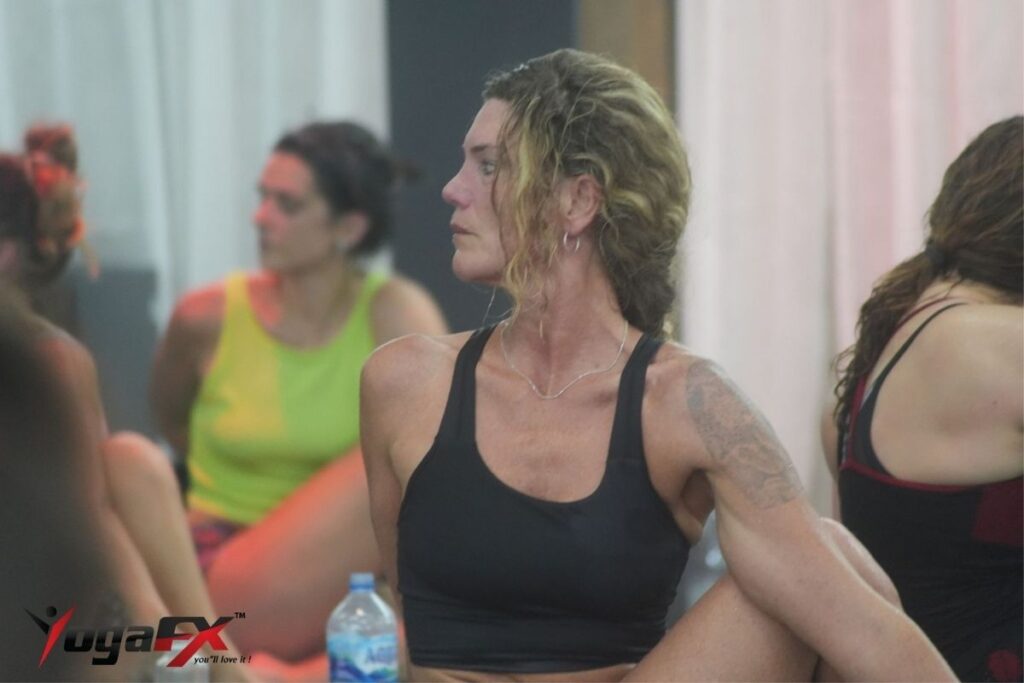
Heat acclimation is a real physiological process, not just a matter of willpower, and understanding the curve helps explain why the schedule is sequenced the way it is. Research on Bikram-style practice has measured energy expenditure of roughly 333 kilocalories per 90-minute class for women and 460 for men, with heart rate reaching about 80 percent of maximum during a session (Porcari et al., 2014, University of Wisconsin). That cardiovascular load is meaningfully higher in the first few sessions before the body adjusts its sweat response and heart rate regulation to repeated heat exposure, which is exactly why day 1 is framed as adjustment rather than assessment.
By days 3 and 4, most students have moved through the steepest part of that adaptation curve, which is part of why the schedule loads the heaviest technical content, floor series anatomy and full dialogue, into the middle of the week rather than the start. A broader systematic review of Bikram-style practice found consistent improvements in flexibility and general well-being building over a structured practice period (Willmott et al., 2025), consistent with what most cohorts report: day 6 postures come more easily than day 1 postures did, not because the material changed but because the body has adapted.
What to Pack and How to Prepare Physically
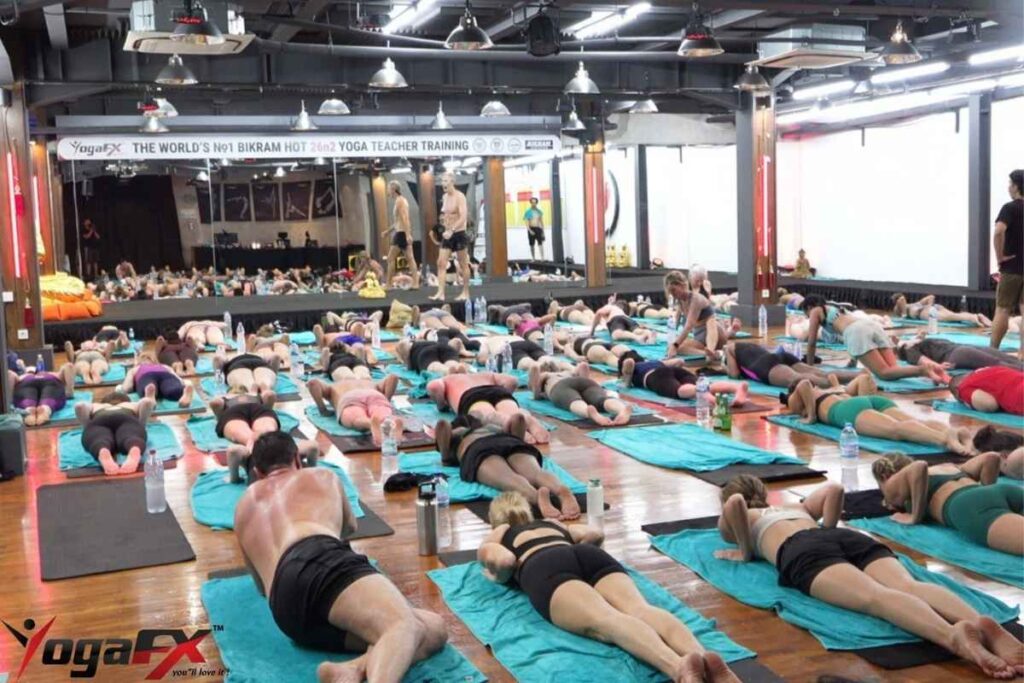
Because the studio runs on genuine tropical heat rather than electric heaters, at roughly 40 degrees Celsius and 40 percent humidity, preparation matters more here than for a standard-temperature training. Bring more workout clothing than you think you need. Two full outfits get soaked through most days, and laundry in Bali takes time you will not have between sessions. A large refillable water bottle and an electrolyte supplement are worth packing rather than sourcing locally on day one.
- Clothing. At least 4-5 changes of lightweight, moisture-wicking practice wear, since you will be in heat multiple times daily.
- Hydration gear. A large water bottle and electrolyte packets, since plain water alone is not enough across repeated heated sessions.
- A dedicated practice mat. One you already trust, rather than buying new on arrival and adjusting to unfamiliar grip mid-course.
- A printed or offline copy of the dialogue script. Screens die and Wi-Fi is not always reliable studio-side; paper does not run out of battery.
Physical preparation matters as much as packing. If your regular practice has been inconsistent in the months before the course, build back up to attending heated classes several times a week beforehand rather than arriving cold. Acclimating to the heat over one or two classes on day one, while also absorbing new material, is significantly harder than showing up already heat-adapted. This is not medical advice, and if you manage a cardiovascular condition, are pregnant, or have any concern about intensive heat exposure, talk to a healthcare professional before enrolling, not after you arrive.
One more practical note worth planning around: jet lag compounds with heat acclimation in ways first-time visitors to Bali sometimes underestimate. If your flight schedule allows it, arriving a day or two before day 1 gives your body a head start on time zone adjustment before it also has to handle a heated 90-minute class. Students who fly in the same morning the course starts tend to find day 1 and 2 noticeably harder than those who built in even a single buffer day beforehand.
Where You Train and Stay in Seminyak
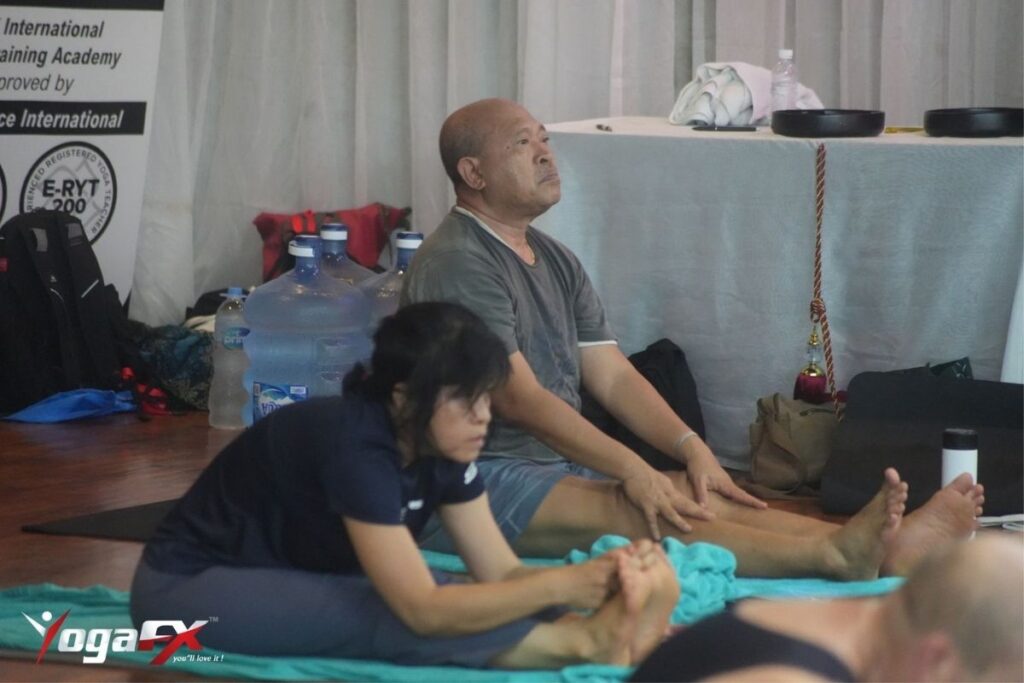
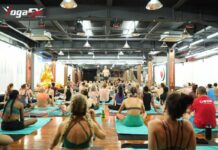
The on-site week runs out of a dedicated wellness facility in the heart of Seminyak, built for exactly this kind of training: heated practice rooms, showers so you are not commuting back to a hotel to change between morning and evening sessions, and a cafe on site for the days you do not want to think about lunch logistics. Being able to walk from posture clinic to shower to practical teaching without leaving the building matters more than it sounds like it would once you are living the schedule.
Accommodation is not bundled into the course fee, which keeps costs flexible for candidates who already have a place in Bali or want to choose their own budget. For everyone else, a short walk from the studio covers most of what you need: a couple of hotels within two minutes on foot, and private villas nearby for candidates who want more space or are traveling with a partner.
The full visa and accommodation logistics for arriving international students are covered in YogaFX’s accommodation and visa guide for YTT students in Bali. Enquire with the team before you book and they can point you toward current package deals with partner accommodation rather than you sorting it out cold.
Bonus Sessions Built Into Your Week
Alongside the core curriculum, cohorts also get a set of masterclass sessions aimed at what happens after graduation, not just the certification itself.
- Yoga and business. The practical side of building a teaching career, from your first classes to pricing yourself fairly.
- Yoga and mindset. Strengthening the inner work that underpins confident teaching, not just physical technique.
- Sound healing. A recovery session that gives the body a different kind of rest from the heat and the dialogue drilling.
- Branding yourself as a yoga teacher. How to present yourself professionally once you are teaching under your own name.
- The art of creating sequences. Building beyond the fixed 26 and 2 script into your own class sequencing for other formats.
- Teaching online versus in-person. The practical differences between the two, useful if you plan to teach remotely after you leave Bali.
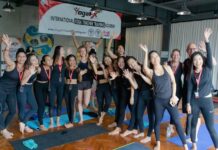
- Graduation dinner. A shared close to the week with the cohort you just went through six demanding days with.
What Graduates Say About the Week
Samantha Grove, a graduate of a recent cohort, has described the experience as going well beyond what she expected going in, pointing specifically to the friendships formed with people from completely different parts of the world as much as the certification itself.
Siobhan Flaherty’s account centers on a similar theme from a different angle: she credits Ian Terry with building a genuine community out of a group of strangers, and singles out his depth of knowledge of the practice as something she would happily travel back to Bali to learn from again.
Celia Takahashi’s experience leaned harder into the physical and emotional demand of the week itself, describing a group that worked and learned hard together and came out the other side having taken noticeably better care of themselves than when they arrived. A fuller collection of graduate stories like these is gathered in YogaFX Graduate Stories: From 1,500+ Alumni in 80+ Countries.
Why the Compressed Format Works at YogaFX
Six days only works because of what happens both before and during it. Founder Ian Terry, who trained for five years, from 2014 to 2019, directly with Bikram Choudhury, the founder of the Bikram Hot 26&2 method, built the schedule and has since run it with more than 1,500 graduates from 80-plus countries, refining the day-by-day sequence based on where cohorts consistently struggled.
Individual attention matters here specifically: in a dialogue-heavy, feedback-dependent schedule like this one, day 5’s individual correction depends on the instructor actually watching every student teach.
Both YogaFX studios, Seminyak and Canggu, run on natural tropical heat rather than electric heaters, which means the acclimation curve you go through during the 6 days matches what you will actually teach in afterward, not a simulated version of it. Graduates consistently describe day 5 and 6 as the point where the course stops being information and starts being something they can actually do, a shift that shows up across YogaFX’s 150 Google reviews, 50 Yoga Alliance reviews and 357 student video testimonials on YouTube.
That pattern is echoed in specific graduate feedback too: candidates who came in expecting mainly a postures refresher have described the day-by-day structure as pushing them further than a syllabus alone would suggest, precisely because each day builds on real feedback from the one before it rather than following a fixed lecture plan regardless of how the cohort is progressing.
If you are still deciding whether this specific structure fits your goals against the program as a whole, our complete YogaFX program overview covers pricing, certification, and comparison against other options. And if you want the module-by-module curriculum breakdown behind each day’s content, rather than the day-by-day schedule covered here, see the Bikram yoga instructor course curriculum.
For a broader look at how this hybrid model compares across schools generally, not just at YogaFX, see this guide to hybrid Bikram yoga teacher training.
FAQ
What does a typical day look like during the 6-day intensive?
Mornings focus on posture clinic while students are fresh, afternoons cover dialogue drilling in small groups, and evenings rotate between anatomy review and practice teaching. Days build progressively: standing series first, then floor series, then full dialogue, then supervised practice teaching, finishing with final assessment on day 6.
Is there a rest day during the intensive?
No, the 6 days run back to back without a built-in rest day. The compressed schedule is intentional, since drilling the same dialogue and postures daily builds retention faster than spreading the same material across two or three weeks with breaks in between.
What should I pack for a hot yoga teacher training in Bali?
Pack 4-5 changes of lightweight moisture-wicking practice wear, a large water bottle, electrolyte supplements, a trusted practice mat, and a printed copy of the dialogue script. Two outfits typically get soaked through per day, and local laundry turnaround is often too slow between sessions.
How physically demanding is the course?
It is intensive: multiple heated 90-minute sessions daily across 6 consecutive days, at roughly 40 degrees Celsius and 40 percent humidity, combined with dialogue drilling and public speaking. Building a consistent heated-practice habit in the months beforehand makes the acclimation curve significantly more manageable.
Which day is the hardest?
Most graduates point to day 5, supervised practice teaching, as the hardest and most clarifying day. Leading a full class solo in the heat, with your cohort watching, tests everything drilled over the previous four days in a way no amount of memorization alone can prepare you for. Day 1 runs a close second for a different reason: jet lag and first heat exposure combined, before your body has had any chance to acclimate.
Do I need prior teaching experience to join?
No. A significant share of each cohort starts with zero teaching experience, and the online pre-course modules exist specifically to bring beginners up to a common baseline before day 1. Existing teachers join too, usually to deepen their Bikram-specific knowledge or to get supervised practice teaching reps they cannot get elsewhere.
Is accommodation included in the training fee?
No, accommodation is booked separately from the course fee. The team can point you toward partner hotels a short walk from the Seminyak studio and current package deals, so you are not left to research options cold once you have enrolled.